|
Projects and Monitoring Committee Kōmiti Whakakaupapa me Aroturuki
PMC25-2 Tuesday, 10 June 2025, 9.30am Council Chambers, 1484 Cameron Road, Tauranga
|
|
Projects and Monitoring Committee Kōmiti Whakakaupapa me Aroturuki
PMC25-2 Tuesday, 10 June 2025, 9.30am Council Chambers, 1484 Cameron Road, Tauranga
|
|
10 June 2025 |
Projects and Monitoring Committee
Membership:
|
Chairperson |
Cr Don Thwaites |
|
Deputy Chairperson |
Cr Allan Sole |
|
Members |
Cr Tracey Coxhead Cr Grant Dally Mayor James Denyer Cr Murray Grainger Cr Anne Henry Cr Rodney Joyce Cr Margaret Murray-Benge Cr Laura Rae Deputy Mayor John Scrimgeour Cr Andy Wichers |
|
Quorum |
Six (6) |
|
Frequency |
Quarterly |
Role:
· To monitor and review the progress of the Council’s activities, projects and services.
Scope:
· To monitor the effectiveness of Council and agency service agreements / contracts.
· To monitor the implementation of Council’s strategies, plans and policies, and projects as contained in the Long Term Plan or Annual Plan.
· To monitor agreements between Tauranga City Council and Western Bay of Plenty District Council and recommend to the respective Councils any changes to agreements, as appropriate.
· To monitor the on-going effectiveness of implemented joint projects, plans, strategies and policies with Tauranga City Council.
· To monitor performance against any Council approved joint contracts with Tauranga City Council and/or other entities.
· Monitor performance against the Priority One approved contract.
· Subject to agreed budgets and approved levels of service, make decisions to enable delivery of the operational and capital programme of Council.
Power to Act:
To make decisions to enable and enhance service delivery performance, in accordance with approved levels of service and subject to budgets set in the Long Term Plan or any subsequent Annual Plan.
Power to Recommend:
To make recommendations to Council and/or any Committee as it deems appropriate.
Power to sub-delegate:
The Committee may delegate any of its functions, duties or powers to a subcommittee, working group or other subordinate decision-making body, subject to the restrictions on its delegations and provided that any sub-delegation includes a statement of purpose and specification of task.
|
Projects and Monitoring Meeting Agenda |
10 June 2025 |
Notice is hereby given that an Projects and Monitoring
Meeting will be held in the Council Chambers,
1484 Cameron Road, Tauranga on:
Tuesday, 10 June 2025 at 9.30am
10.1 Precious Family Reserve public toilet location options
10.3 Operational Risk and Status Report
11.1 Katikati Wastewater Future Directions
|
Whakatau mai te wairua Whakawātea mai te hinengaro Whakarite mai te tinana Kia ea ai ngā mahi
Āe |
Settle the spirit Clear the mind Prepare the body To achieve what needs to be achieved. Yes |
2 Present
Members are reminded of the need to be vigilant and to stand aside from decision making when a conflict arises between their role as an elected representative and any private or other external interest that they may have.
A period of up to 30 minutes is set aside for a public forum. Members of the public may attend to address the Board for up to five minutes on items that fall within the delegations of the Board provided the matters are not subject to legal proceedings, or to a process providing for the hearing of submissions. Speakers may be questioned through the Chairperson by members, but questions must be confined to obtaining information or clarification on matters raised by the speaker. The Chairperson has discretion in regard to time extensions.
Such presentations do not form part of the formal business of the meeting, a brief record will be kept of matters raised during any public forum section of the meeting with matters for action to be referred through the customer relationship management system as a service request, while those requiring further investigation will be referred to the Chief Executive.
|
10 June 2025 |
10 Reports
10.1 Precious Family Reserve public toilet location options
File Number: A6713235
Author: Peter Watson, Acting General Manager, Infrastructure Group
Authoriser: Miriam Taris, Interim Chief Executive Officer
Executive Summary
At its meeting on 10 March 2025 the Projects and Monitoring Committee received and considered a petition against the establishment of a new toilet facility in Precious Reserve, Ōmokoroa.
Staff were requested to provide advice and report back to the Committee.
This report considers the options available for the Committees consideration.
|
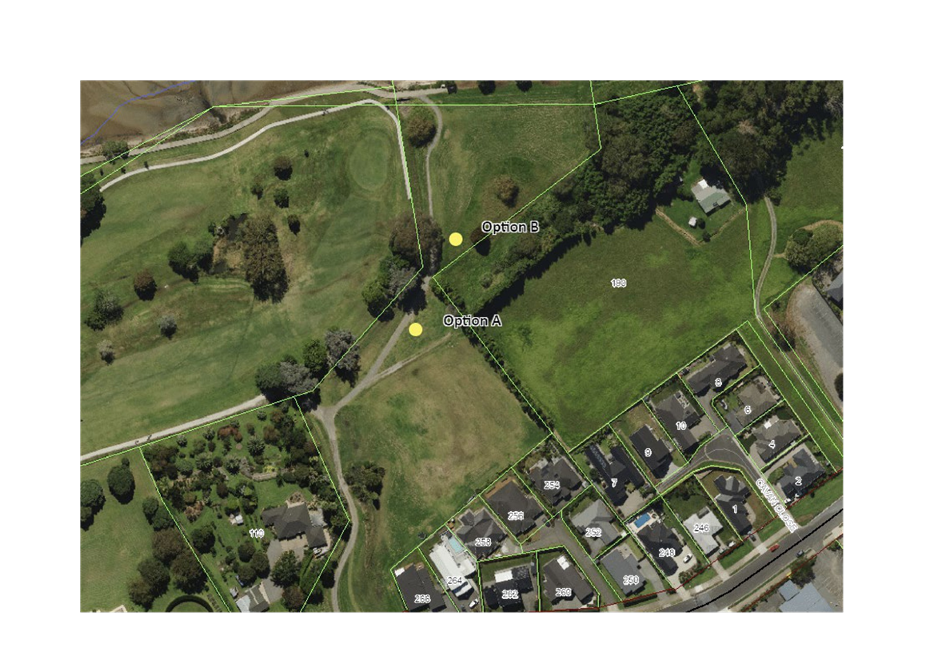
1. That the Acting General Manager, Infrastructure Group’s report dated 10 June 2025 titled ‘Precious Family Reserve public toilet location options’ be received. 2. That the report relates to an issue that is considered to be of (low) significance in terms of Council’s Significance and Engagement Policy. 3. That the Projects and Monitoring Committee approves the following option; a. Proceed with the installation of the toilet facility as shown on Attachment 1 being the consented location or; b. Relocate the toilet facility to a new position on Precious Family Reserve as shown on Attachment 2 and increase the budget to relocate the toilet by $50,000 funded from rates in the 2025/26 Financial Year or; c. The toilet facility be used at a different site elsewhere in the District. |
Background
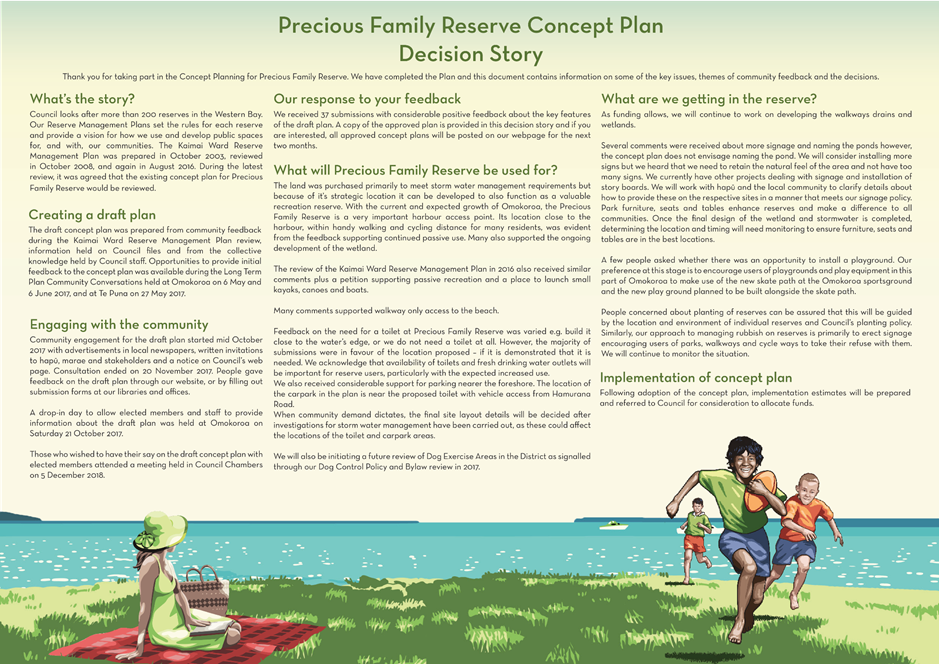
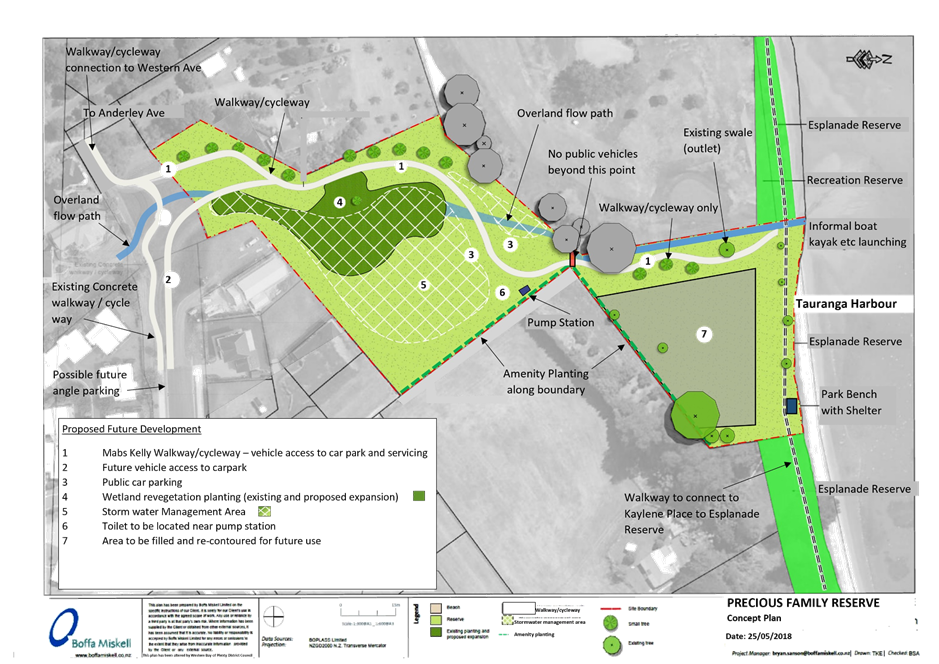
1. The concept plan for Precious Family Reserve was adopted in 2018 following public consultation. The implementation of the concept plan outcomes has been delayed due to funding timing.
2. The siting of the toilet needed to shift from the area shown on the concept plan as there were siting constraints associated with the underground wastewater infrastructure that we not investigated at the time of the concept planning stage.
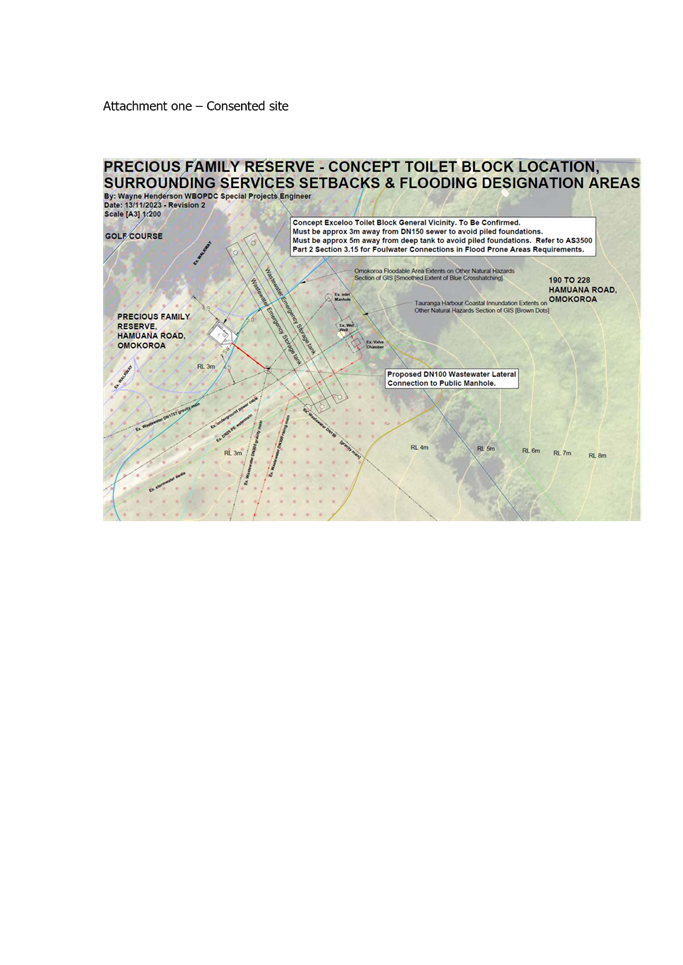
3. Based upon the new nearby site, a resource consent was required due to the toilet being in a floodable area as identified on the District Plan maps. A consent was applied for and duly granted for the preferred site that avoids the underground pipes and storage tanks.
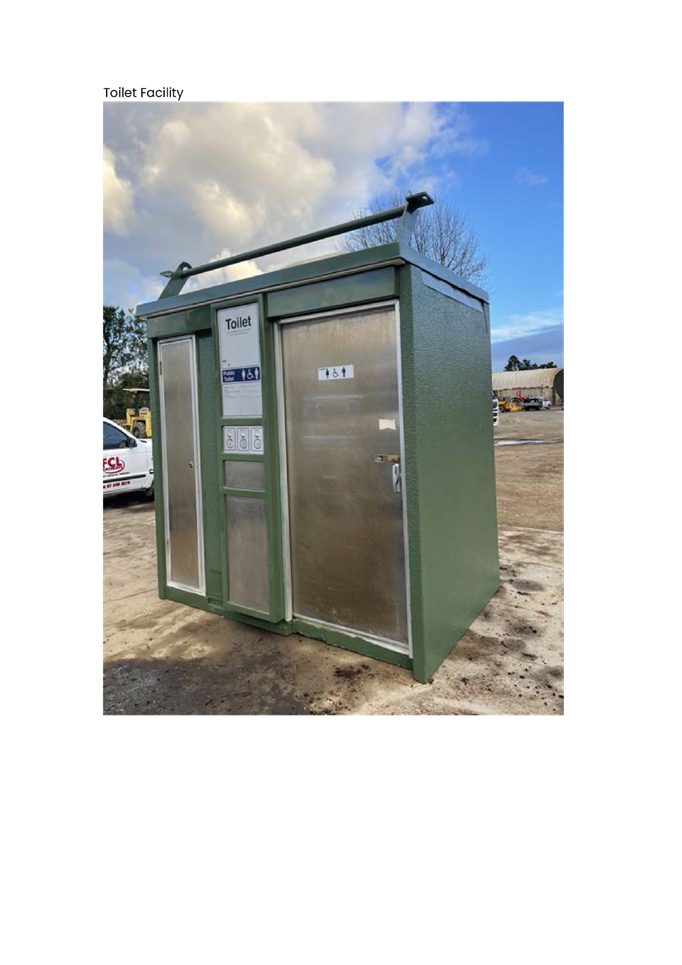
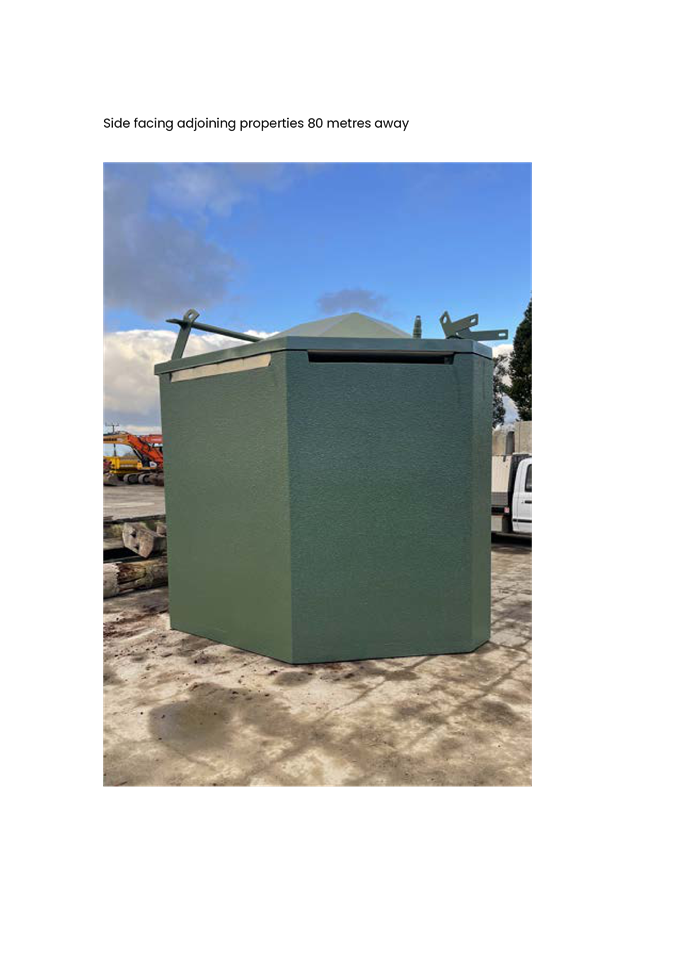
4. The toilet facility (Attachment 3) was subsequently ordered and paid for. The toilet is a ‘drop in type’ off the shelf facility that is manufactured in Gisborne and transported to site for installation on a foundation built on site.
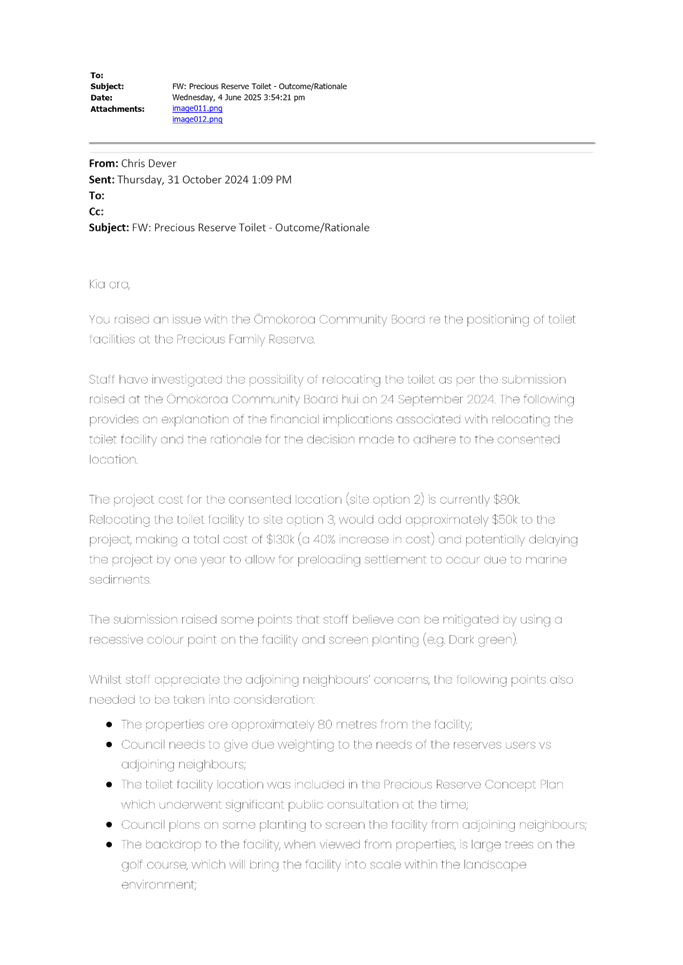
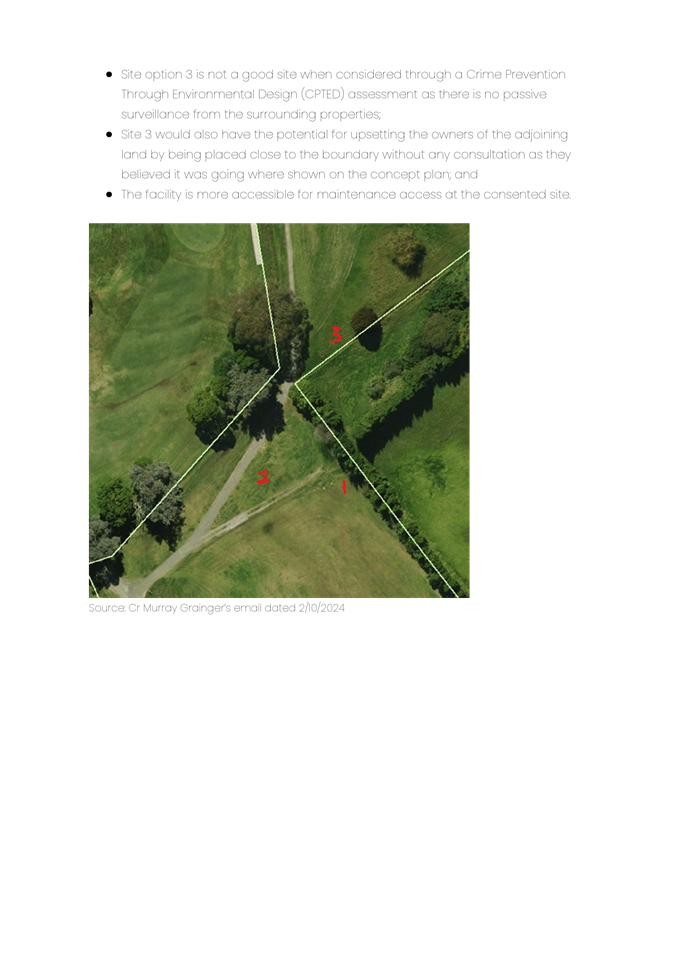
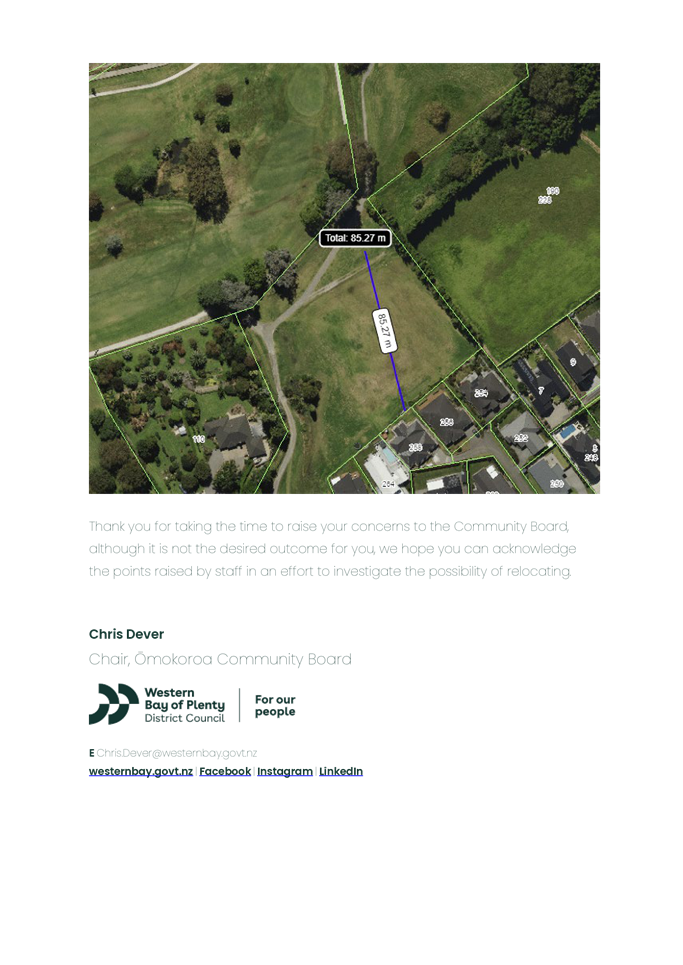
5. Two/three residents became concerned when a consultant was setting up the site in anticipation of installation. The concerned residents then raised the matter with the Ōmokoroa Community Board. Staff provide the background to the situation to the community Board Chairman, who subsequently wrote to the concerned residents explaining Council’s rationale behind the selected location. Attachment 4.
6. At it’s meeting on 10 March 2025, the Committee adopted the following resolution
RESOLUTION PMC25-1.2
Moved: Cr L Rae
Seconded: Deputy Mayor J Scrimgeour
1. That the petition to halt the construction of a public toilet in the Precious Family Reserve, Ōmokoroa dated 10 March 2025 be received and the matter be referred to staff for advice and reported back to the Committee.
CARRIED
Significance and Engagement
7. The Local Government Act 2002 requires a formal assessment of the significance of matters and decision in this report against Council’s Significance and Engagement Policy. In making this formal assessment there is no intention to assess the importance of this item to individuals, groups, or agencies within the community and it is acknowledged that all reports have a high degree of importance to those affected by Council decisions.
8. The Policy requires Council and its communities to identify the degree of significance attached to particular issues, proposals, assets, decisions, and activities.
9. In terms of the Significance and Engagement Policy this decision is considered to be of low significance because the issue localised to a reserve and affects several adjoining residents.
Engagement, Consultation and Communication
10. Consultation on the reserve concept plan was undertaken in 2017/18, which included the location of the toilet facility as shown on the attached concept plan (Attachment 5).
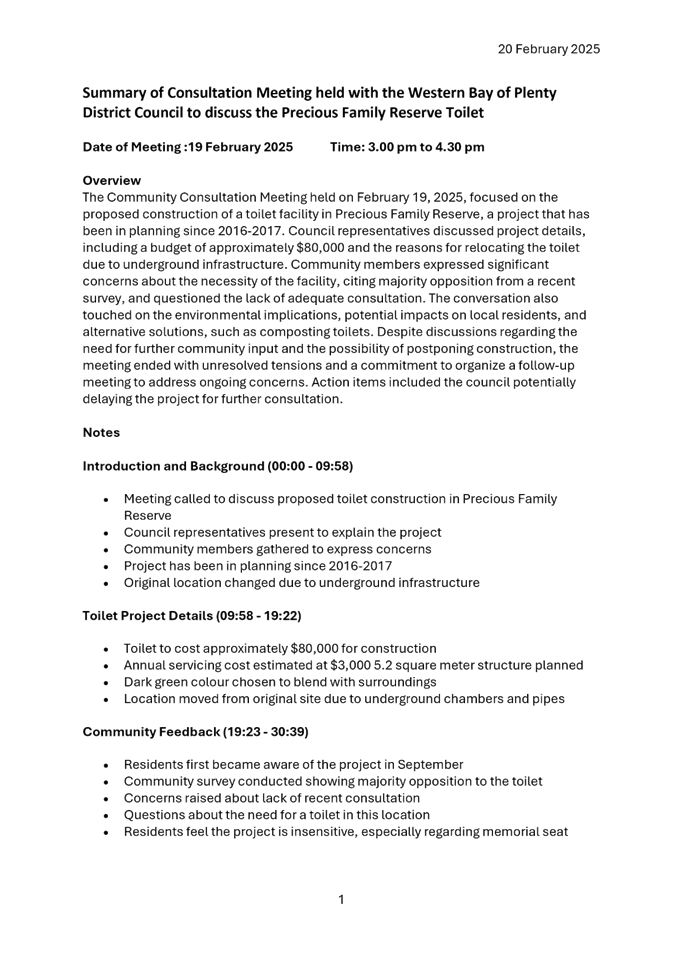
11. There was a public meeting held on site on 19 February where staff and several Ward Councillors attended a site meeting were approximately forty members of the public attended (Attachment 6) are the minutes taken by the meeting organiser. The meeting was recorded. It was agreed that the installation of the toilet facility would be delayed by one month to allow the adjoining residents time to prepare a petition to Council. The petition was considered at the 10 March Committee meeting.
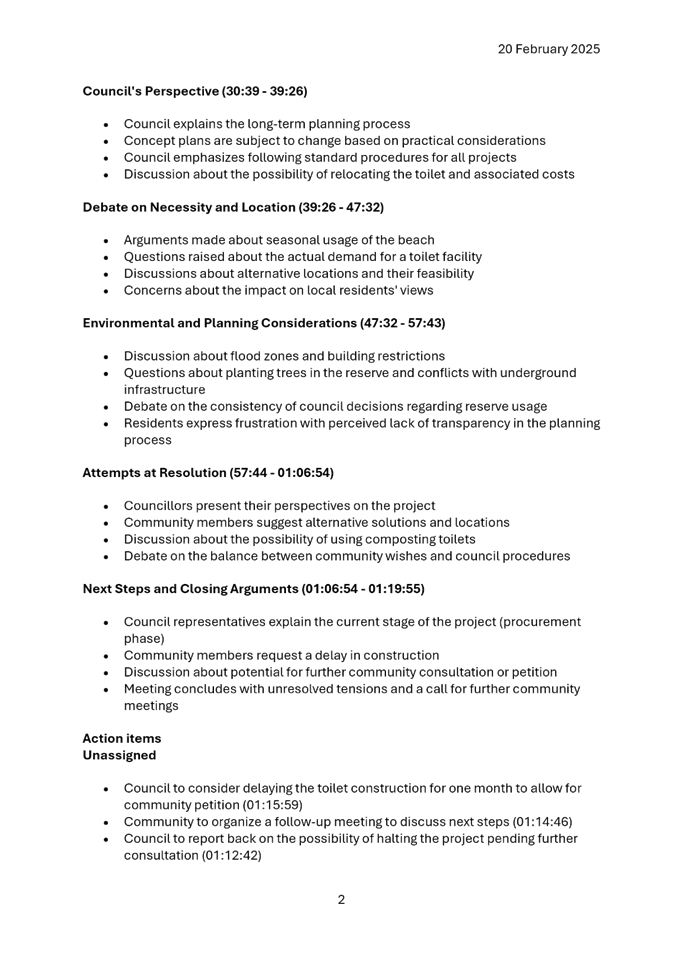
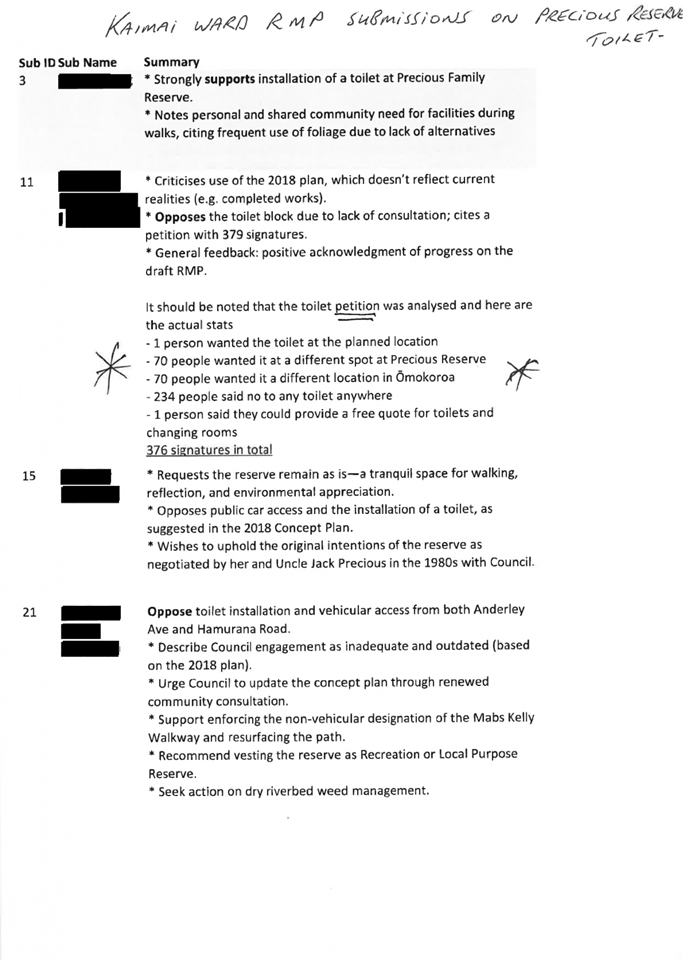
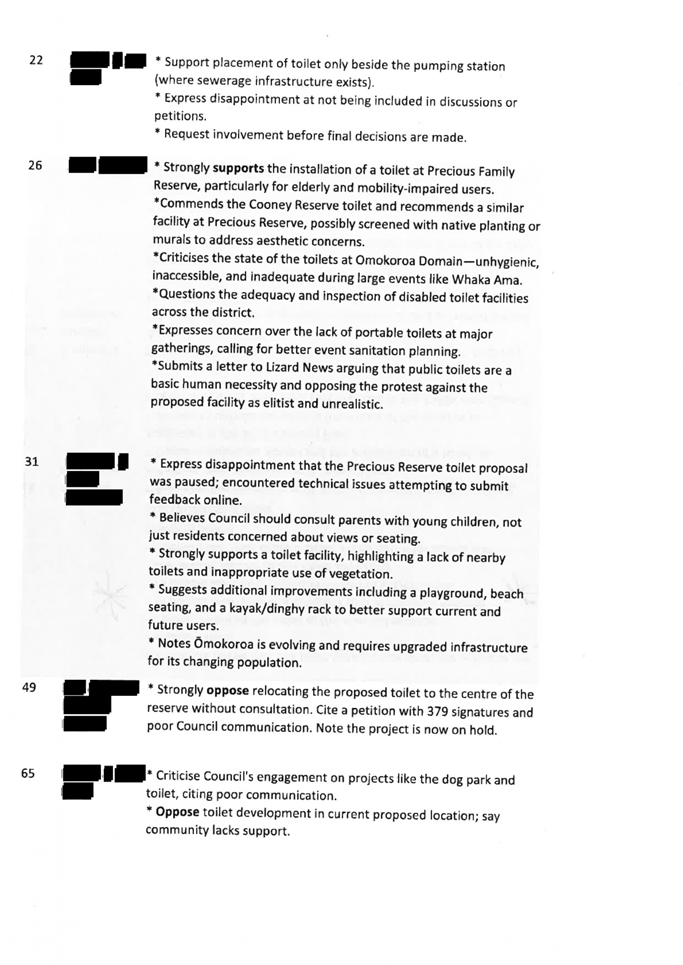
12. Council also received submissions on the Precious Reserve toilet through the Kaimai Ward Reserve Management Plan review. A synopsis of these submissions (both for and against) are included as Attachment 7.
|
Interested/Affected Parties |
Completed/Planned
|
||
|
Name of interested parties/groups |
Local residents and those who signed the petition |
Planned |
Completed |
|
Tangata Whenua |
The resource consent process included input from tangata whenua |
||
|
General Public |
Opportunity was provided by the petition organisers to involve the public input. |
||
Issues and Options Assessment
|
Option A 3. That the Projects and Monitoring Committee approves the following option; d. Proceeds with the installation of the toilet facility as shown on Attachment A being the consented location or;
|
|
|
Assessment of advantages and disadvantages including impact on each of the four well-beings · Economic · Social · Cultural · Environmental |
Advantages · Sunk project costs are realised · No need to renew consents for a different location on Precious Reserve. · No need for additional design costs · Further project delay minimised · Achieves compliance with Crime Prevention through Environmental Design (CPTED) principles · Provides a public toilet as intended by the concept plan
Disadvantages · Residents and those who opposed the toilet location through the petition will be disappointed with the outcome · Places the toilet facility approximately 17 metres from a memorial seat. |
|
Costs (including present and future costs, direct, indirect and contingent costs). |
The facility has been purchased and costs incurred to date for the design and consenting costs. |
|
Other implications and any assumptions that relate to this option (Optional – if you want to include any information not covered above). |
|
|
Option B That the Projects and Monitoring Committee approves the following option;
3. b Relocate the toilet facility to a new position on Precious Reserve as shown on Attachment A and increase the budget to relocate the toilet by $50,000 funded from rates in the 2025/26 Financial Year or; |
|
|
Assessment of advantages and disadvantages including impact on each of the four well-beings · Economic · Social · Cultural · Environmental |
Advantages; · Would provide some relief for several adjoining property owners. · Provides a public toilet as intended by the concept plan · Provides a public toilet to users of a public pathway Disadvantages: · Additional costs ($50K rates funding) · Lower compliance with Crime Prevention through Environmental Design (CPTED) principles · May not comply with disability access requirements |
|
Costs (including present and future costs, direct, indirect and contingent costs). |
Additional costs to obtain new resource consent due to floodable area and extended infrastructure eg sewer pipe, water, electricity . |
|
Other implications and any assumptions that relate to this option (Optional – if you want to include any information not covered above). |
|
|
Option C That the Projects and Monitoring Committee approves the following option;
3. c The toilet facility be used at a different site elsewhere in the district. |
|
|
Assessment of advantages and disadvantages including impact on each of the four well-beings · Economic · Social · Cultural · Environmental |
Advantages; · Residents and those who opposed the toilet location through the petition will be satisfied with the outcome
Disadvantages: · Concept plan outcome won’t be achieved. · No toilet facility provided to users of a popular pathway |
|
Costs (including present and future costs, direct, indirect and contingent costs). |
Toilet facility has been paid for. An existing project budget would need to be allocated for installation at another site.
|
|
Other implications and any assumptions that relate to this option (Optional – if you want to include any information not covered above). |
|
Statutory Compliance
· The Precious Reserve site has been granted a resource consent due to the floodable area identified on the District Plan hazard maps.
Funding/Budget Implications
|
Budget Funding Information |
Relevant Detail |
|
|
To relocate the toilet to around the corner behind the hedge would require an additional $50,000 from rates to achieve this outcome. Funding for the installation portion of the toilet could be reallocated to a different site should option three be adopted. |
1. Consented
Site Location ⇩ 
2. Alternative
Location Options ⇩
3. Toilet
Facility ⇩
4. Omokoroa
Community Board Chairperson email ⇩
5. Concept
Plan ⇩
6. Summary
of Consultation Meeting - 19 February 2025 ⇩ 
7. Kaimai
Ward RMP Submissions on Precious Reserve Toilet ⇩
|
10 June 2025 |
10.2 Ahi Pātiki / Athenree Crossing Draft Concept Plan Public Engagement Feedback Results and Next Steps
File Number: A6746214
Author: Scott Parker, Cycleways Manager
Authoriser: Peter Watson, Acting General Manager, Infrastructure Group
Executive Summary
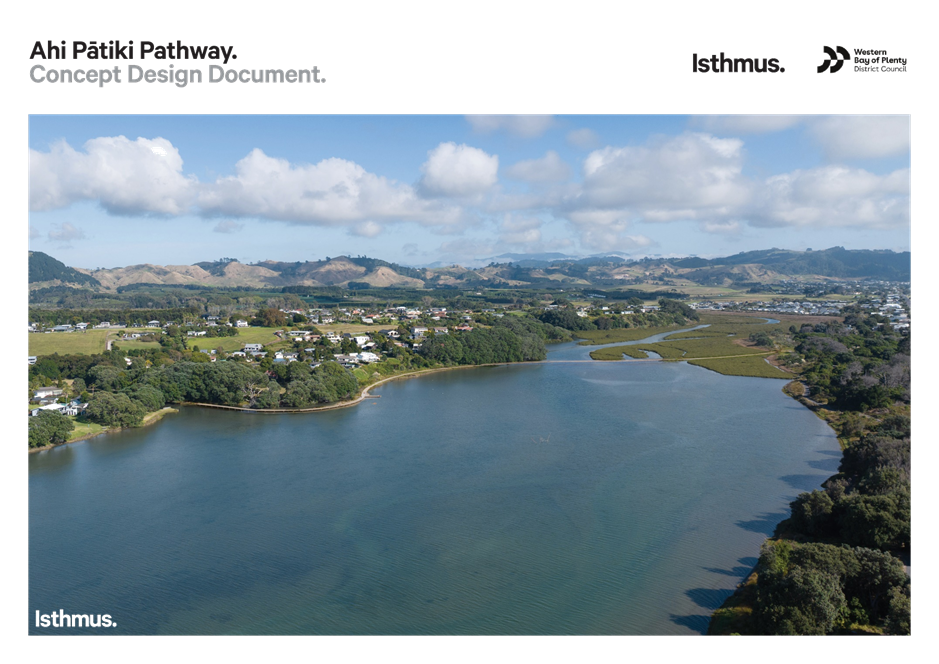
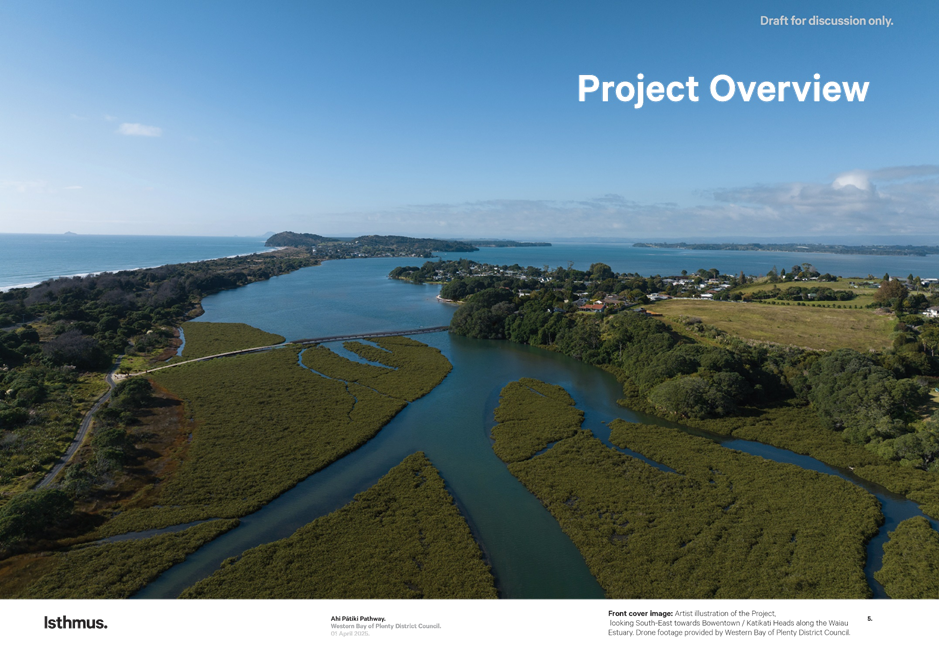
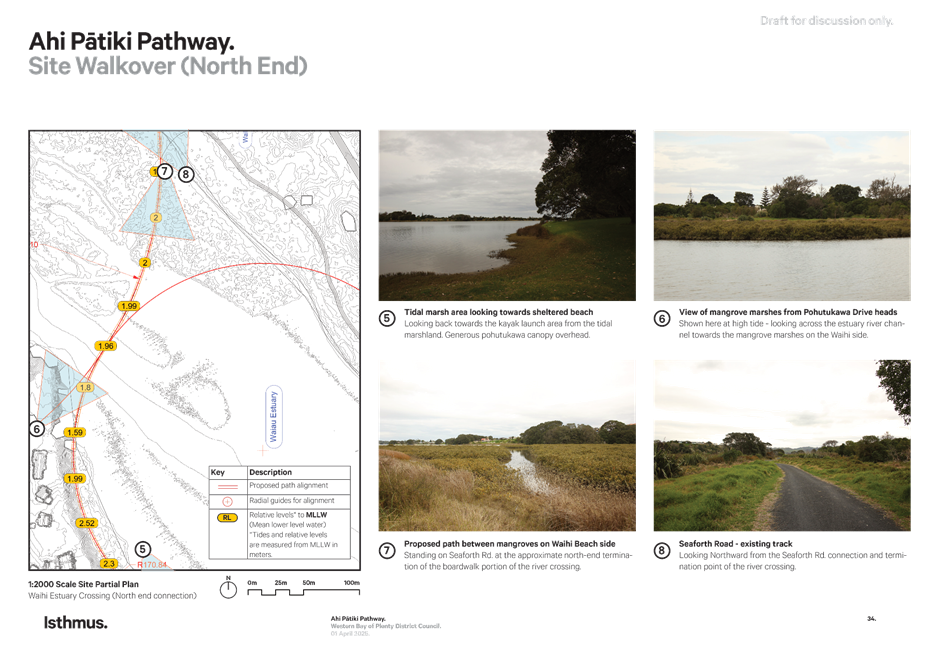
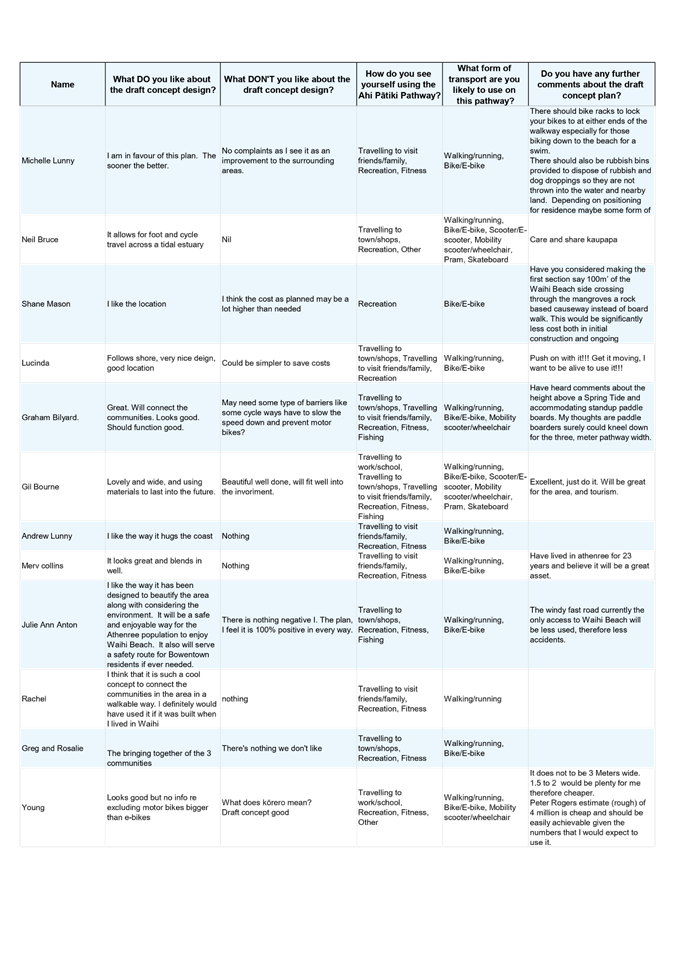
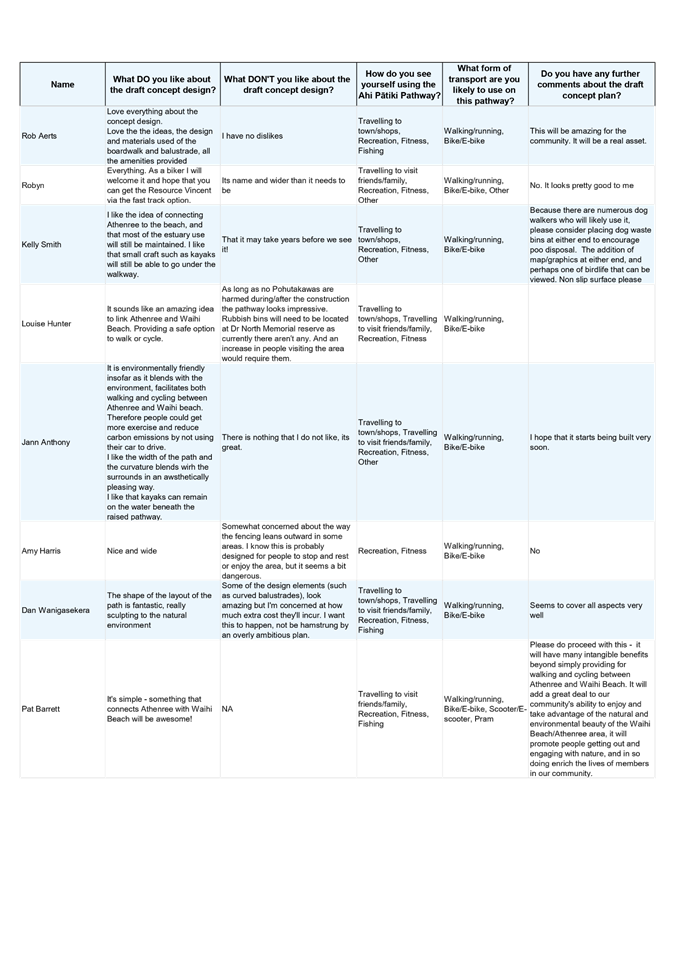
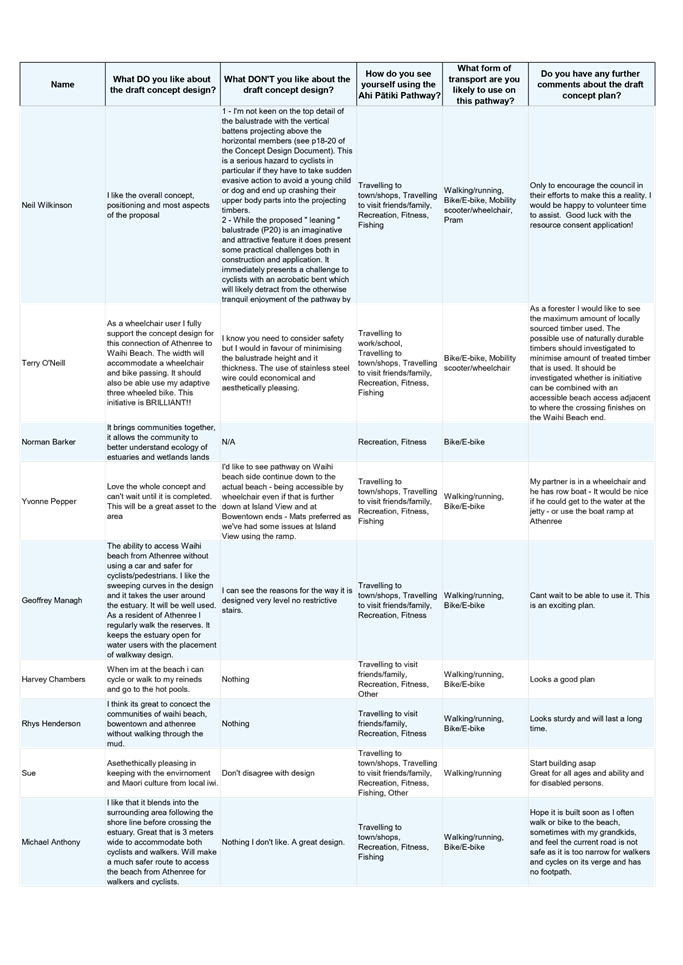
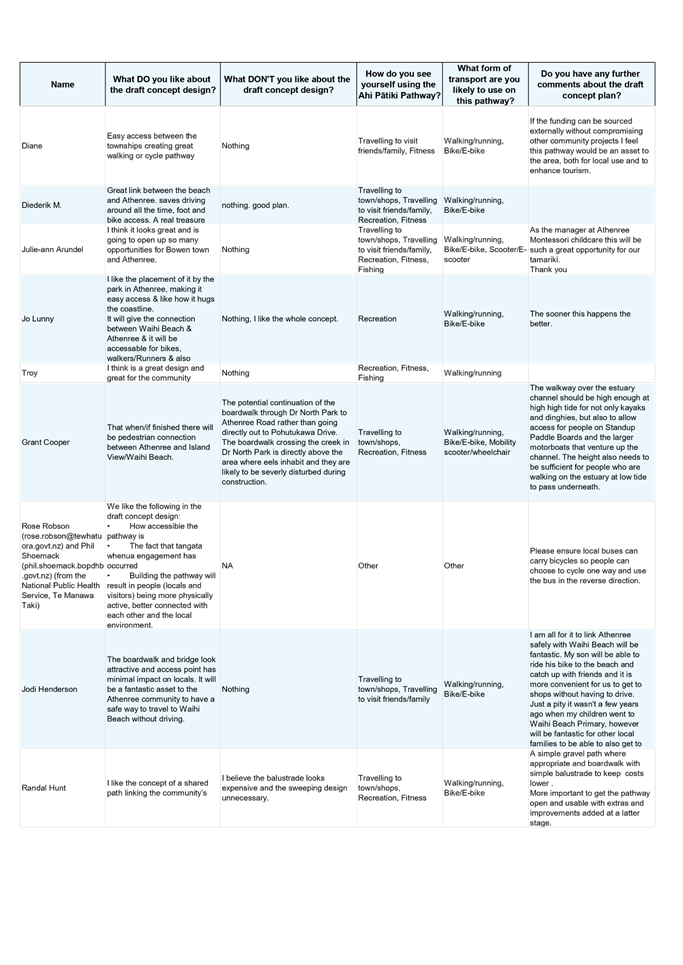
This report requests the Projects and Monitoring Committee to consider the feedback received following public engagement on the Ahi Pātiki pathway draft concept plan, which took place from Wednesday 9 April to Wednesday 7 May 2025, and seeks approval to proceed to the Resource Consent application process.
|
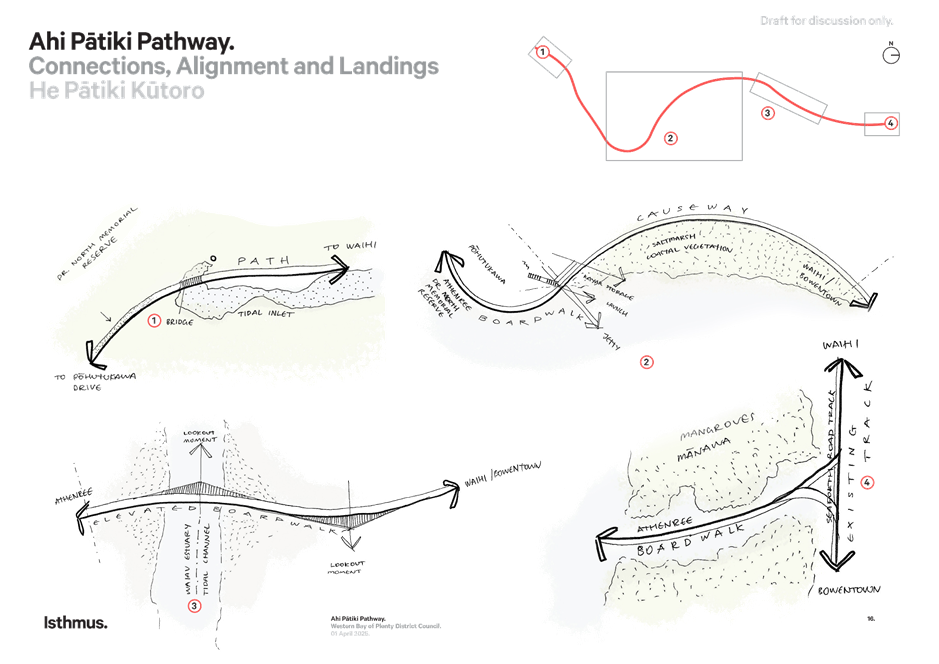
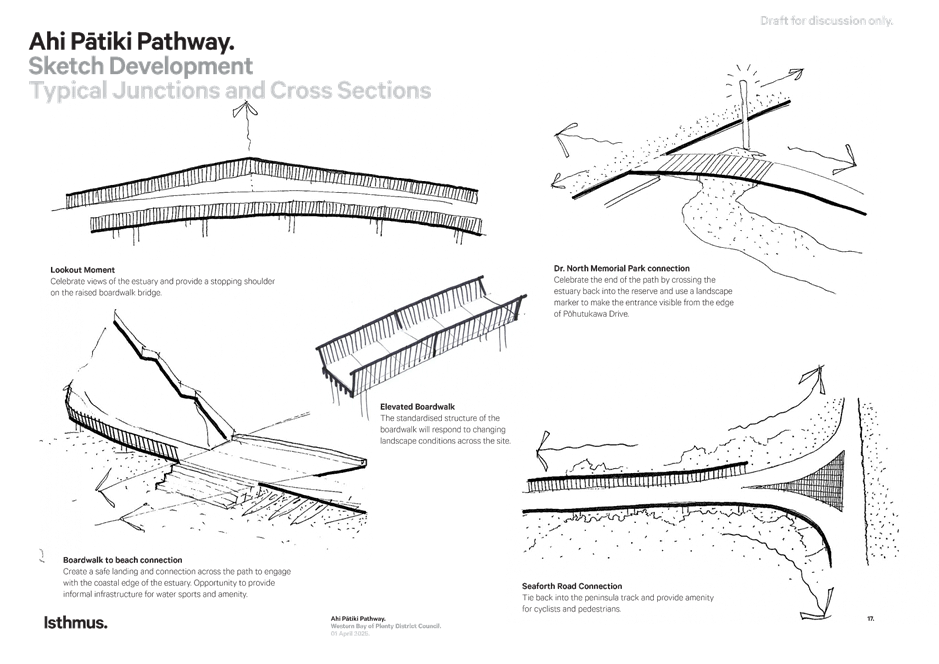
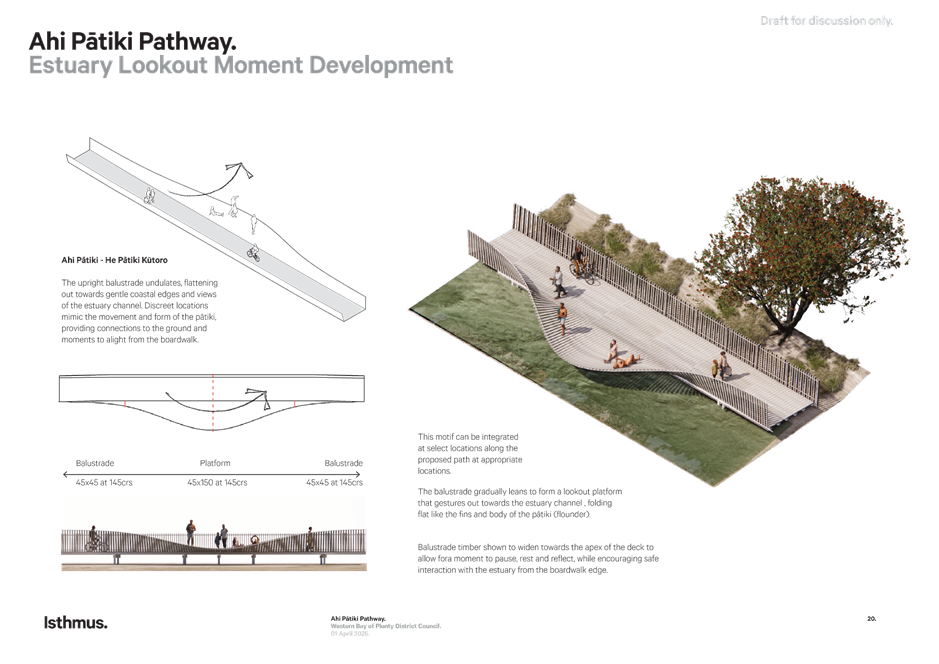
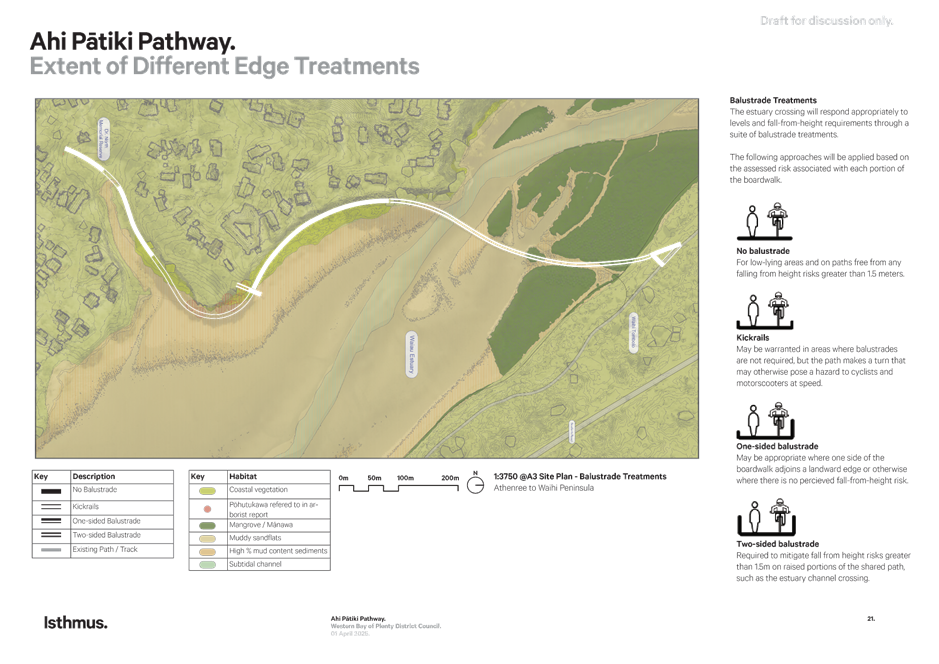
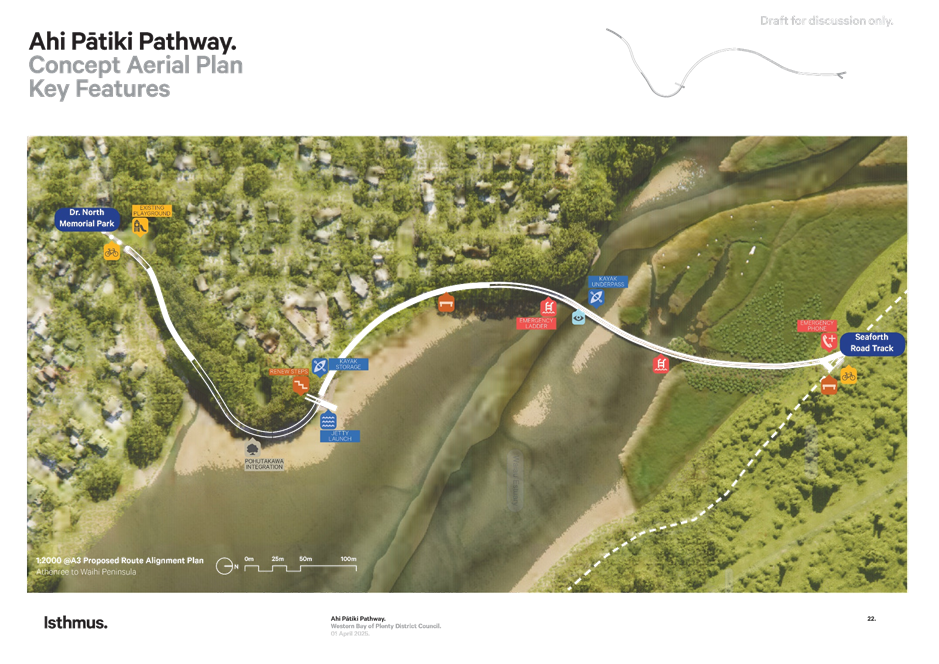
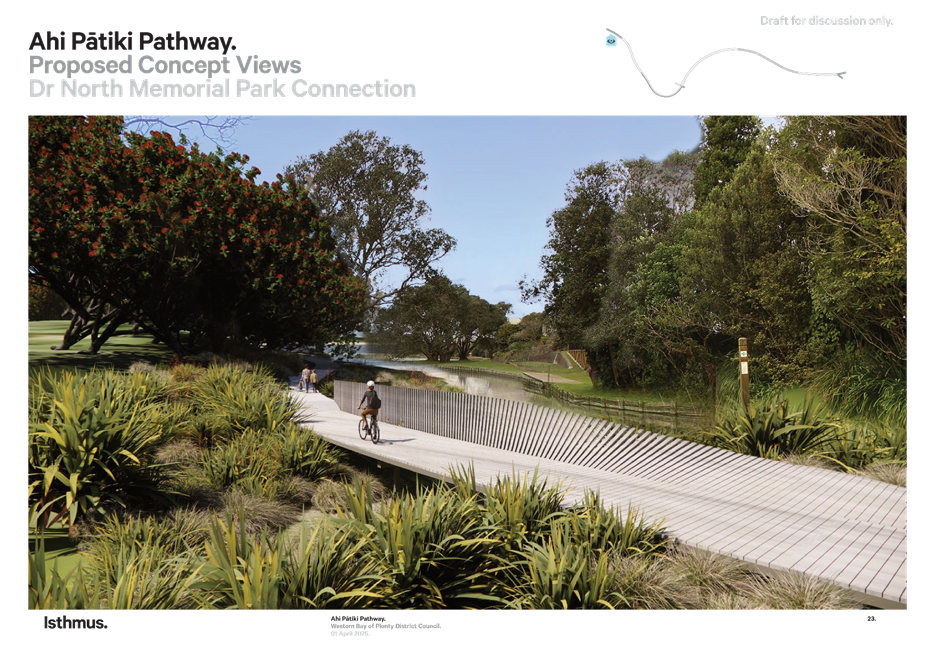
1. That the Cycleways Manager’s report dated 10 June 2025 titled ‘Ahi Pātiki / Athenree Crossing Draft Concept Plan Public Engagement Feedback Results And Next Steps’ be received. 2. That the report relates to an issue that is considered to be of low significance in terms of Council’s Significance and Engagement Policy. 3. That the Projects and Monitoring Committee receives the feedback following public consultation on the Ahi Pātiki Pathway draft concept plan, as shown in Attachments 2-5 of this report. 4. That the Projects and Monitoring Committee adopt the draft Ahi Pātiki Pathway concept design version dated 31 March 2025, as shown in Attachment 1 of this report. AND 5. That the Projects and Monitoring Committee approve for staff to proceed with the Resource Consent application process and to report back to the Committee on the decision outcome. AND 6. That if the Resource Consent application is approved, that staff develop a funding strategy to advance the project. |
Background
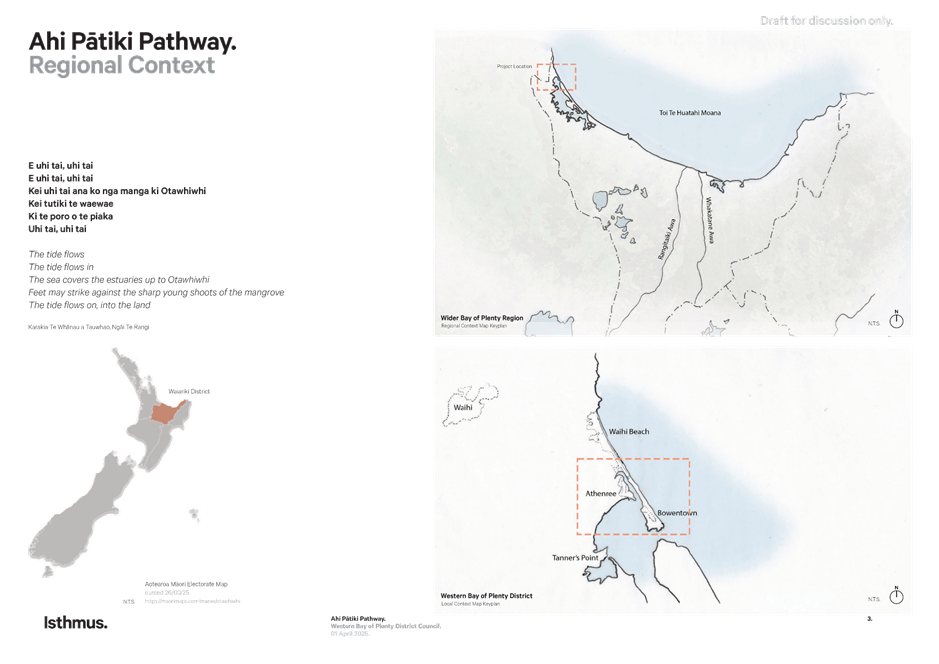
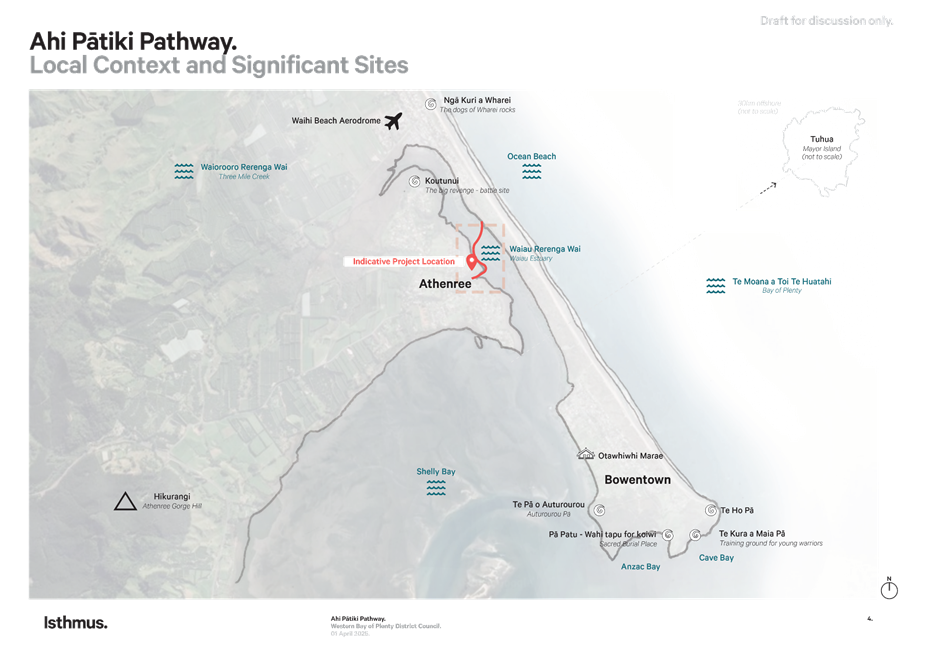
1. This project is identified a priority project within the Waihī Beach Community Plan, and it continues to develop significant local interest. Te Whānau ā Tauwhao ki Otawhiwhi and the Waihī Beach Community Board have been key partners from the beginning.
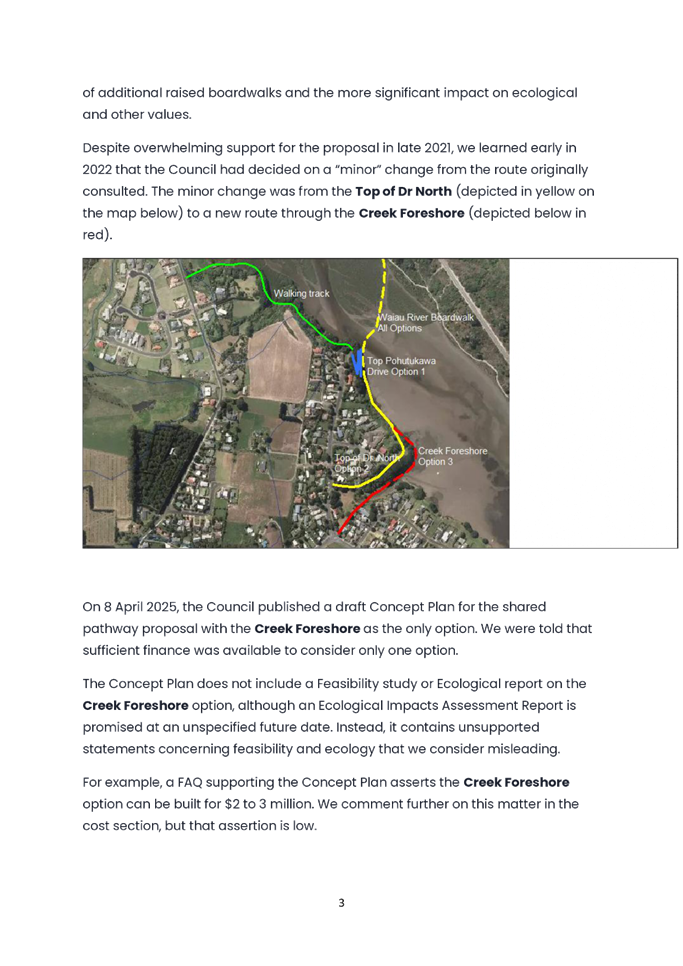
2. Council commenced public consultation on this project in 2021, where feedback on the route options feasibility report was sought, resulting in 92% of the 430 submitters supporting the pathway across the Waiau Estuary.
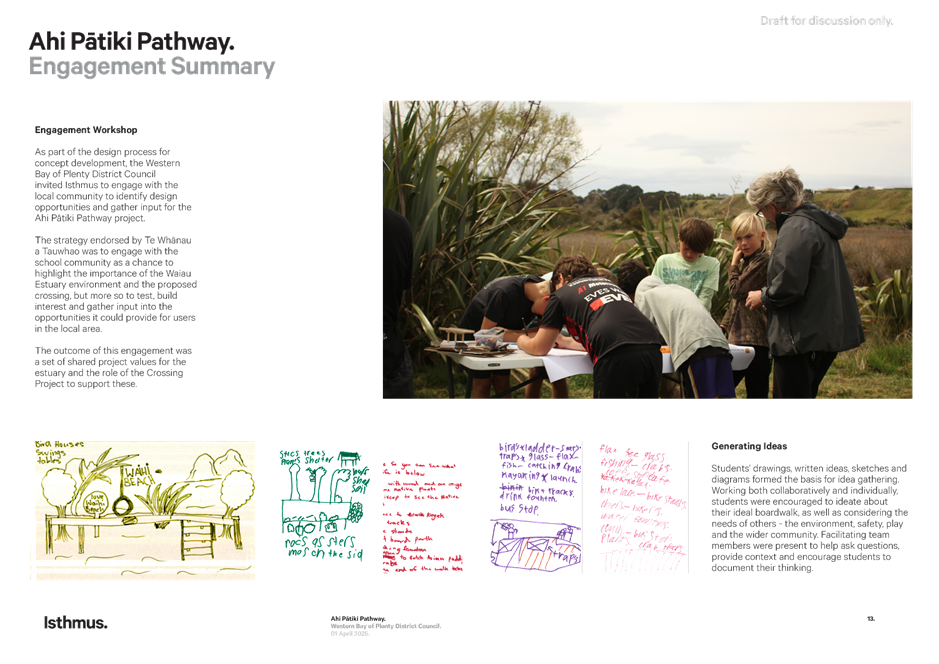
3. Since then, continued engagement with key partners, Te Whānau ā Tauwhao ki Otawhiwhi, Waihī Beach Community Board and students from Waihī Beach School have assisted to develop the draft concept plan, which has:
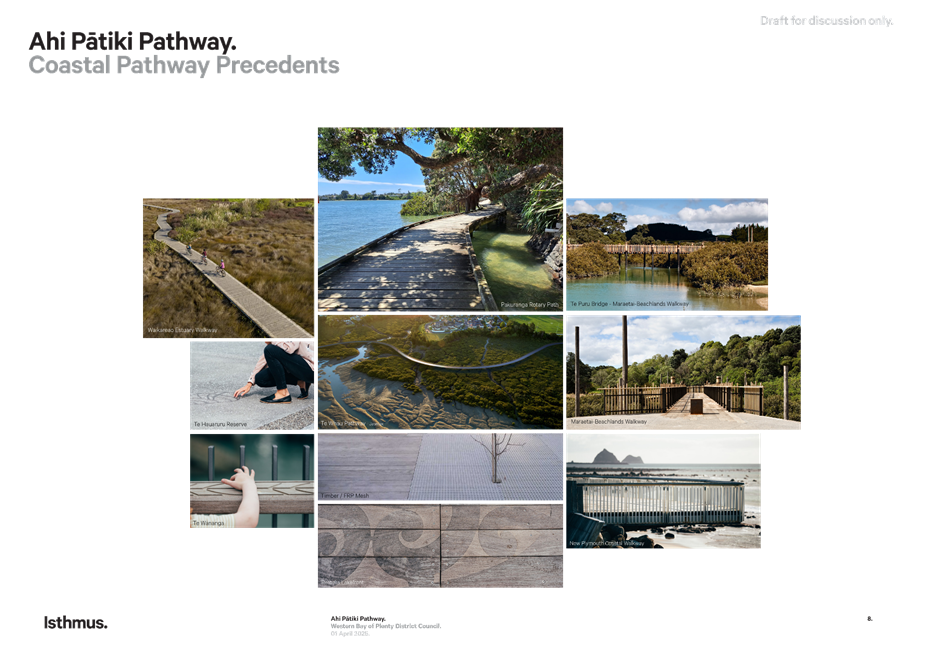
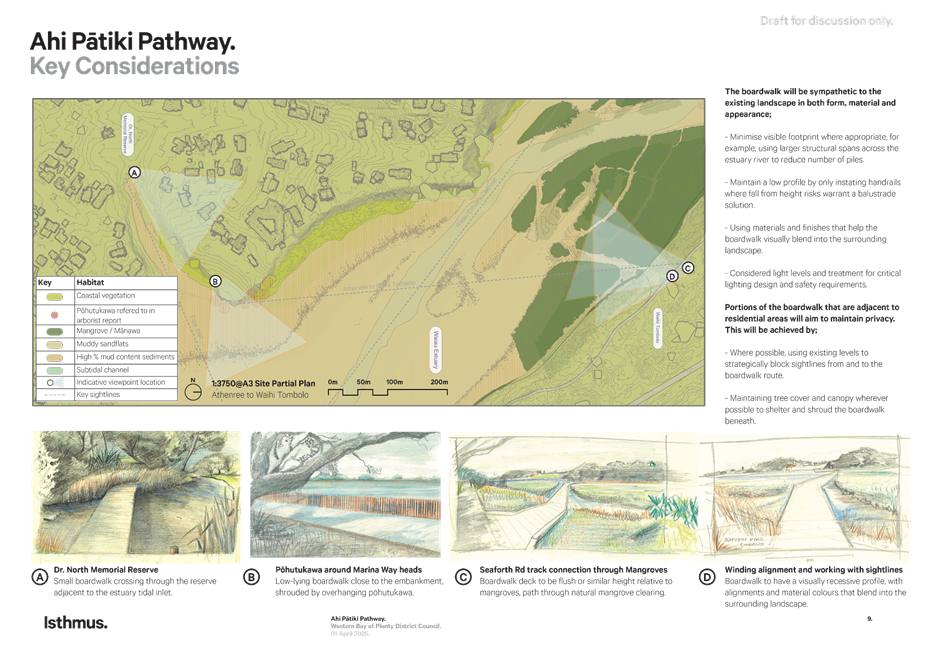
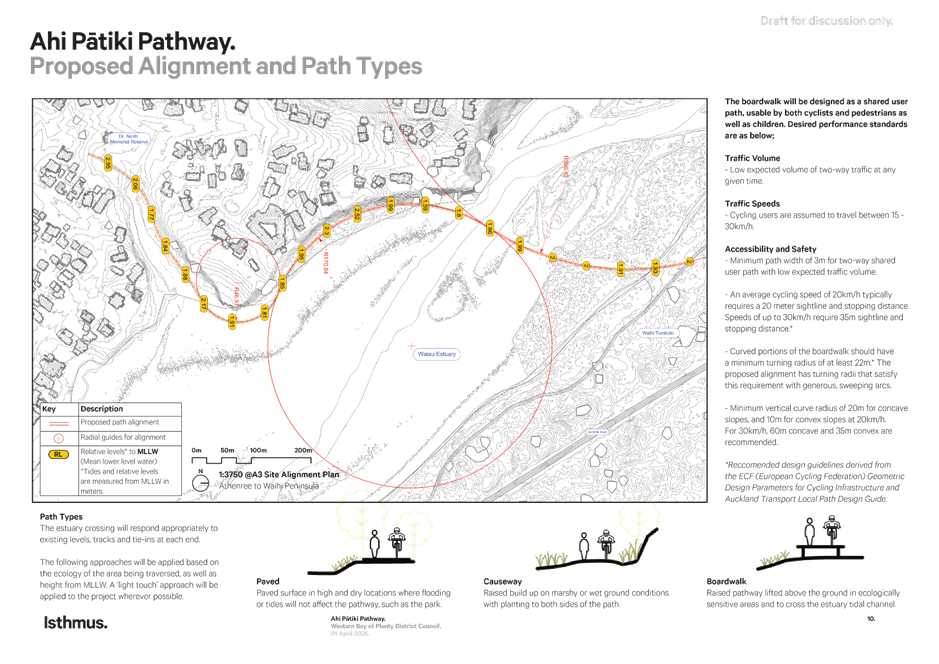
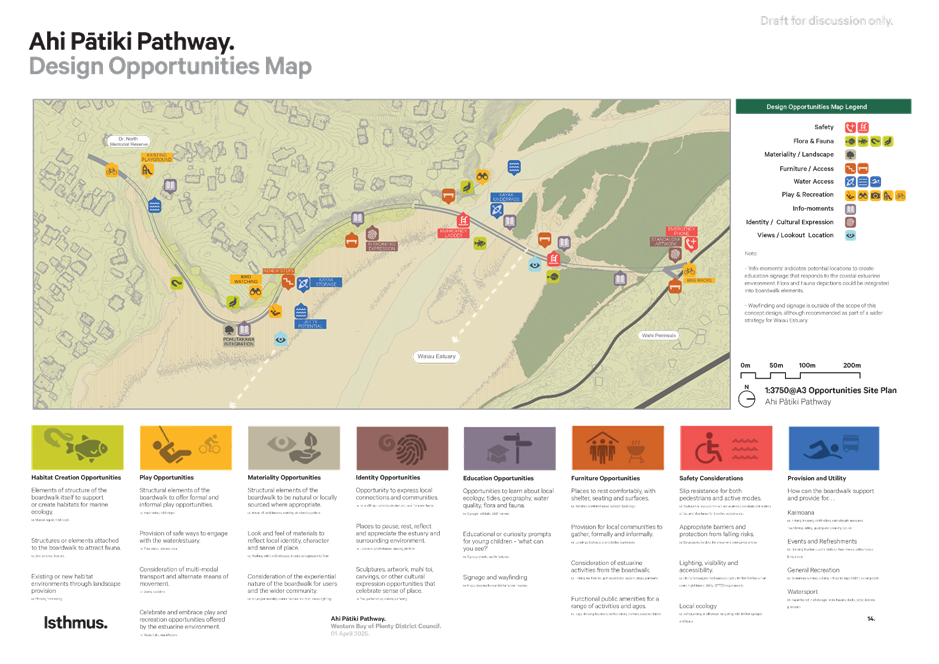
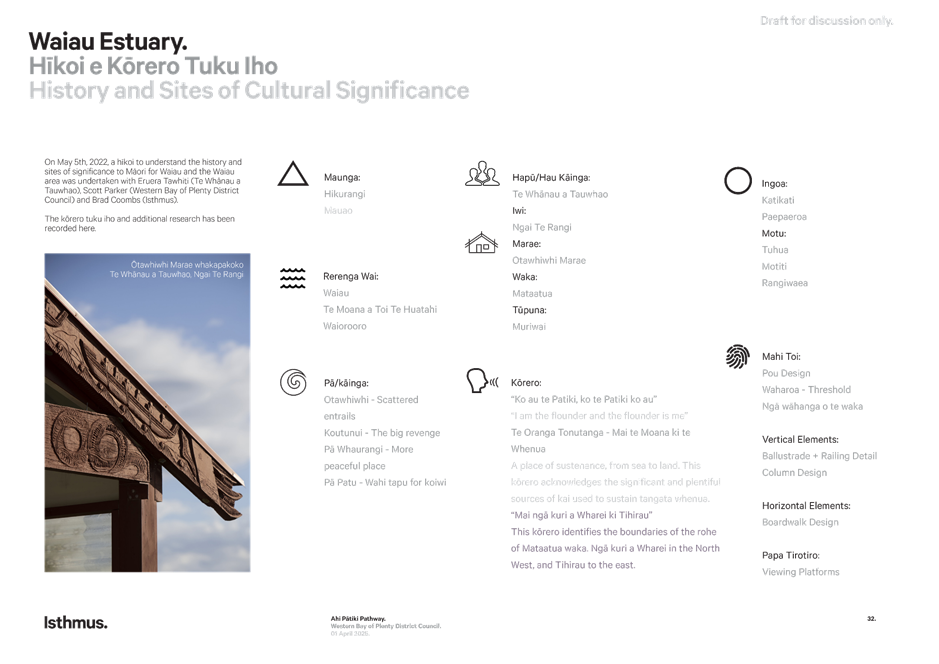
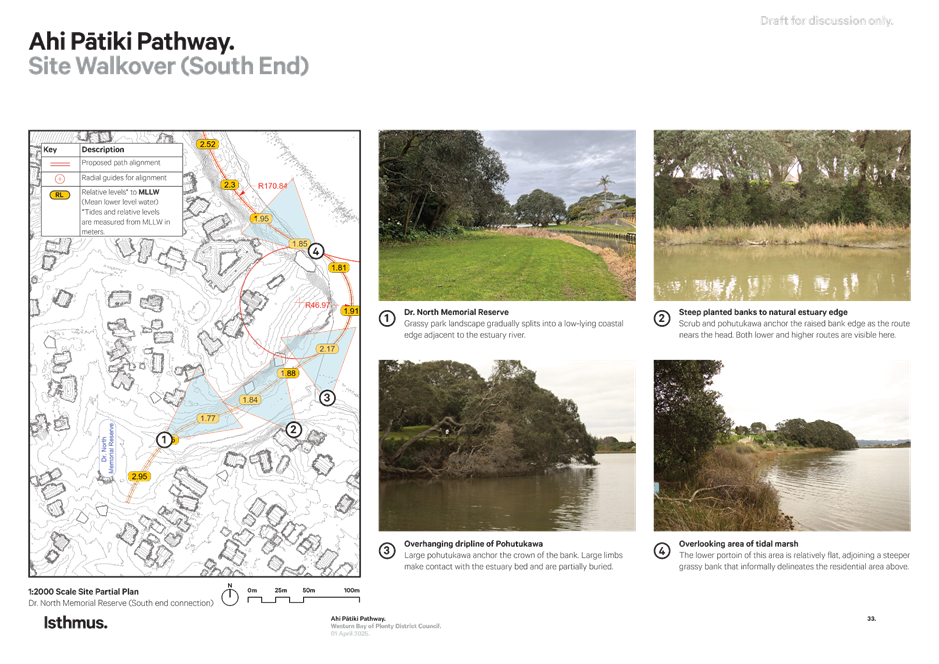
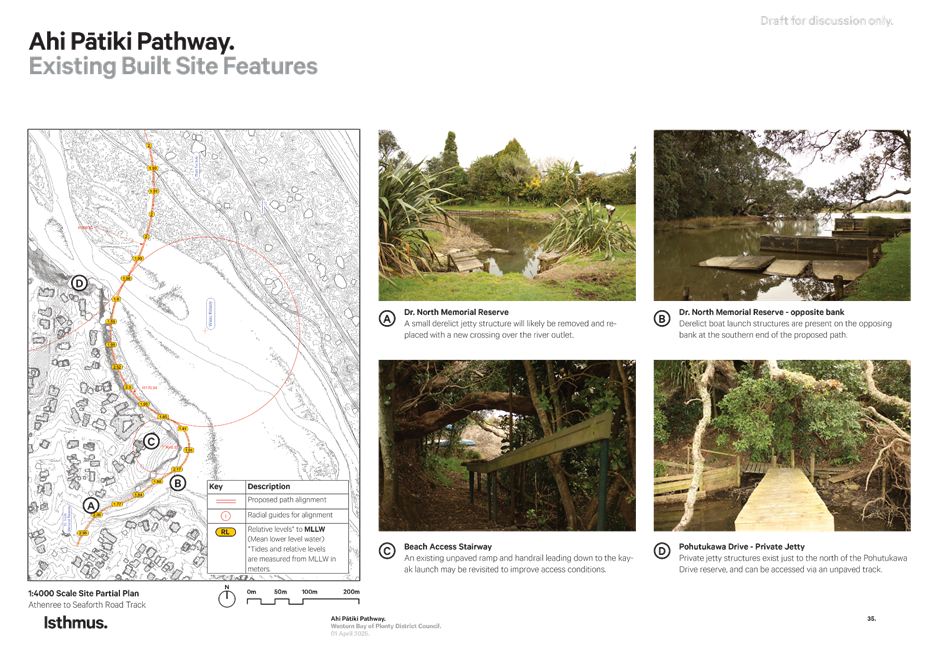
(a) Realigned the path at Dr North Reserve (Athenree) to reduce cultural and archaeological risks. Path realignment beside the Athenree Inlet also provides a much flatter/easier gradient for users of all abilities.
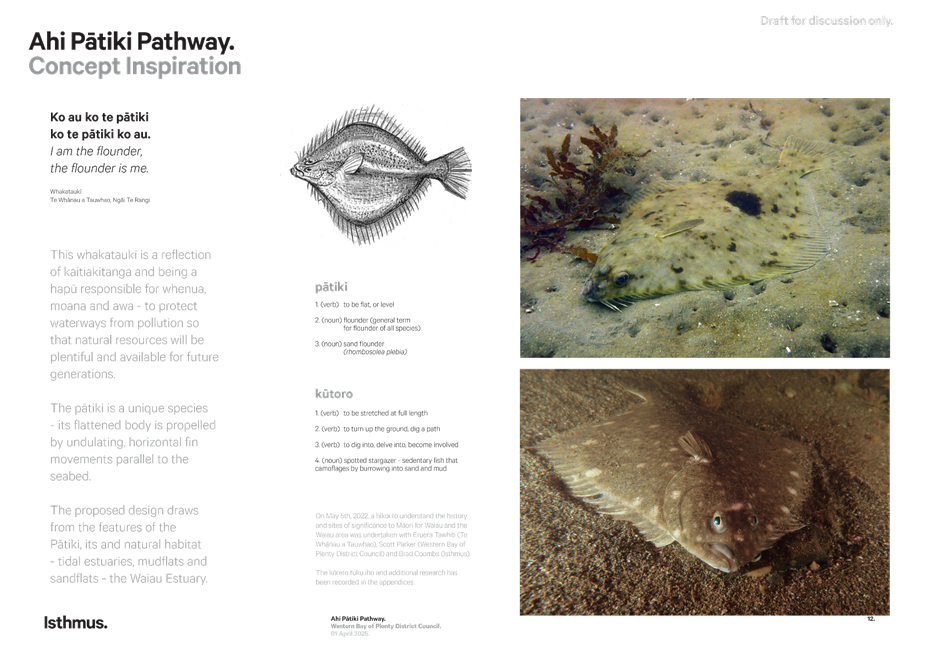
(b) Gifted (from Te Whānau ā Tauwhao ki Otawhiwhi) the name Ahi Pātiki to this project and the pathway itself.
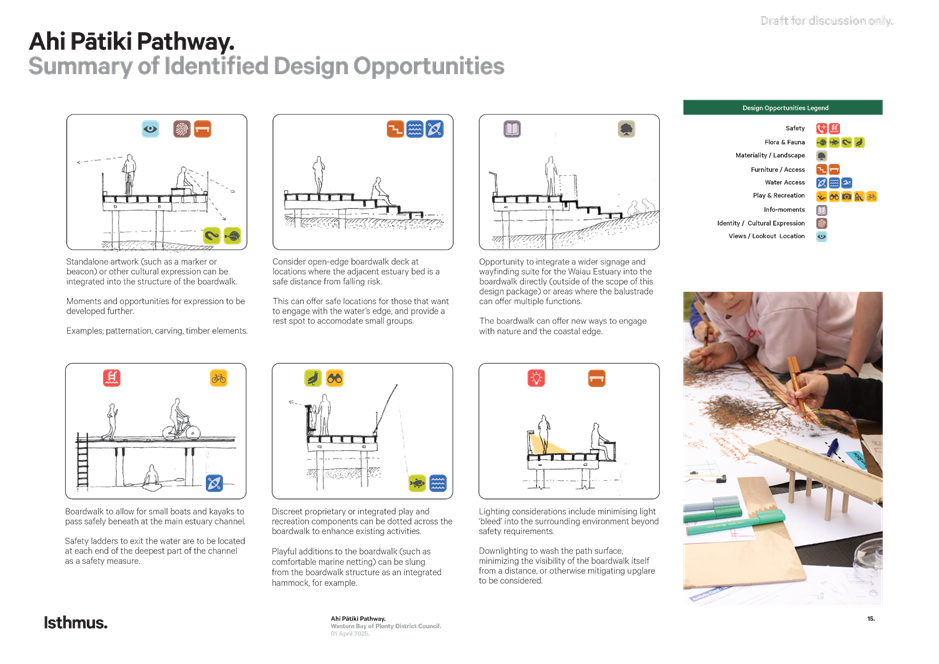
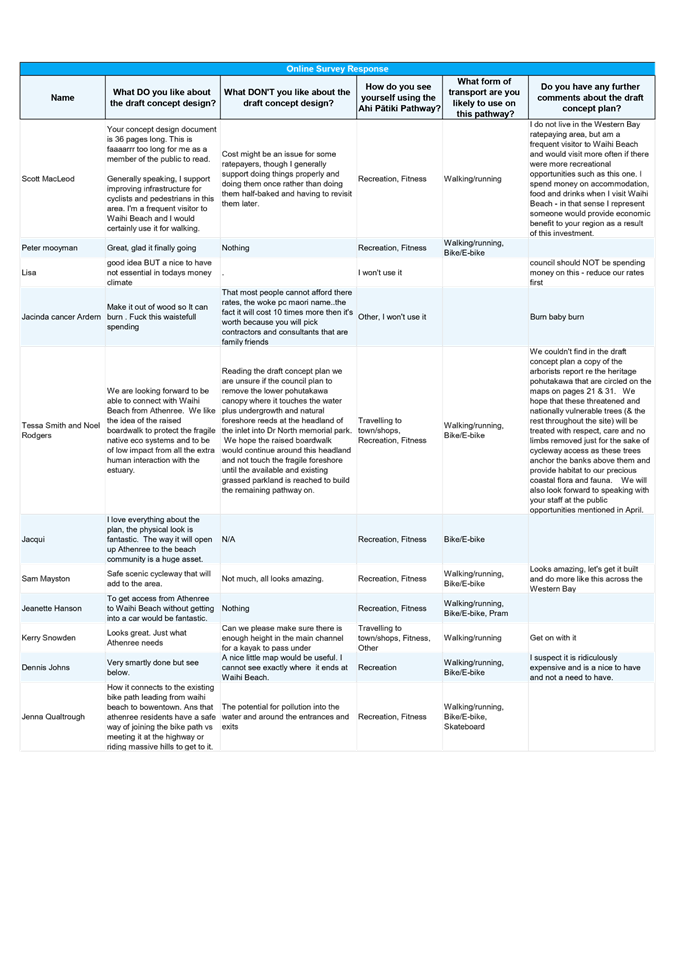
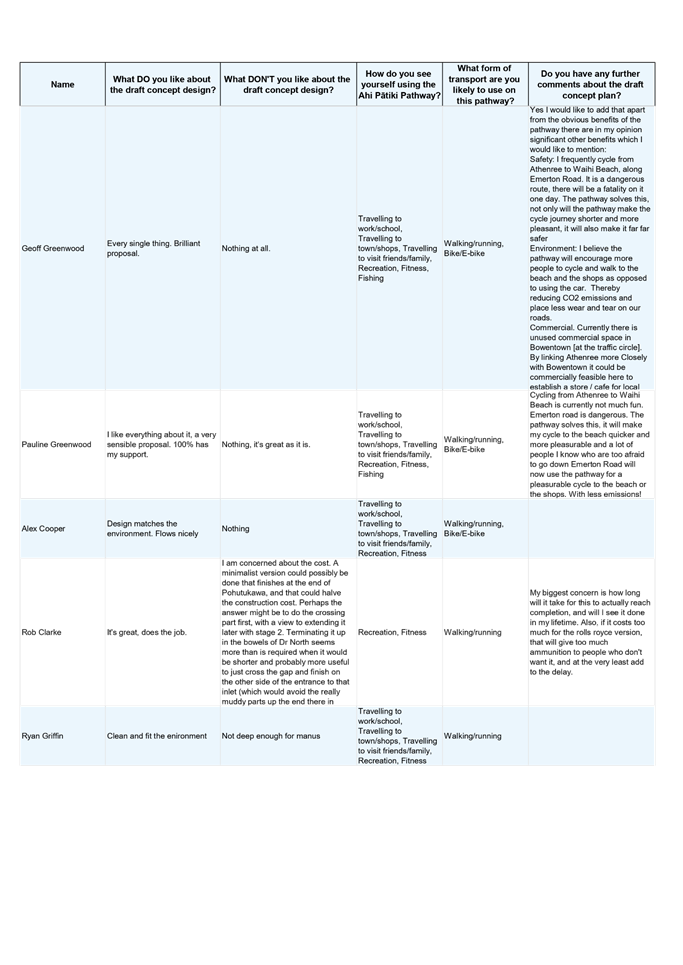
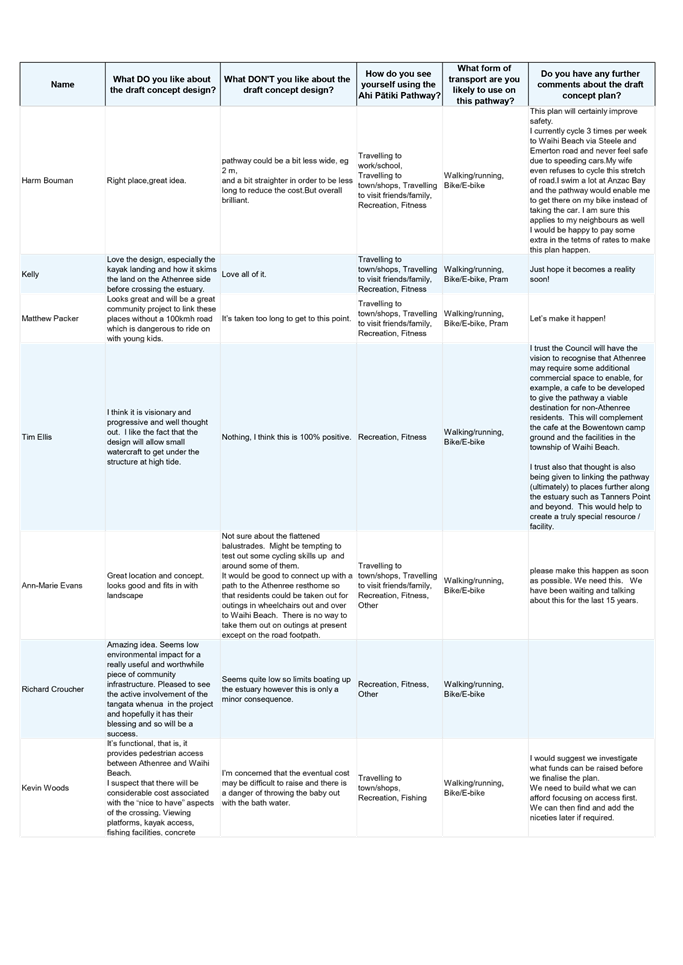
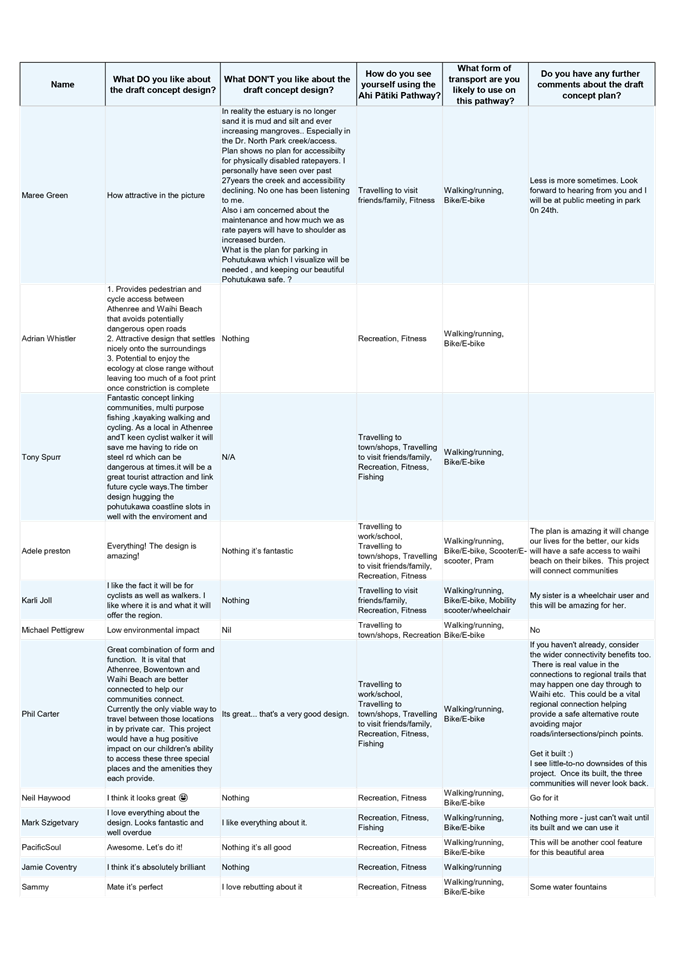
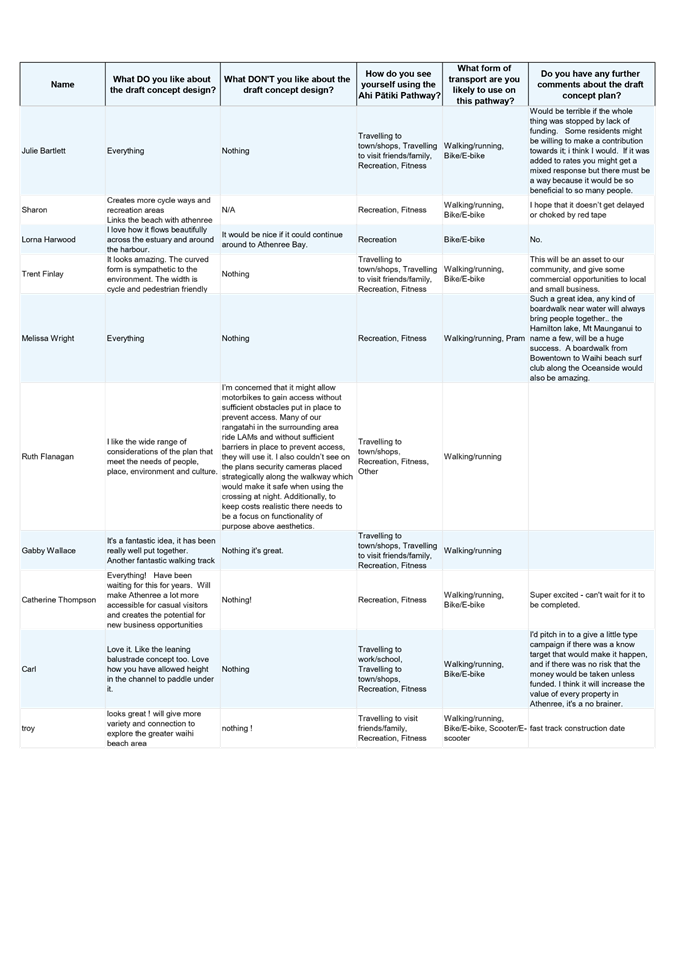
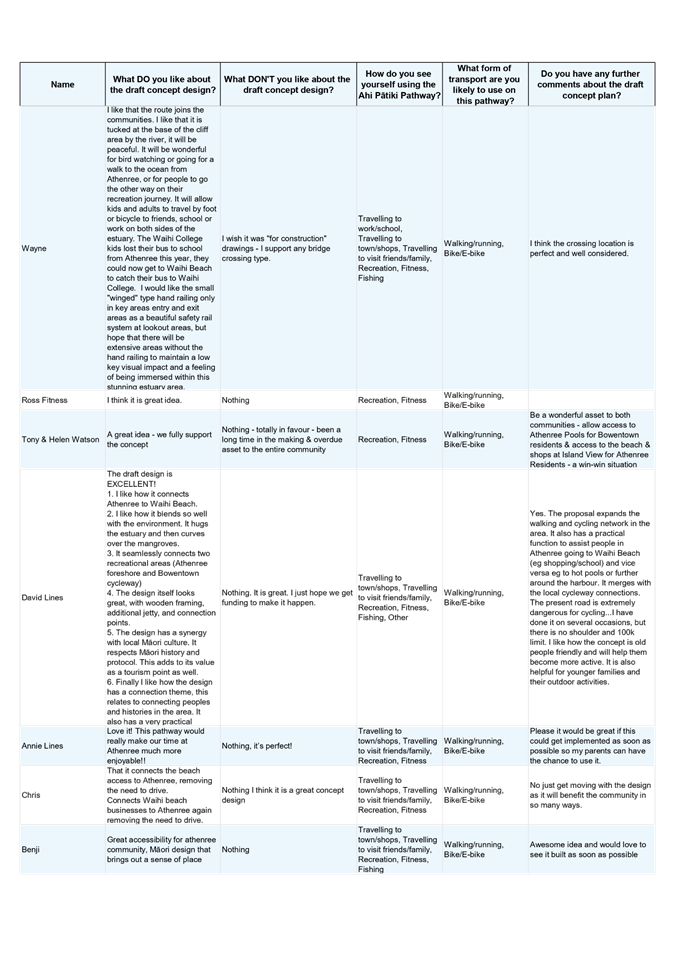
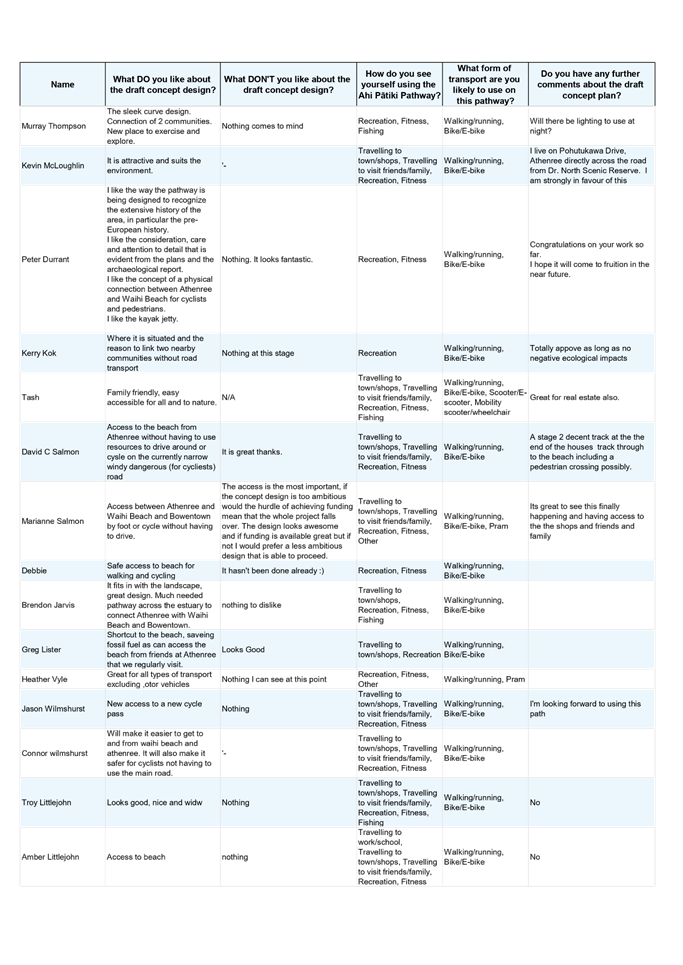
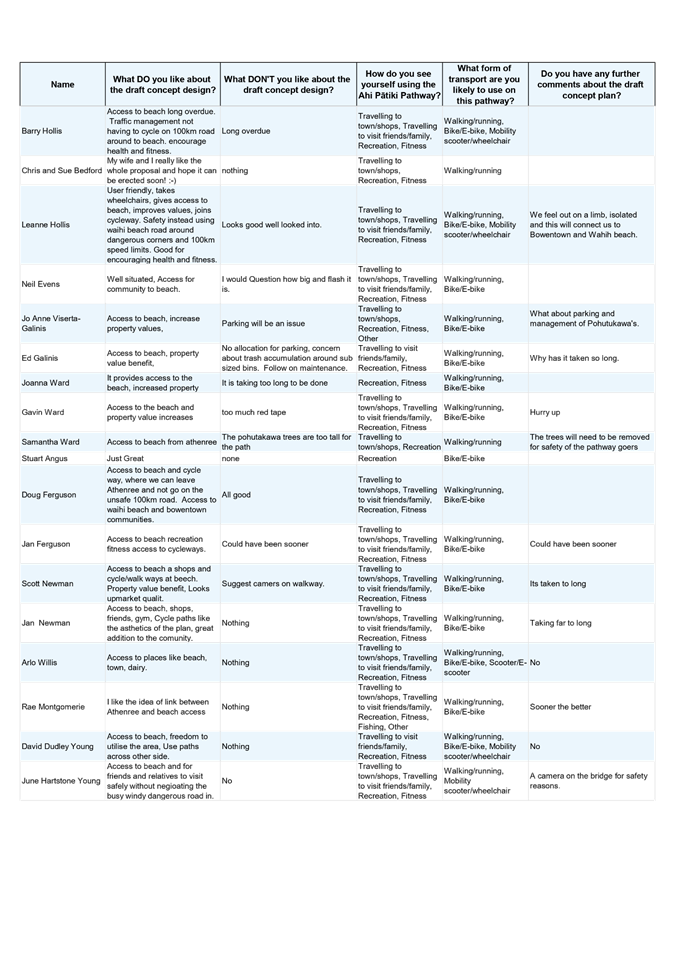
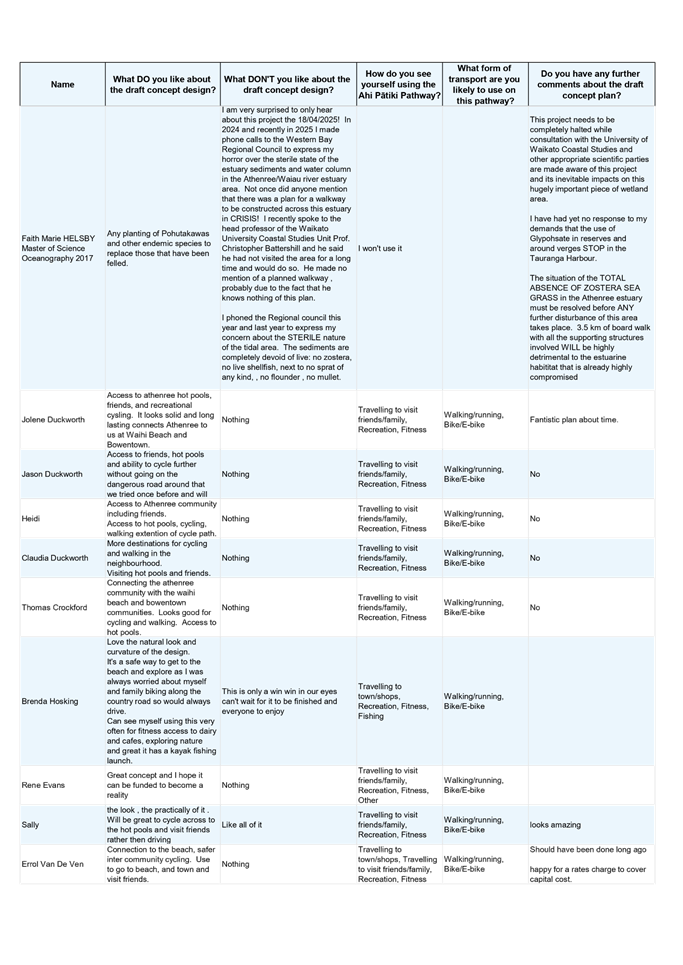
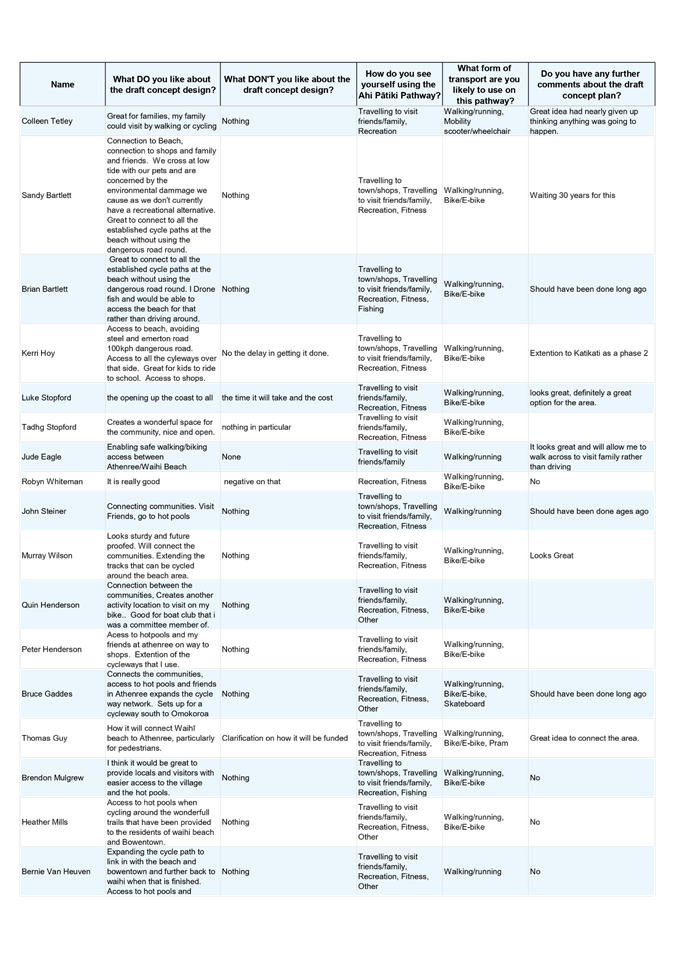
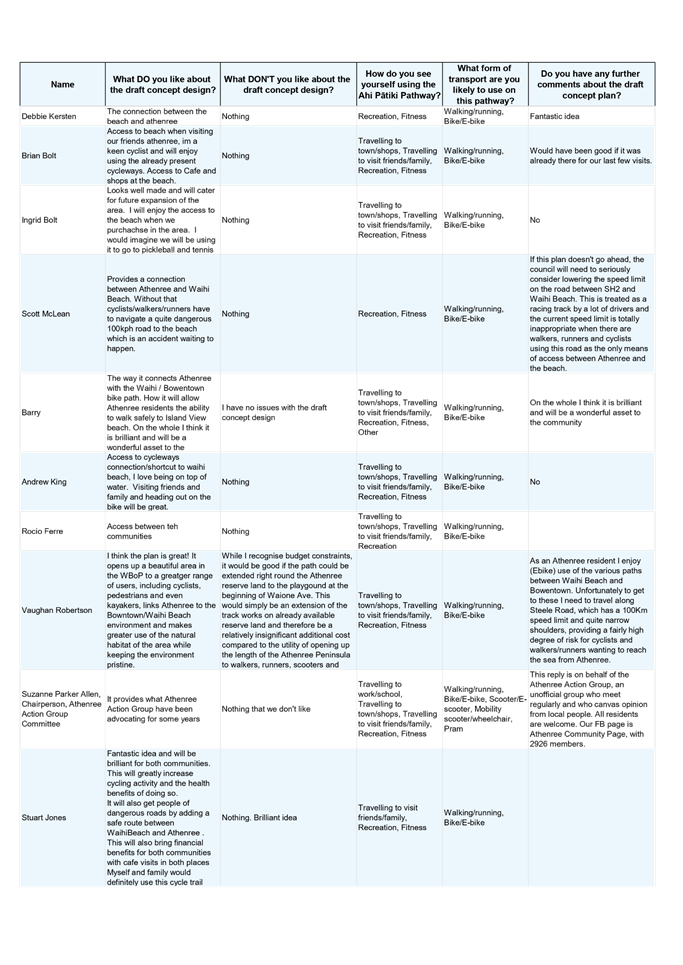
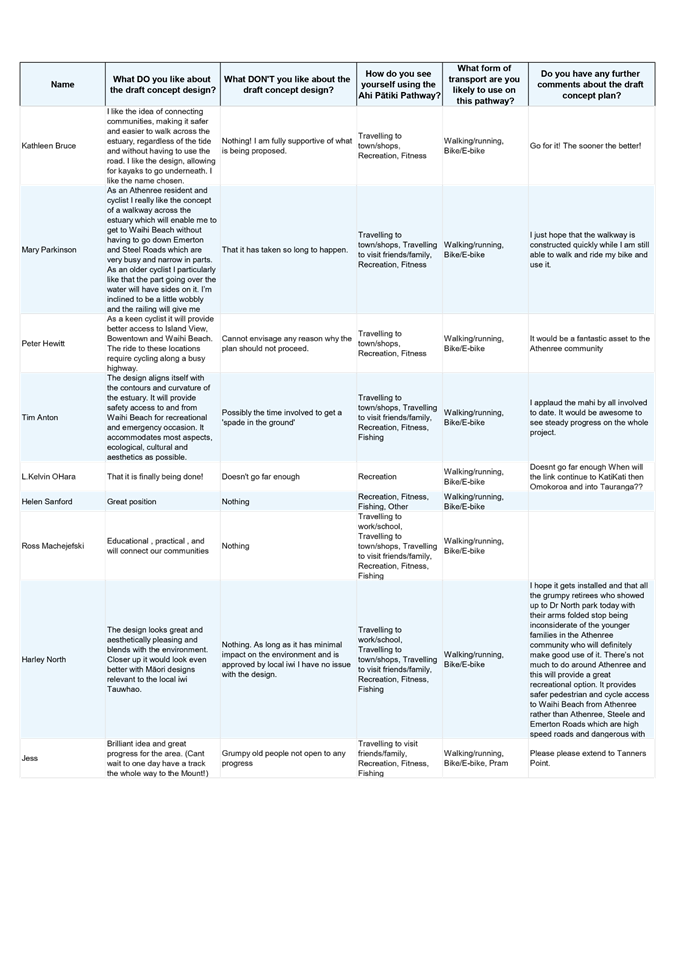
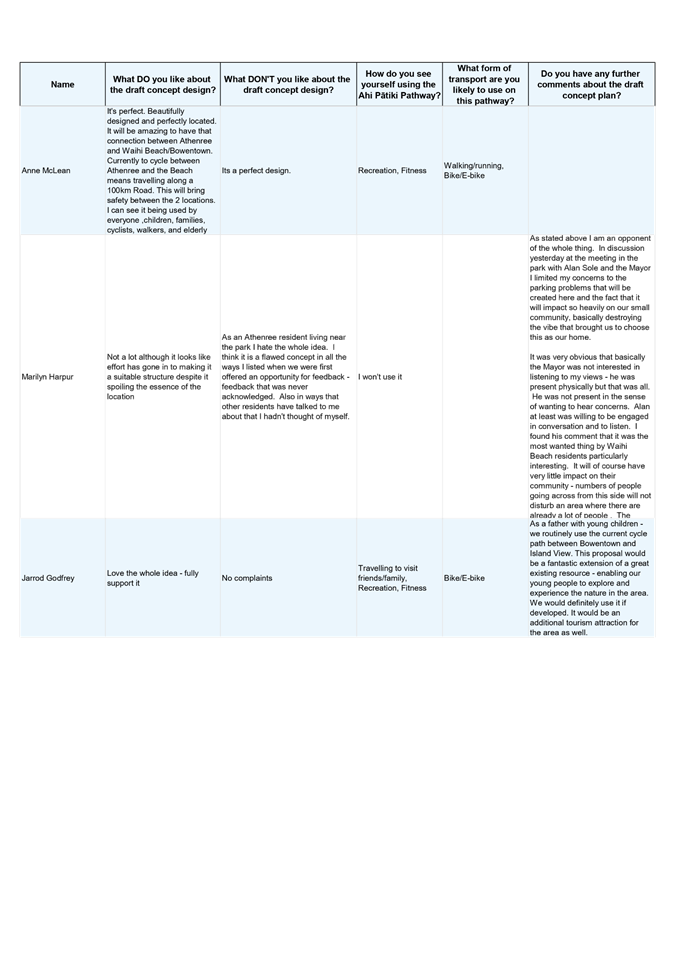
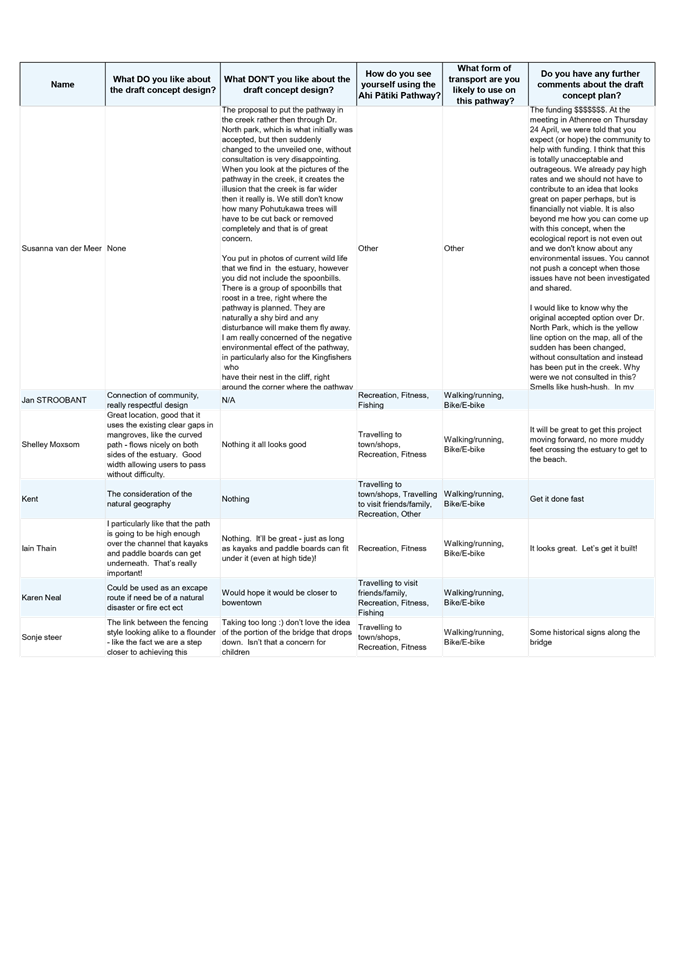
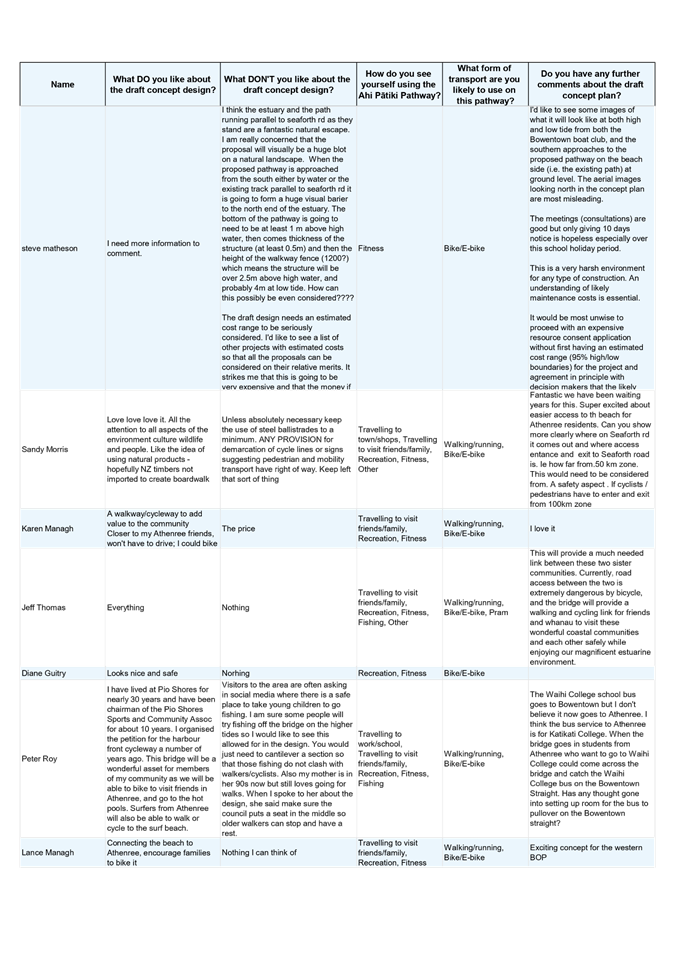
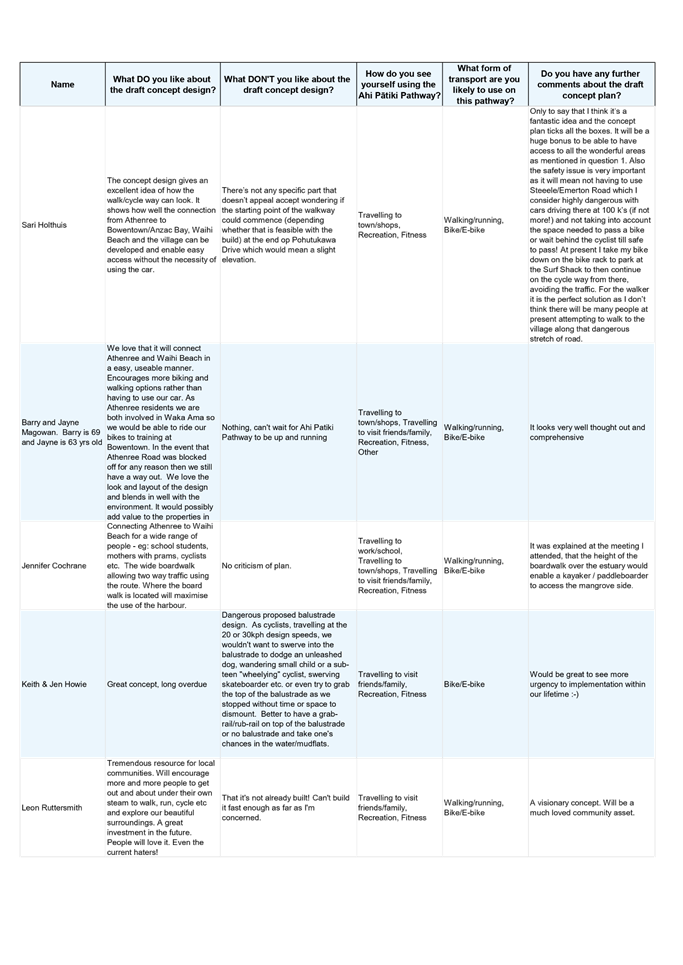
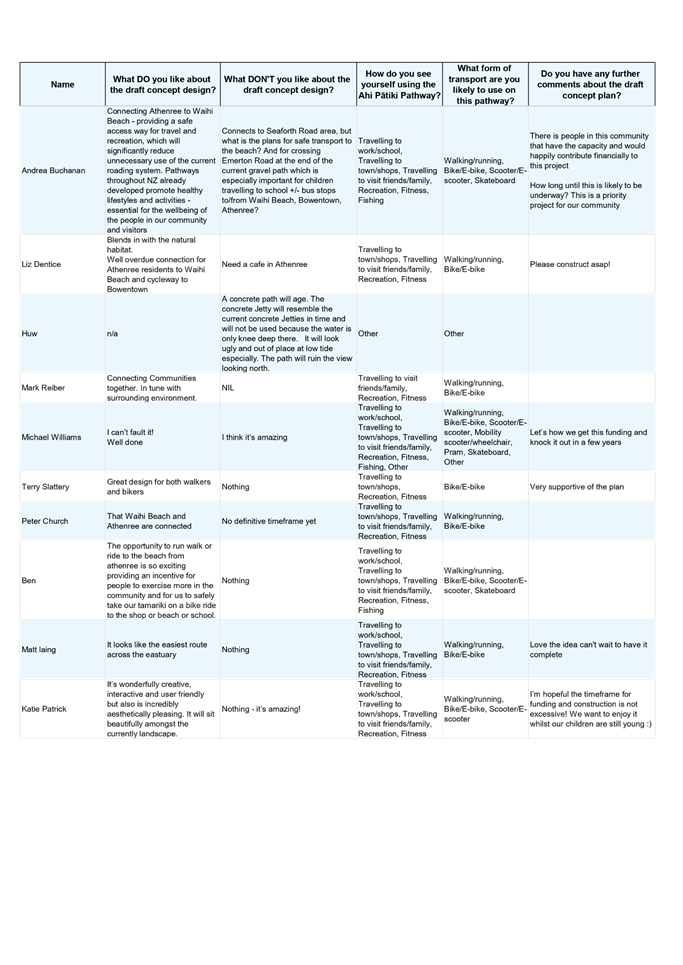
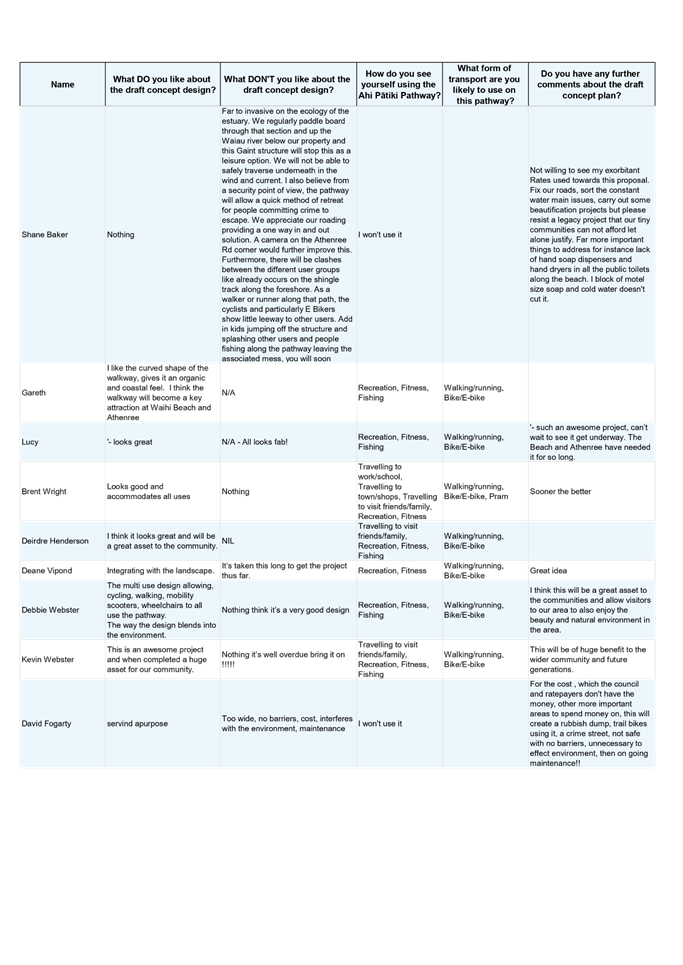
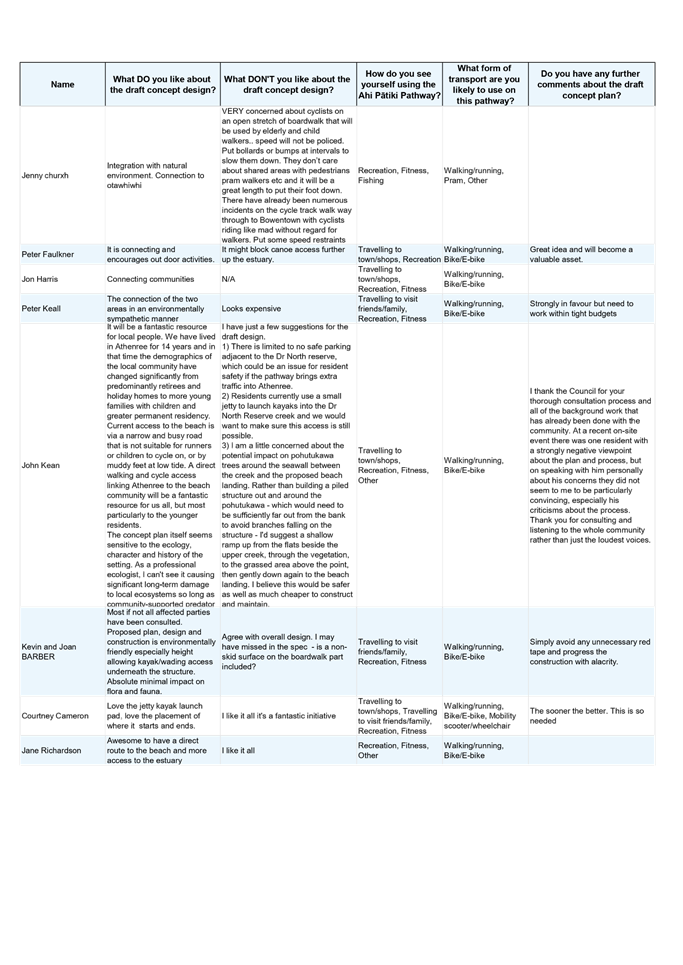
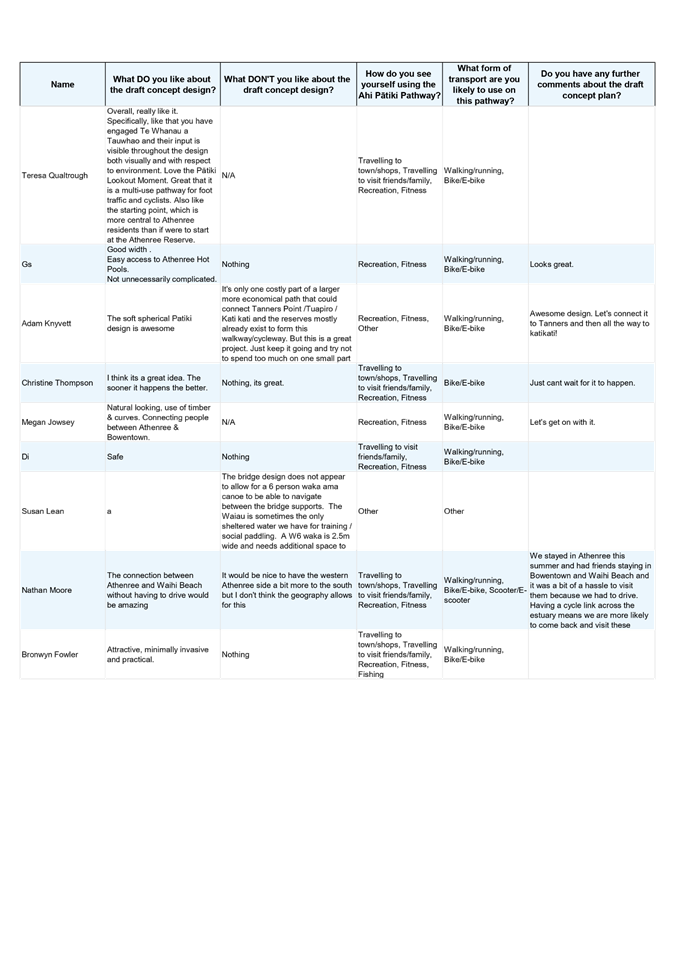
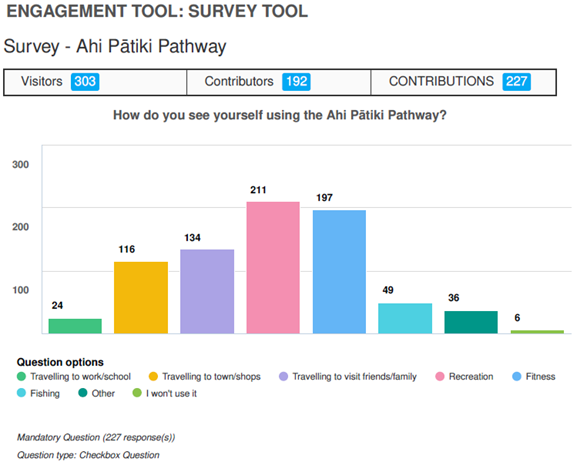
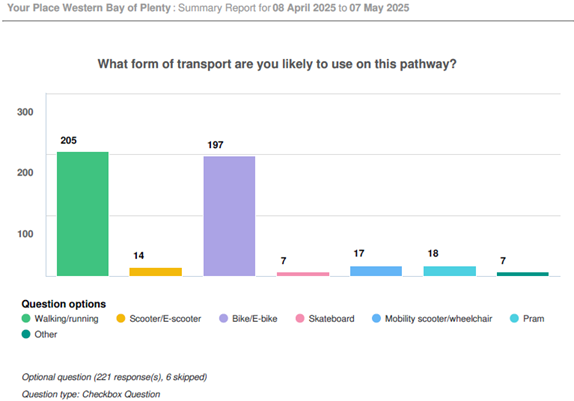
4. Public Engagement on the draft concept plan took place from Wednesday 9 April to Wednesday 7 May 2025 including three face-to-face drop-in events and an online survey. A total of 277 submissions were received, indicating majority support. Feedback Analysis is included below. The draft concept plan has been included as Attachment 1 and submitted data is included in Attachments 2-5.
5. The request for approval of this draft concept plan is slightly different to Council’s normal approval process. Typically, a draft plan would be formally approved, publicly consulted, feedback workshopped, plan changes made and Council adoption of a “final” concept. However, with this project, there has been significant input into the draft concept including from elected members. From this round of public consultation and feedback, no changes to the draft concept plan are proposed and workshopping is not considered necessary. The improvement themes submitted can be mitigated without material change during the detailed design stage should this project progress.
6. The feedback from this round of consultation will be included within the Resource Consent application for transparency. The application will also request the consenting authority to fully notify the application.
7. Transportation walking and cycling funding is sufficient to complete and lodge the resource consent application.
8. The Resource Consent application is expected to be lodged in July 2025 and several months later to obtain a decision. Should the application be successful, a funding strategy will need to be prepared, with a high reliance on external funding to progress into detailed design, procurement and eventual construction. This project may qualify for NZTA funding depending on Government Policy at the time.
Submissions received and analysed
9. The survey prompted both positive and negative responses (refer to Attachments 2-5) as well as improvement suggestions. An analysis of the feedback received has been undertaken with the following key findings:
(a) Positive Feedback (approx. 70%): The majority of submissions are in favour, highlighting benefits such as improved community connectivity, safety for cyclists and pedestrians, environmental sensitivity, and cultural appreciation.
(b) Negative Feedback (approx. 30%): A smaller portion of submissions expressed criticism, focusing on concerns such as potential environmental disruption, expense and financial concerns, and a desire for more comprehensive community consultation.
(c) Feedback common themes:
The submissions exhibit several common themes:
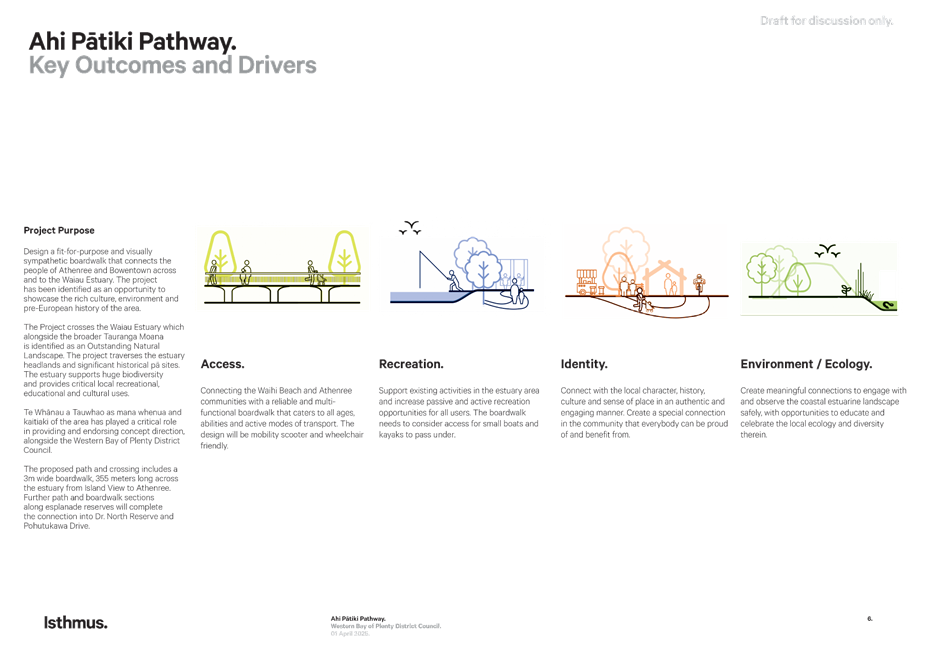
(i) Connectivity and Accessibility: A significant theme is the emphasis on connectivity. The pathway is seen as a means to connect Athenree and Waihī Beach, making travel between these areas easier without the need for vehicles. This is particularly valued for providing a safe route for cyclists and pedestrians, which is seen as a major asset to the community.
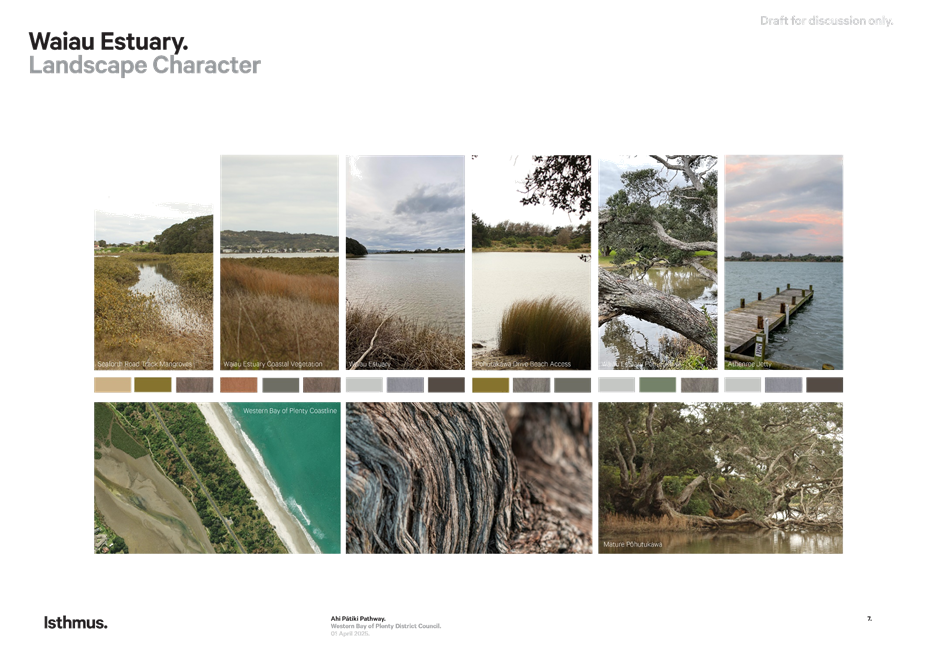
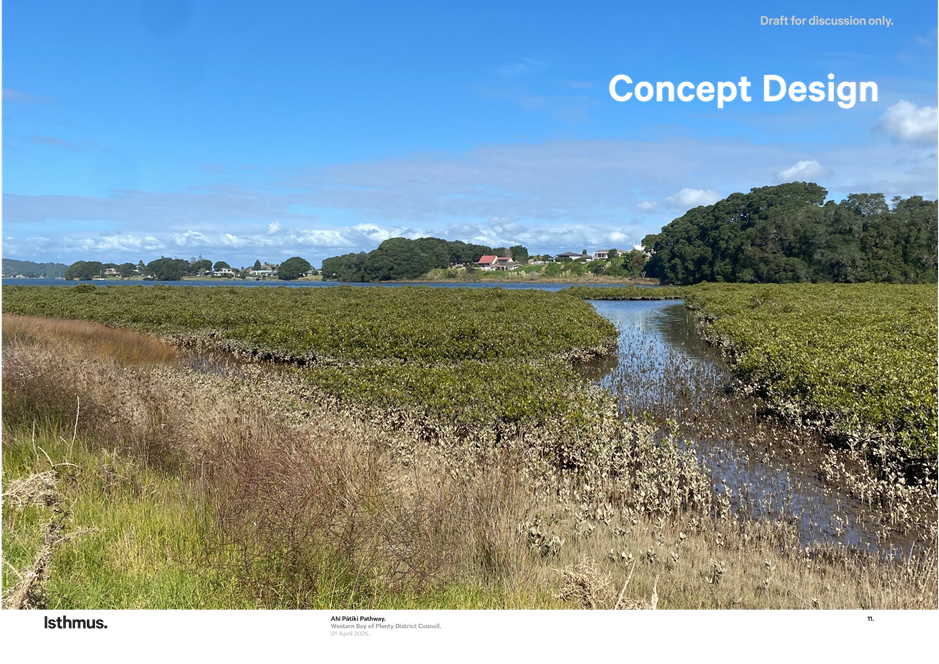
(ii) Integration with Natural Environment: Many submissions highlight the design's sensitivity to the natural environment, emphasising that it blends well with surrounding habitats and respects the local ecology. It is noted that the pathway should minimise ecological disturbance while enhancing recreational opportunities.
(iii) Cultural and Historical Respect: There is appreciation for the design's recognition of the area's cultural heritage, particularly its connection with Māori history and pre-European times.
(iv) Safety and Utility: The pathway is praised for improving safety for cyclists and pedestrians, particularly for children and the elderly, by providing an alternative to using the main road, which is considered dangerous.
(v) Potential Environmental Concerns: Some submissions express concerns about the potential ecological impact of developing the pathway, especially regarding disturbance to bird life and other wildlife. There is a call for careful consideration of the environmental impacts and mitigation strategies.
(vi) Community and Recreation Benefits: The pathway is expected to encourage outdoor activities and social interactions, thereby supporting healthier lifestyles. The provision for multi-use, including cycling, walking, and access for mobility scooters and wheelchairs, is highlighted as an inclusive feature.
(vii) Aesthetic and Design Appreciation: The aesthetic aspects of the design, such as its curves and how it follows the natural contours of the landscape, are appreciated for adding visual appeal to the area.
Overall, while there is significant support and excitement about the potential benefits of the pathway, particularly in enhancing connectivity and promoting active lifestyles, there is also a clear demand for the project to proceed with environmental and cultural sensitivity.
(d) Improvement Suggestions: Specific improvement themes have been identified from the submissions. These are ranked below from the most mentioned to the least mentioned, with a response on how these suggestions will be mitigated.
|
IMPROVEMENT SUGGESTION THEME |
MITIGATION |
|
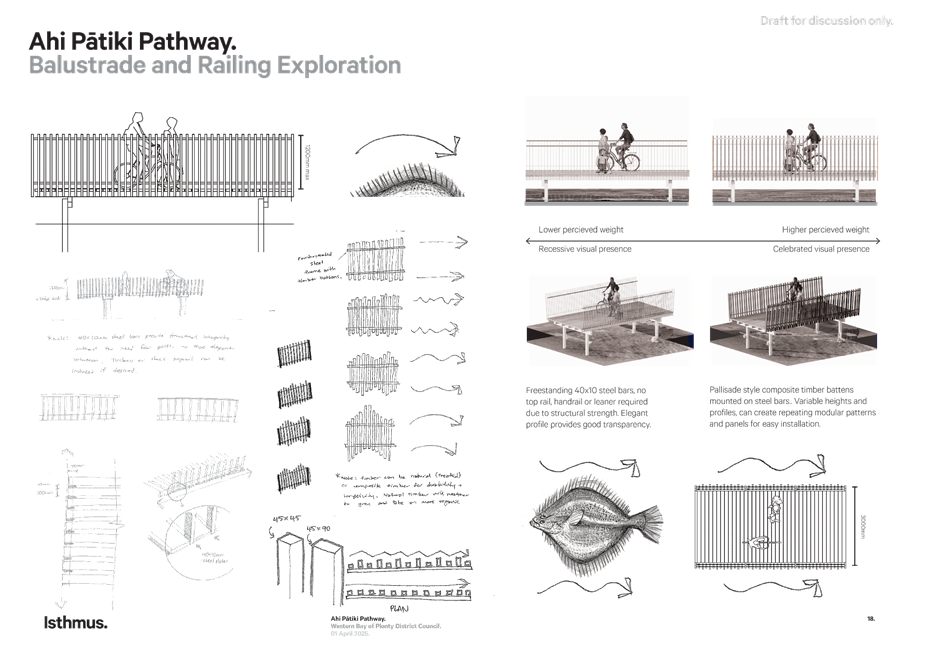
Balustrade and Safety Features: Many submissions expressed concerns about the proposed boardwalk balustrade design, suggesting it may pose a hazard to cyclists and pedestrians. Suggestions included adding grab-rails or reducing the balustrade height for improved safety. |
The detailed design stage will ensure that balustrade / handrail features, while conveying artistic and cultural elements, will be fit for purpose and meet required design standards (which have been developed with user safety in mind). |
|
Environmental Considerations: There are calls to ensure minimal impact on the natural environment, particularly regarding the Pohutukawa trees and local wildlife habitats. |
Detailed professional assessments (environmental effects including trees) are currently being finalised which address these concerns. Unfortunately, these weren’t available for this consultation stage but they will be included in the Resource Consent Application documents and be available for public scrutiny / submissions during the RC application public submission process. |
|
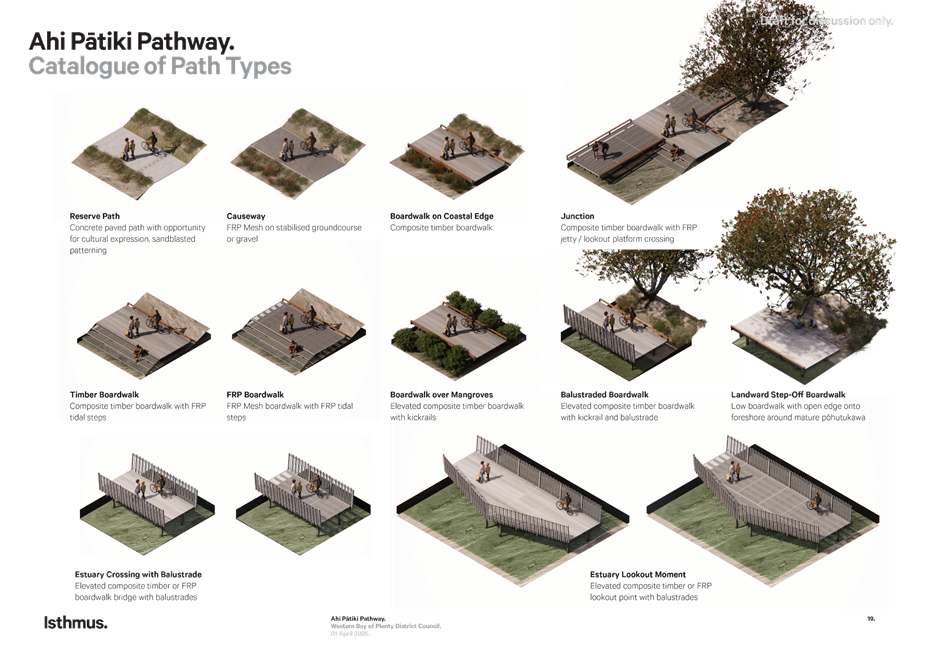
Concrete or Composite Material Concerns: Some submissions raised issues about the use of concrete or composite materials, which could have negative impacts on the surrounding soft shorelines. |
The concept design stage has not considered specific materials. The detailed design stage will consider the pros & cons of various material and construction methods to ensure the best balance of long life, environmental effects and cost. It is likely that if the Resource Consent application is approved, there will be a consent condition requiring Consenting Authority approval of the design and construction methodology. |
|
Access and Parking Issues: Improvements were suggested for parking areas adjacent to the pathway to prevent congestion and maintain safety for residents. |
Ahi Pātiki pathway connects to the existing network of paths & trails already present at Waihī Beach – consequently it is not expected to generate additional parking demand as trail users will park where they do already. At Athenree, there is plenty of on -street parking capacity to accommodate visitor vehicles arriving/starting from there. There is no Council plan to construct additional parking but consideration should be given to new public toilet facilities at Athenree (Dr North Reserve) during the next review of the Katikati / Waihi Beach Ward RMP review. |
|
Continuation and Connectivity: A suggestion was made to extend the pathway further to improve connectivity between communities, emphasizing the importance of accessibility. |
This idea supports the Tauranga Moana trail strategy included within Council’s Walking & Cycling Action Plan. |
|
Traffic Management and User Conflict: There were recommendations for implementing speed restraints to manage potential conflicts between different users, particularly cyclists, to ensure safety for all. |
This can be a consideration during the detailed design stage. Primary mitigation for this is user education and signage. The paramount intention is that this path will be accessible for everyone and that any barriers or restrictions must be weighed carefully against access needs. |
(e) Statistical feedback:
Significance and Engagement
10. In terms of the Significance and Engagement Policy this decision is considered to be of low significance because:
(a) The project is and has been widely consulted and there is already a high level of community engagement. No special consultative procedure is required.
(b) No significant Council funding decision is required yet.
(c) Tangata whenua have been involved from the beginning and are a valuable contributor to the concept design process.
(d) The project aligns with the WBOPDC Recreation and Open Space policy and the Walking and Cycling Action Plan. It is also a high priority project in the Waihī Beach Community Plan.
Engagement, Consultation and Communication
11. Close engagement with Te Whānau ā Tauwhau ki Otawhiwhi has been in place since the project started. Communication, engagement and consultation with the community has been ongoing since the 2021 Feasibility study and the April 2025 concept plan engagement. The next opportunity for public consultation will be through a resource consent application request to fully notify the application.
|
Interested/Affected Parties |
Completed/Planned |
|
|
Waihī Beach Community Board |
Workshops with and regular brief updates to the Board since 2019. |
Completed |
|
Tangata Whenua and engagement day with Waihī Beach School |
Multiple hīkoi held with Te Whānau ā Tauwhao when investigations started early 2021 and have been contributing to the draft concept plan since then. Engagement day with students from Waihī Beach School, November 2024. |
|
|
General Public |
Public consultation in 2021 to the location options Feasibility Report – resulted in 93% support for the preferred location. Public consultation April 2025 on the draft concept plan. |
|
Issues and Options Assessment
12. The options at this stage of the project are to either adopt the draft concept plan, approve progression of a resource consent application (through to a consent decision), and develop a funding strategy – recommendations 4, 5 and 6, or to not approve. Any of these decisions does not bind Council to construct the Ahi Pātiki pathway.
|
Option A – recommendations 4, 5 and 6 · That the Projects and Monitoring Committee adopt the draft Ahi Pātiki Pathway concept design version dated 31 March 2025, as shown in Attachment 1 of this report. AND · That the Projects and Monitoring Committee approve for staff to proceed with the Resource Consent application process and to report back to the Committee on the decision outcome. AND · That if the Resource Consent application is approved, that staff develop a funding strategy to advance the project. |
|
|
Assessment of advantages and disadvantages including impact on each of the four well-beings · Economic · Social · Cultural · Environmental |
Advantages Economic: · The Resource Consent process has sufficient funding and there is no commitment to construct the pathway (if the application is successful) · Should the project proceed to construction, there will be increased tourism and boost to local businesses through increased spending. Also, the construction and maintenance of the boardwalk may create jobs for local residents during different phases of the project. Social: · The decision to proceed with the resource consent application process positively reinforces public messaging and expectations to date. · Should the project proceed to construction, there will be improved community connectivity, encouraging social interaction and reducing travel time. It also offers a new space for walking, cycling, and various recreational activities, promoting a healthier lifestyle. Cultural: · Should construction proceed, it provides opportunity for the preservation and celebration of cultural heritage, incorporating cultural narratives and educational opportunities. This also fosters a sense of pride in local history and cultural identity, strengthening community bonds. Environmental: · Should construction proceed, it will increase user engagement with the estuarine environment, fostering awareness and appreciation for local biodiversity. An ecologically sensitive design with minimal ecological impact help balance access with environmental stewardship. Disadvantages Economic: · Development of the boardwalk requires significant upfront investment, potentially straining public resources or budgets. There will also be ongoing maintenance expenses, adding long-term financial commitments. Social: · Should construction proceed, temporary disruptions may occur impacting local residents and businesses. · Once constructed, increased user traffic could lead to congestion, particularly at peak times or during events, affecting local comfort. Cultural: · Should construction proceed, efforts to monetize cultural elements could dilute or misinterpret local heritage. There are also challenges to ensure cultural elements are respectfully and accurately represented. Environmental: · Should construction proceed, despite careful planning, construction may disrupt local habitats and wildlife temporarily. In addition, over time, human activity could potentially impact delicate estuarine ecosystems if not managed appropriately. |
|
Costs (including present and future costs, direct, indirect and contingent costs). |
This decision does not commit Council to funding or constructing the Ahi Pātiki pathway. Consenting costs can be absorbed within the existing budget |
|
Option B The Projects and Monitoring Committee does not adopt the draft Ahi Pātiki Pathway concept design dated 31 March 2025, does not proceed with the Resource Consent application process or develop a funding strategy to advance the project. |
|
|
Assessment of advantages and disadvantages including impact on each of the four well-beings · Economic · Social · Cultural · Environmental |
Advantages Economic: · No additional long-term costs associated with a new asset No social or cultural advantages have been identified Environmental: · Status quo - no associated ecological disruption or impacts
Disadvantages Economic: · potential business growth lost opportunity Social: · contrary to public messaging, expectations and community plans – damage to Council reputation. · Lost opportunity to enhance community connectivity, social interaction, travel times, various recreational activities and a healthier lifestyle. Cultural: · lost opportunity for the preservation and celebration of cultural heritage, cultural narratives and educational opportunities. · Lost of trust with community and key project partners Environmental: · Lost opportunity for increased education, user engagement with the estuarine environment, fostering awareness and appreciation for local biodiversity and environmental stewardship. |
|
Costs (including present and future costs, direct, indirect and contingent costs). |
There are less future operational costs if the project doesn’t progress. |
Statutory Compliance
13. There are no legislative or statutory compliance requirements associated with this report. The topic is consistent with Council’s Walking and Cycling Action Plan.
Funding/Budget Implications
14. The Transportation Walking and Cycling budget of $500,000 for 2025, has allocated $100,000 towards this project which is expected to be sufficient to complete and obtain a decision through the resource consent application process.
|
Budget Funding Information |
Relevant Detail |
|
Project 307606 |
Description: Transportation - Waihī Beach - Athenree/Waiau Estuary Crossing Remaining 2025 budget of $91,537.50. Expected remaining costs include finalising of specialised professional reports and the resource consent application costs associated with the processing of the resource consent(s), which may include public hearings. |
1. Ahi
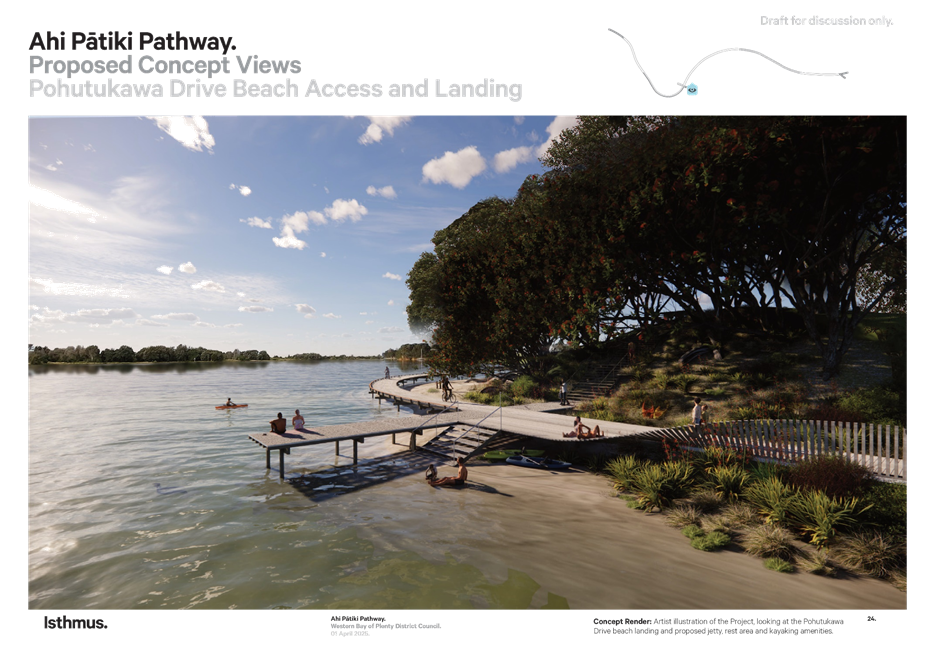
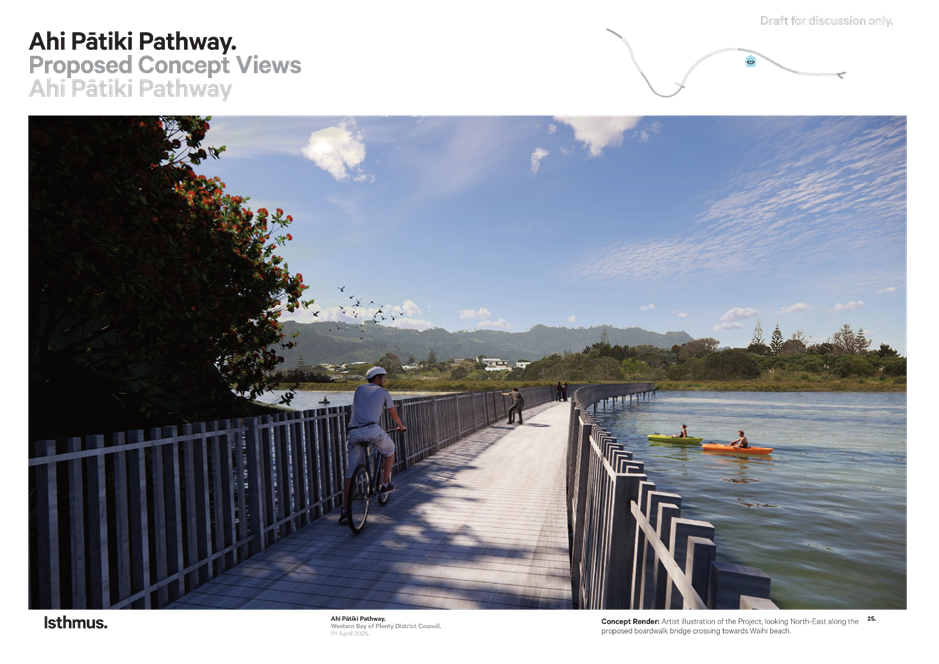
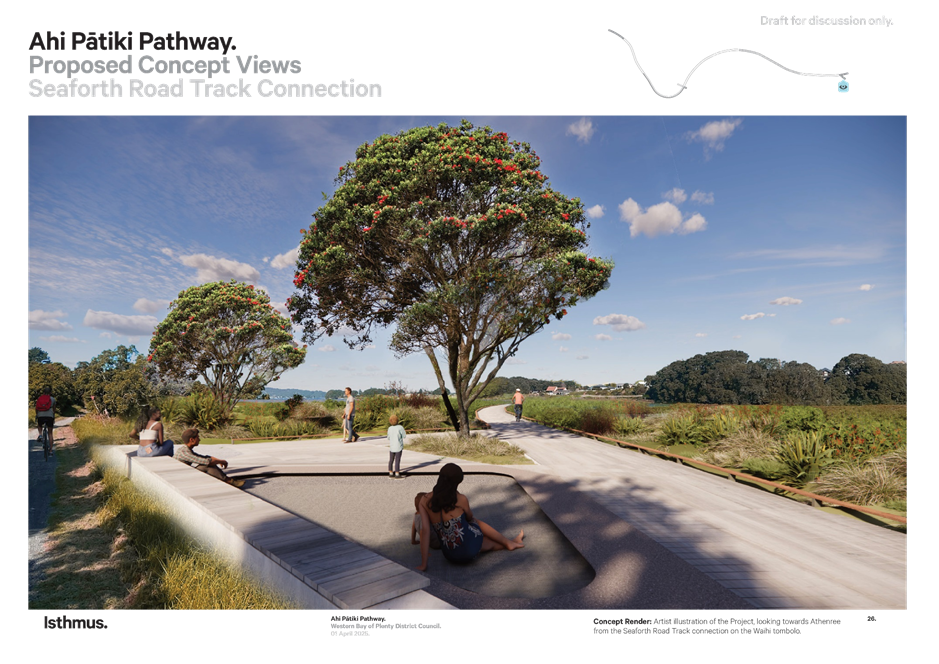
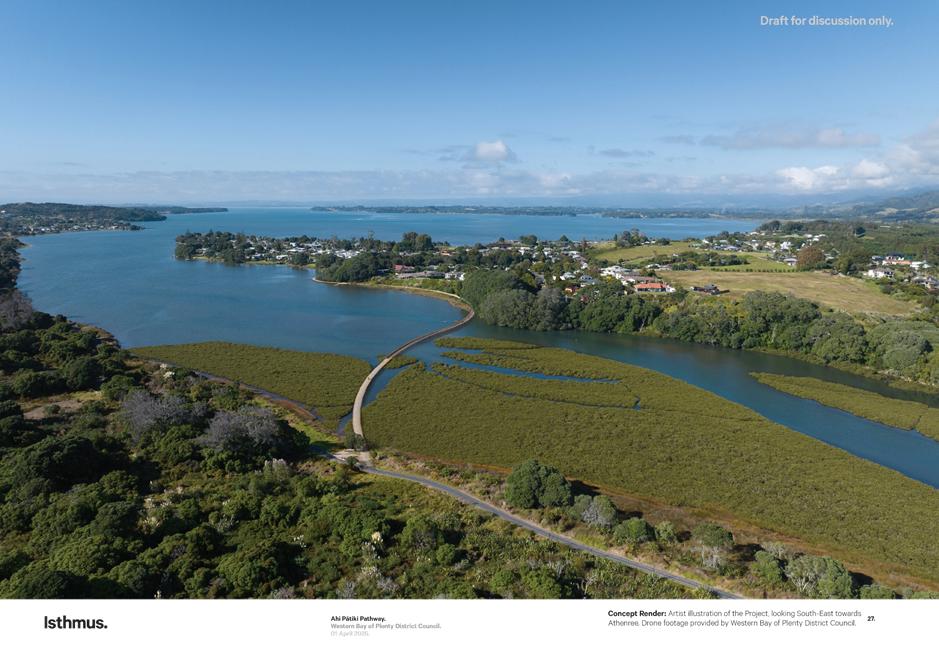
Pātiki Pathway Concept Design - Final for April Public Consultation ⇩
2. Ahi
Pātiki extract of online survey responses ⇩ 
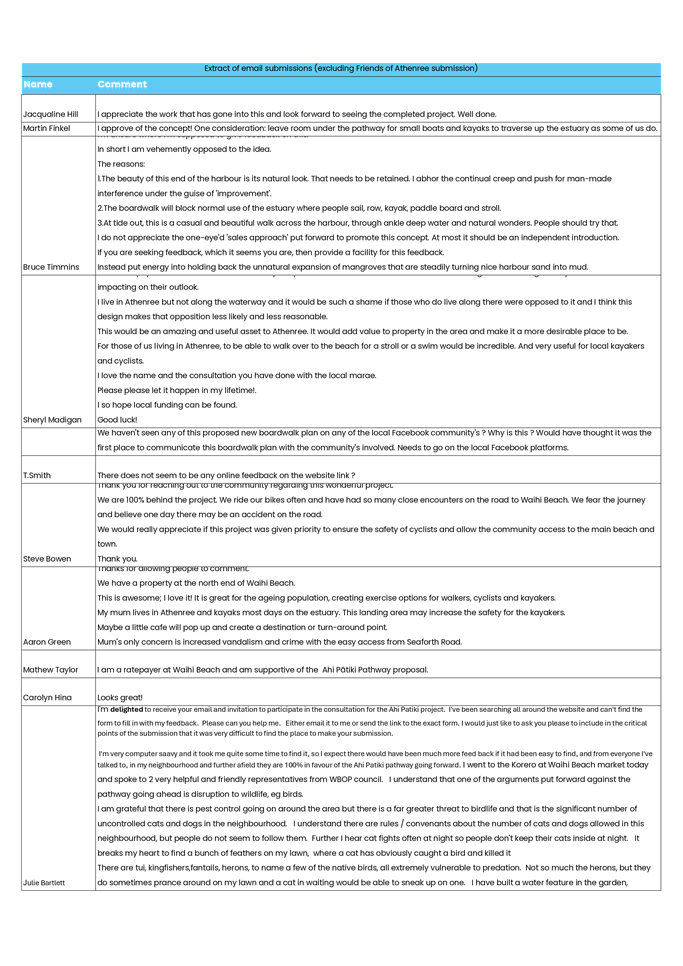
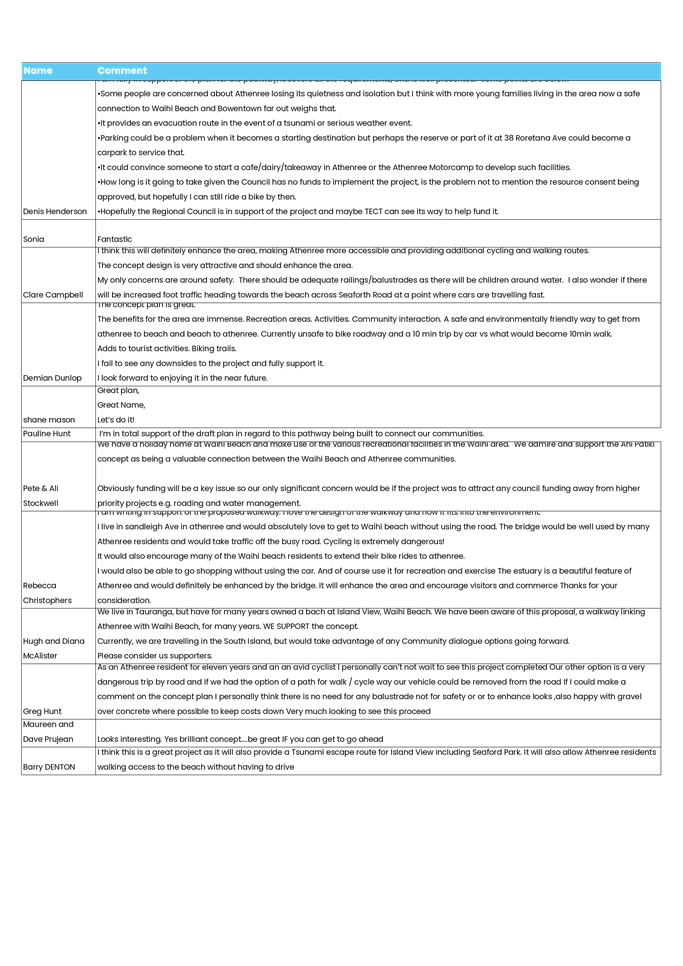
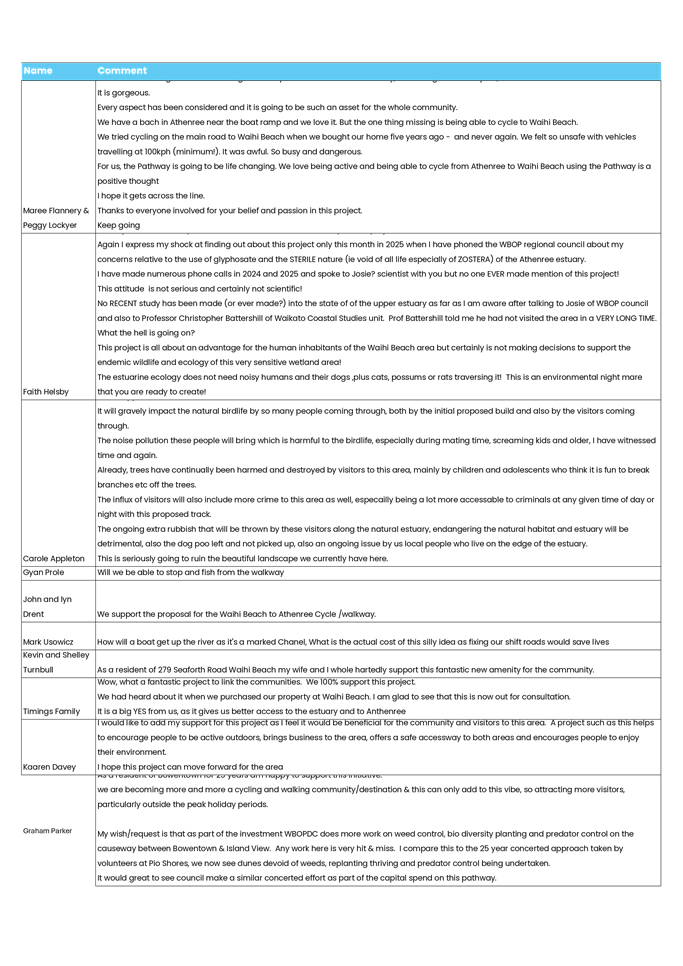
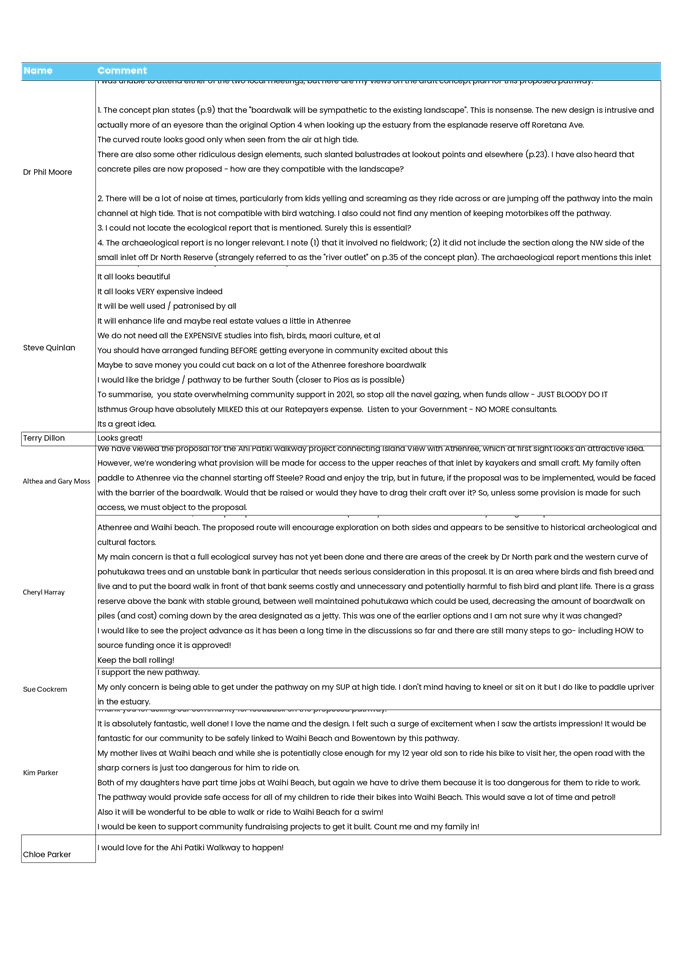
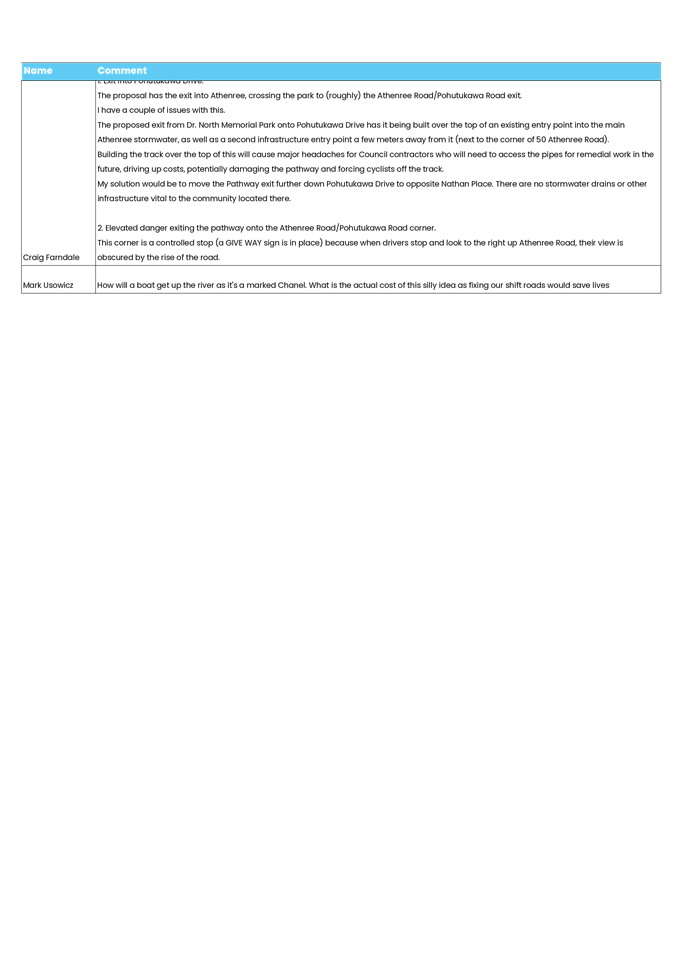
3. Ahi
Pātiki extract of email submissions excluding Friends Of Athenree sub ⇩
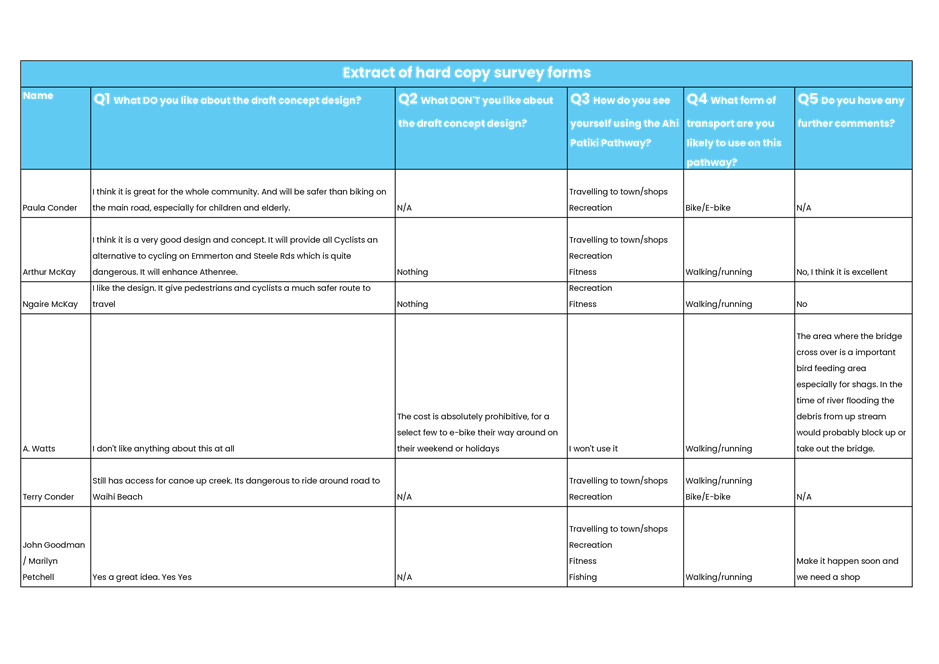
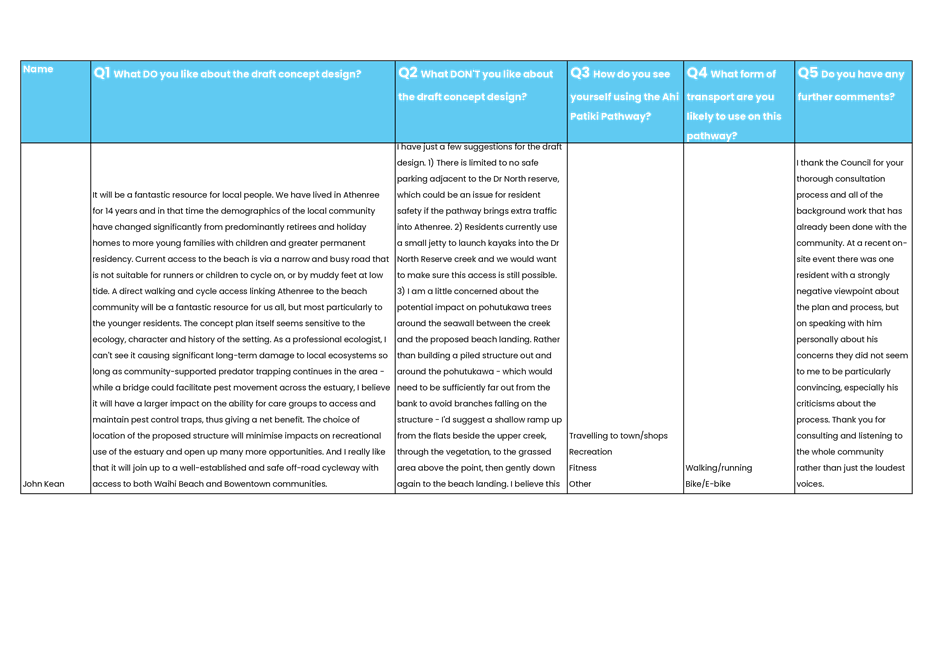
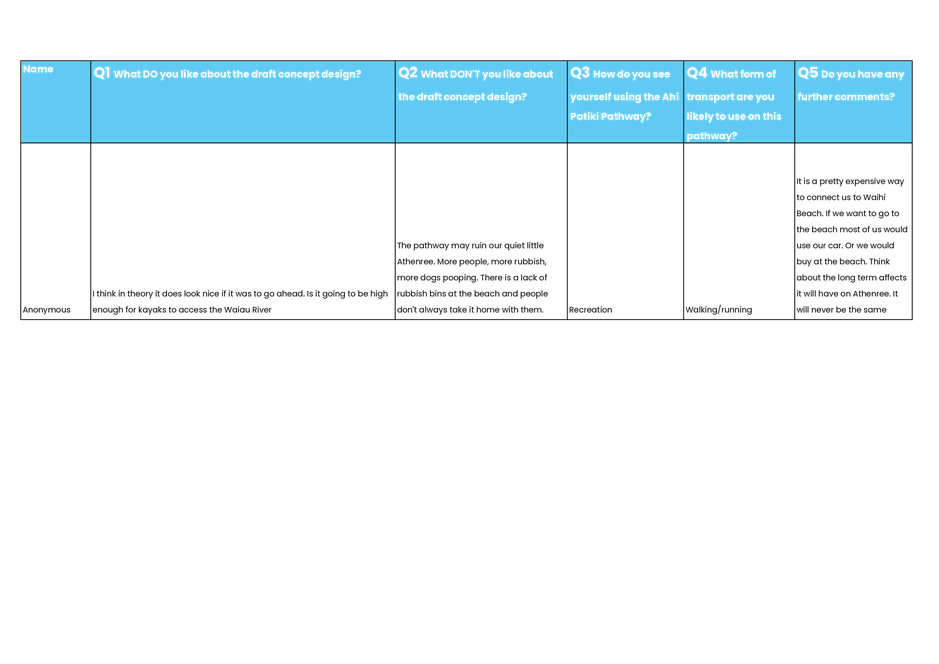
4. Ahi
Pātiki extract of hard copy survey forms ⇩
5. Ahi
Pātiki Feedback - Friends of Athenree submission ⇩
|
10 June 2025 |
10.3 Operational Risk and Status Report
File Number: A6724412
Author: Tracy Gaby, Executive Assistant Infrastructure Group
Authoriser: Peter Watson, Reserves and Facilities Manager
Executive Summary
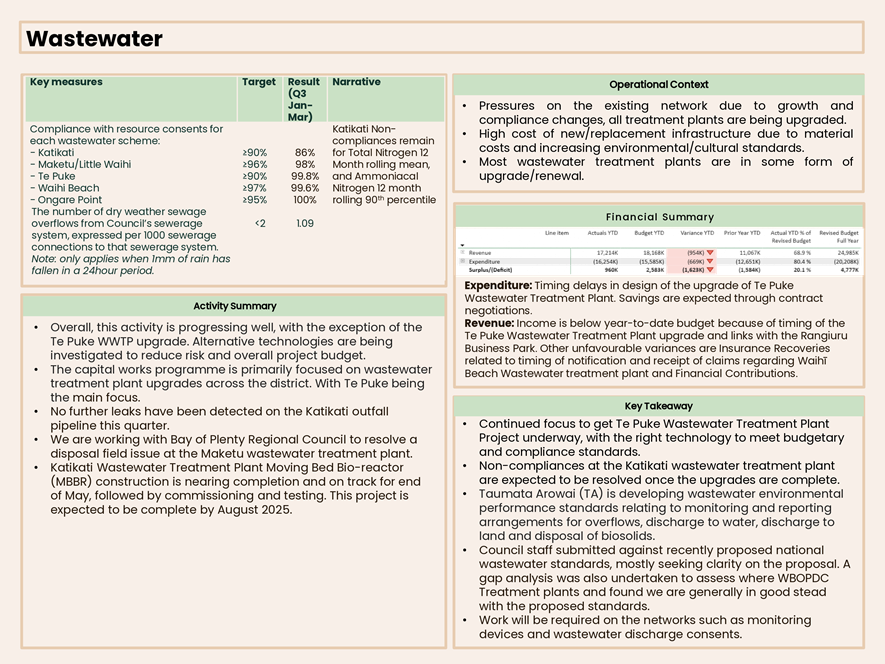
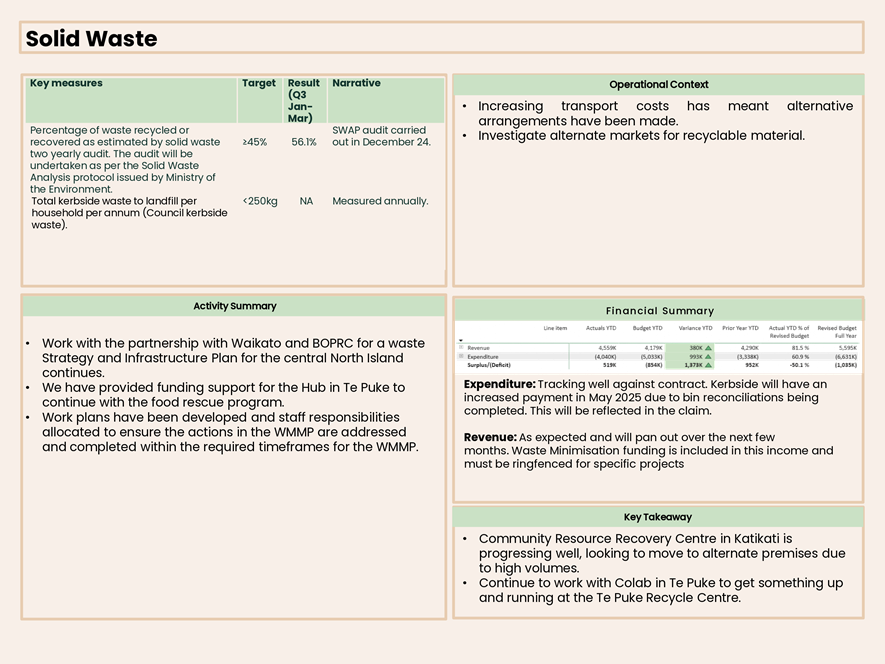
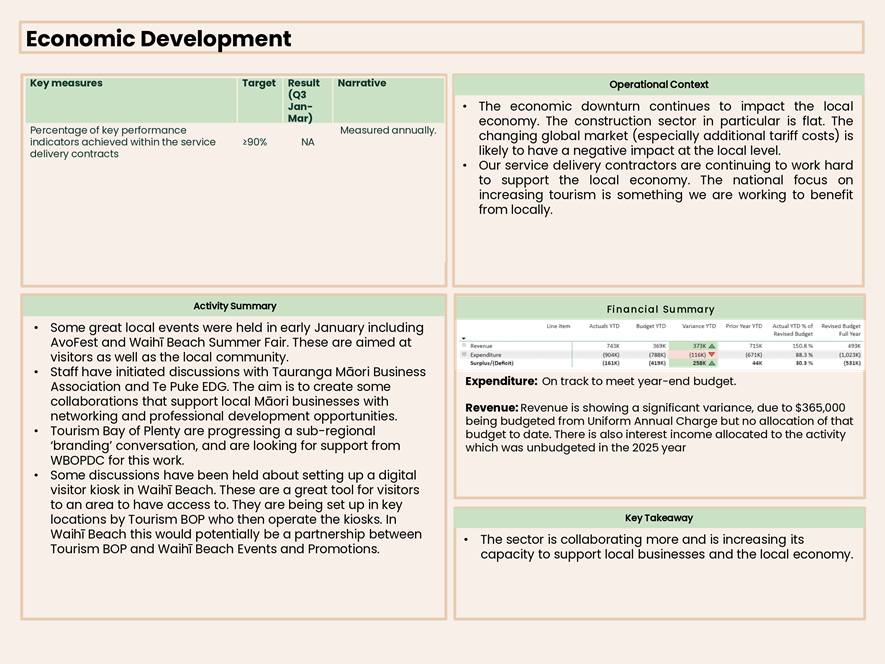
1. The purpose of this report is to present the Scorecard report for Quarter 3 ending 31 March 2025, and to advise the Projects and Monitoring Committee on Infrastructure and Regulatory matters.
|
That the Executive Assistant Infrastructure Group’s report, dated 10 June 2025 titled ‘Operational Risk and Status Report’ be received. |
Background
Background
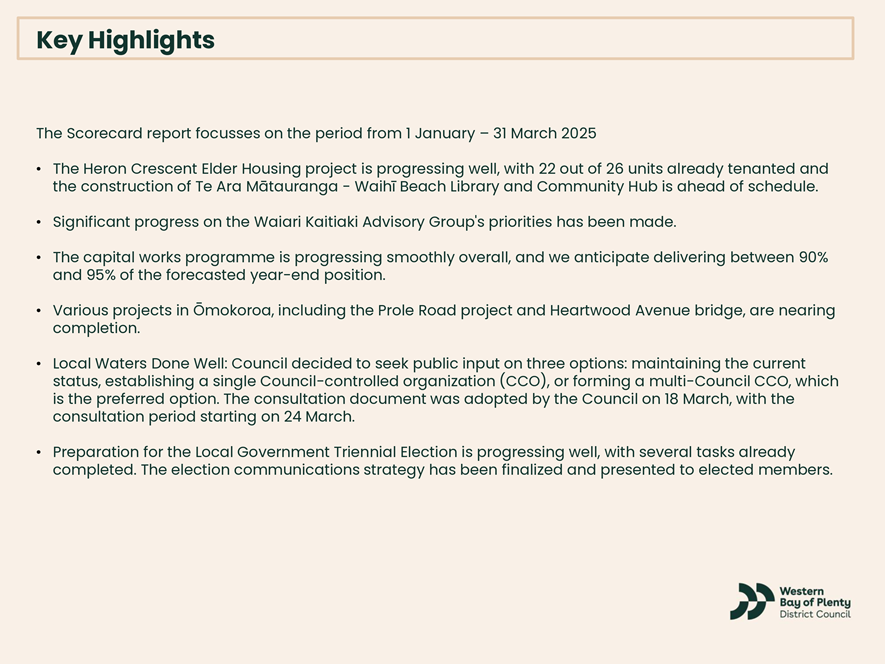
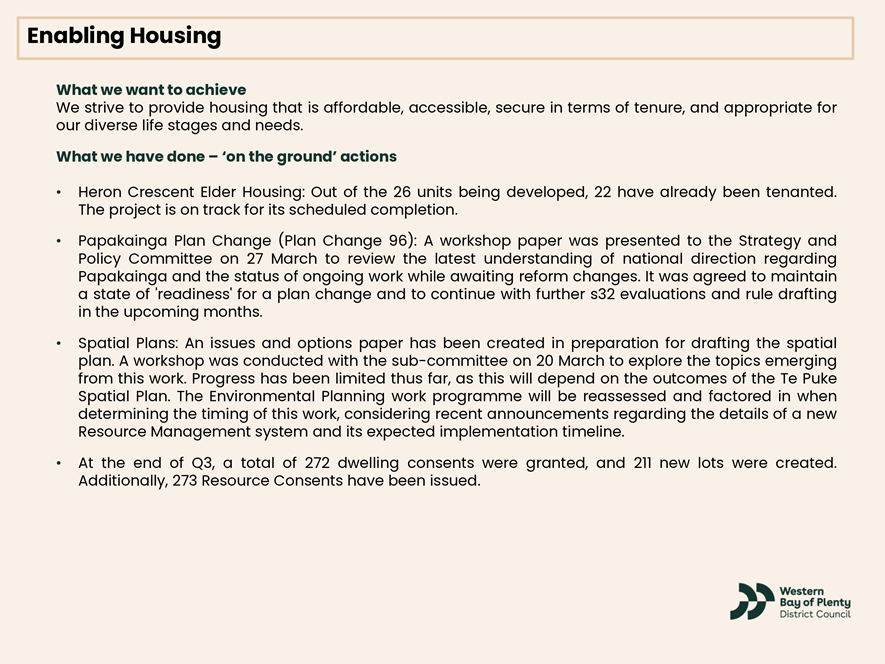
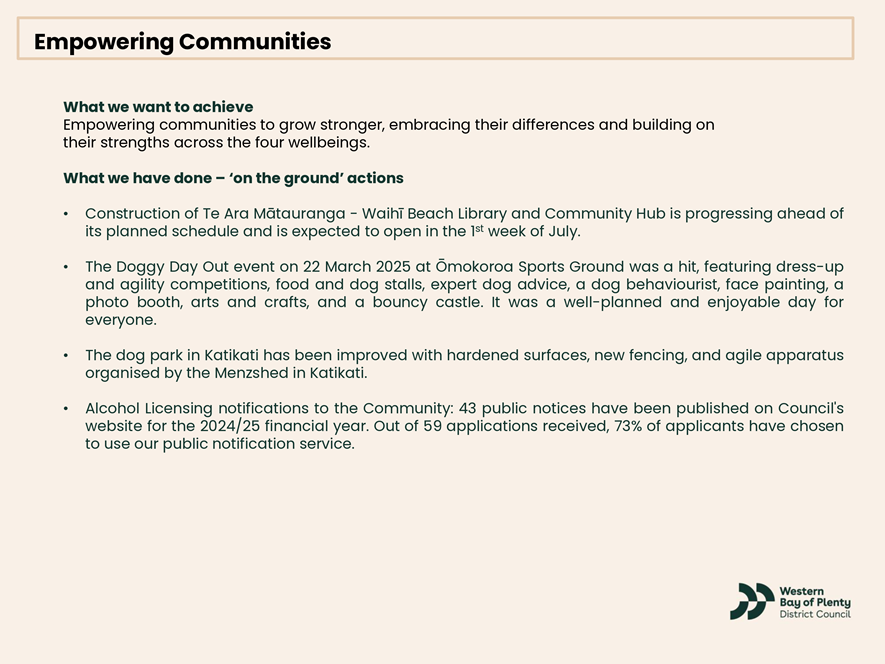
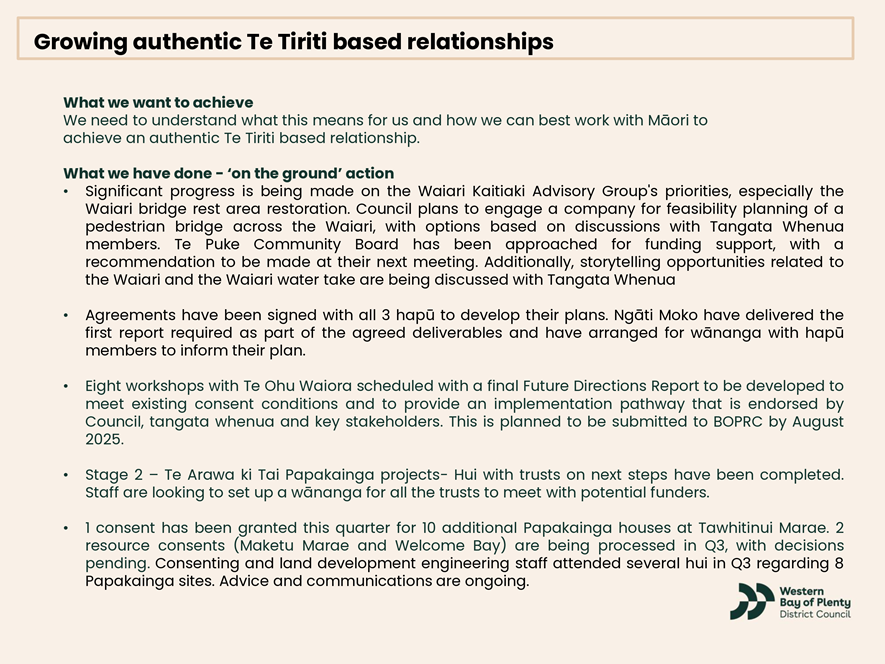
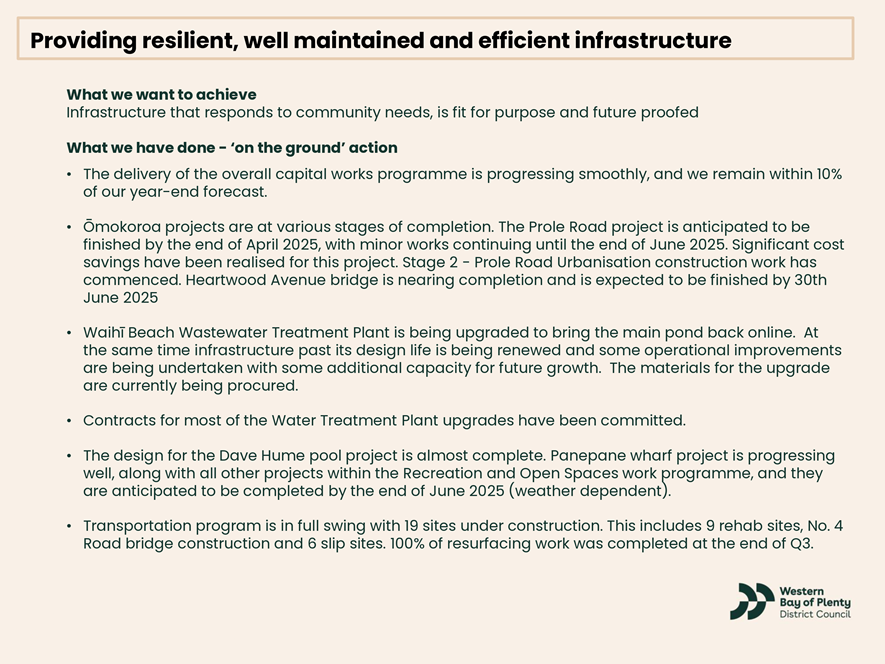
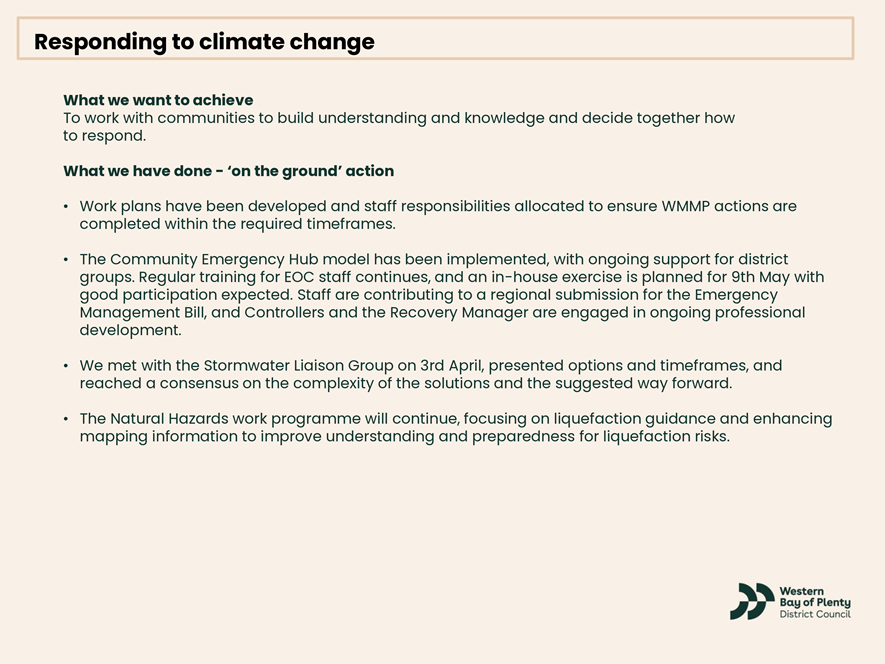
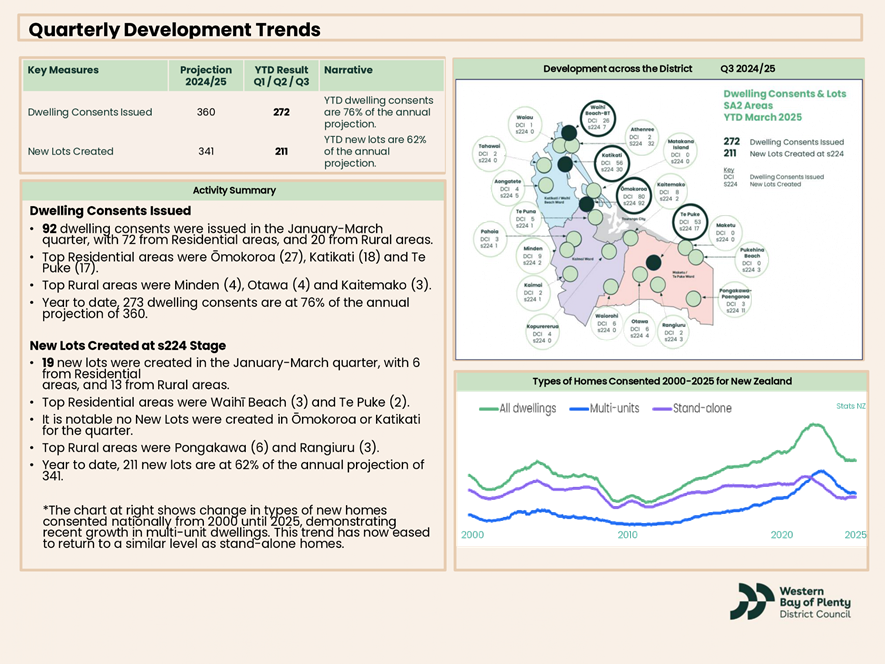
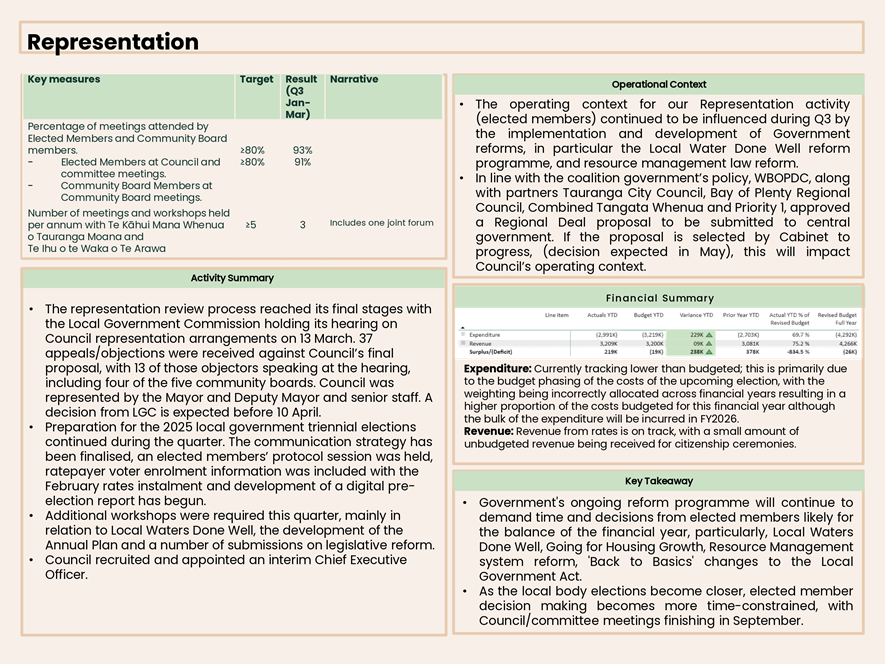
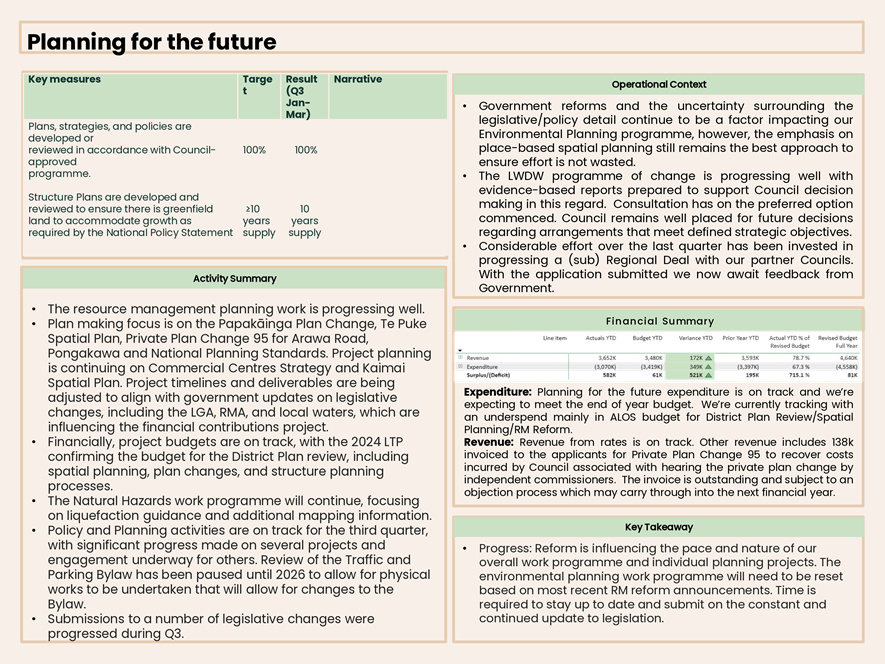
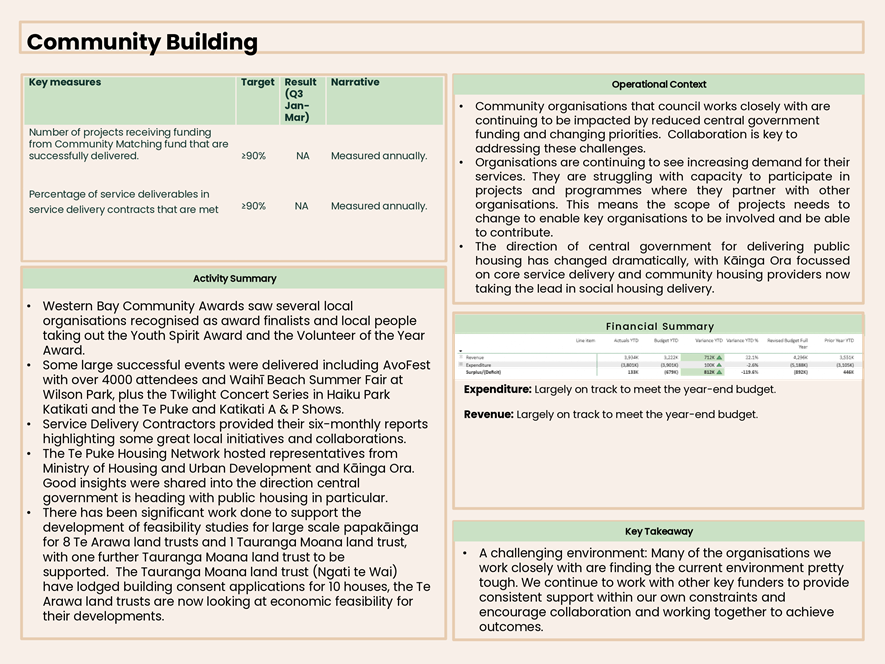
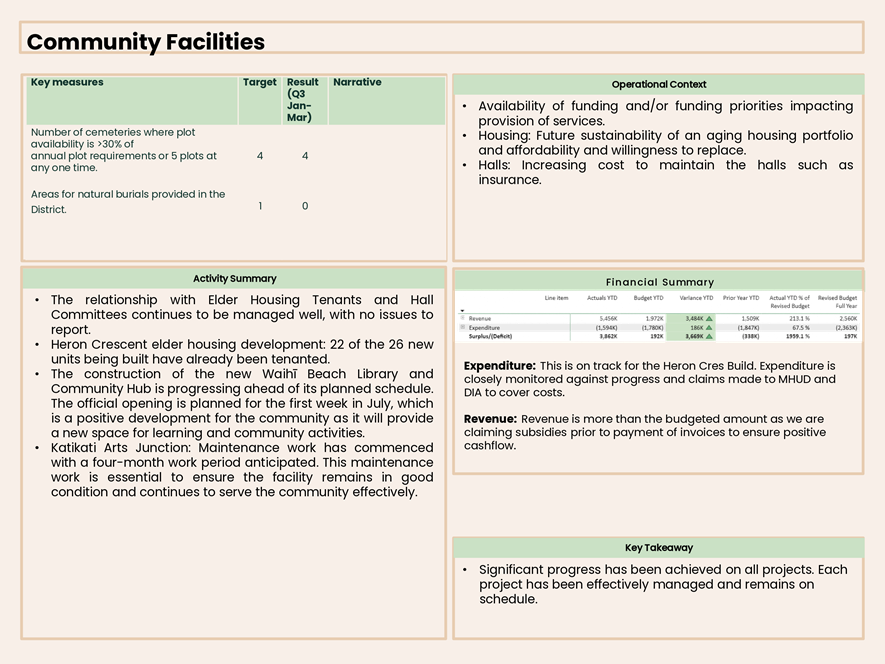
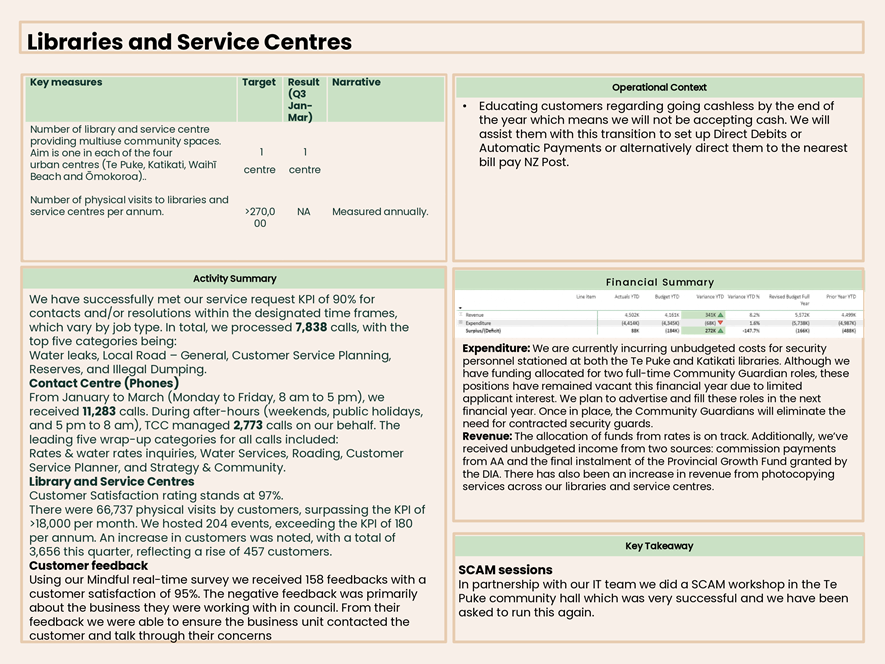
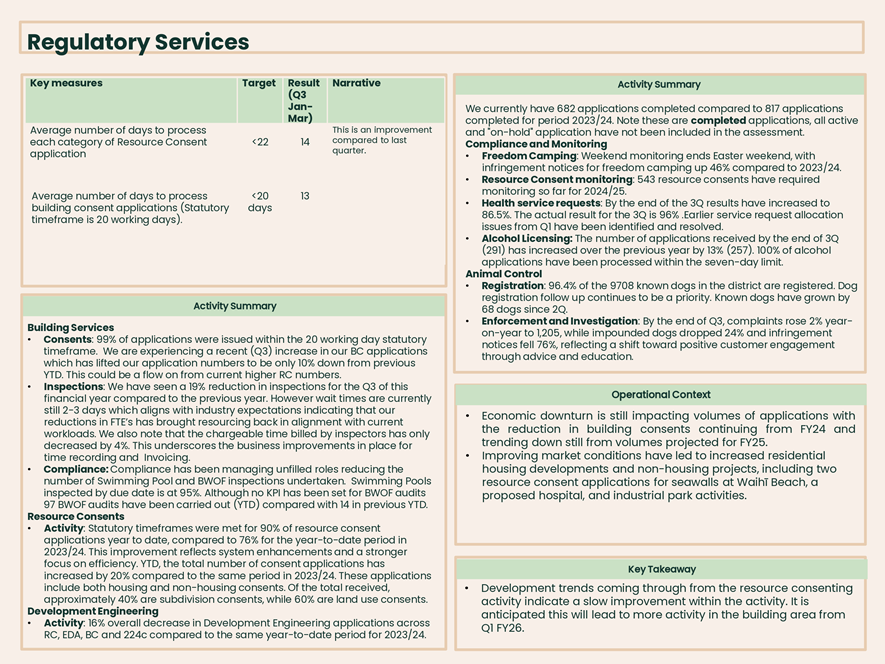
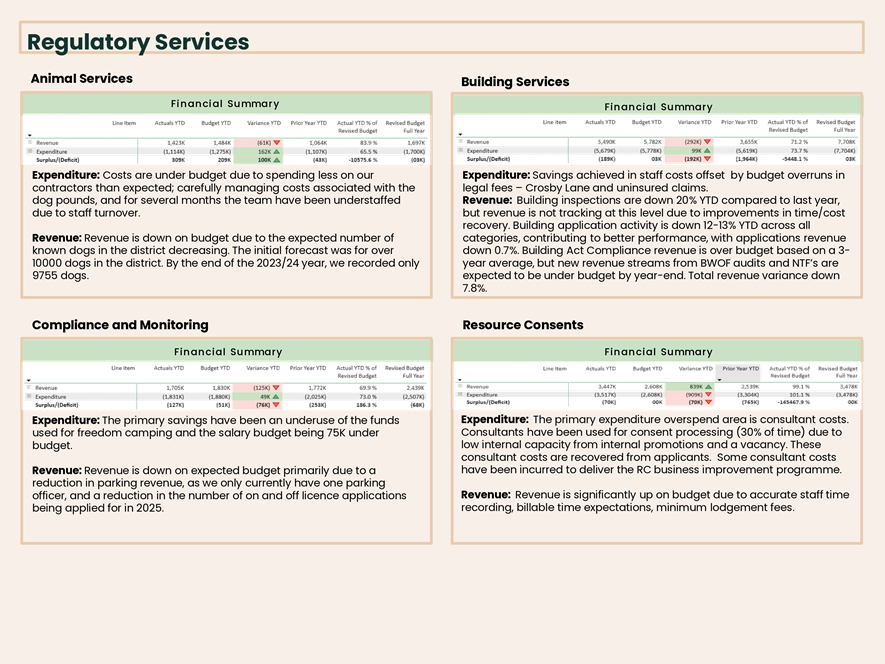
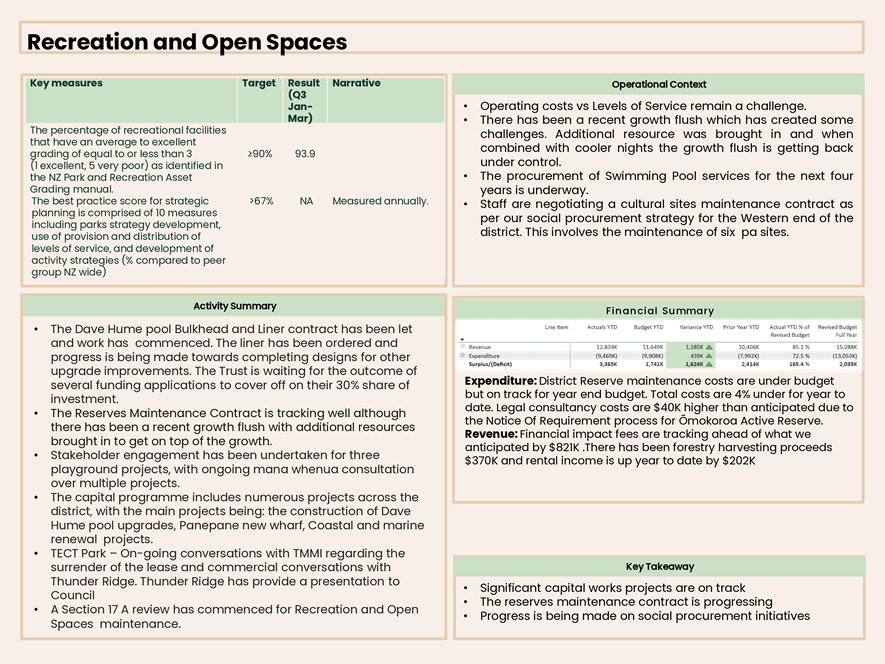
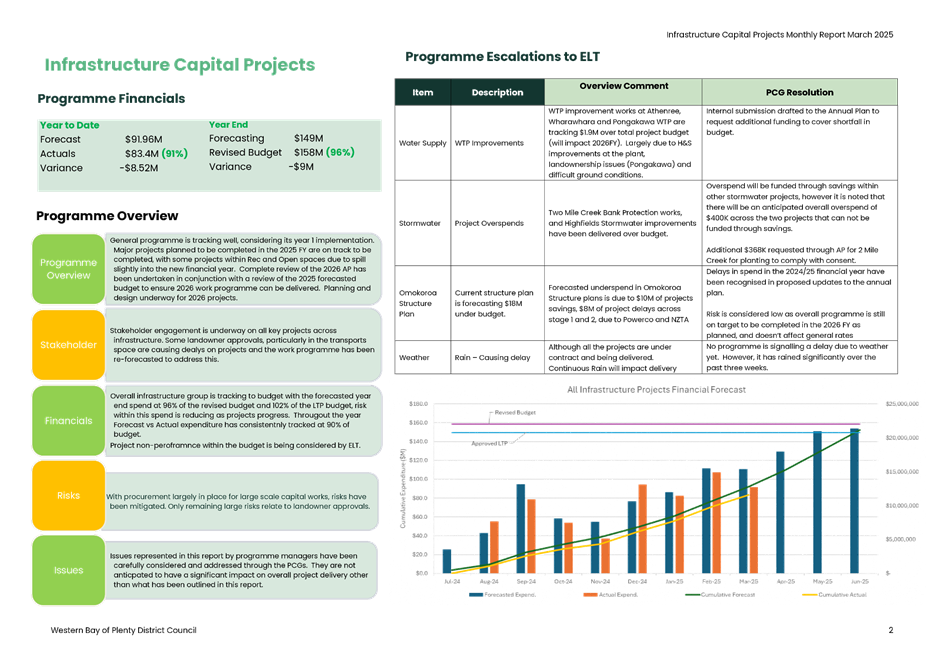
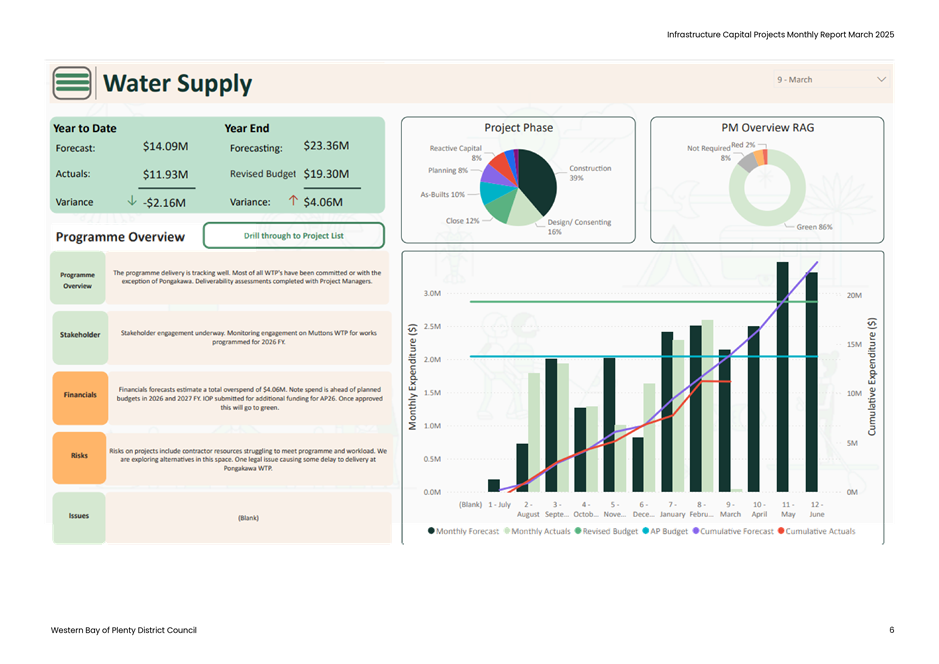
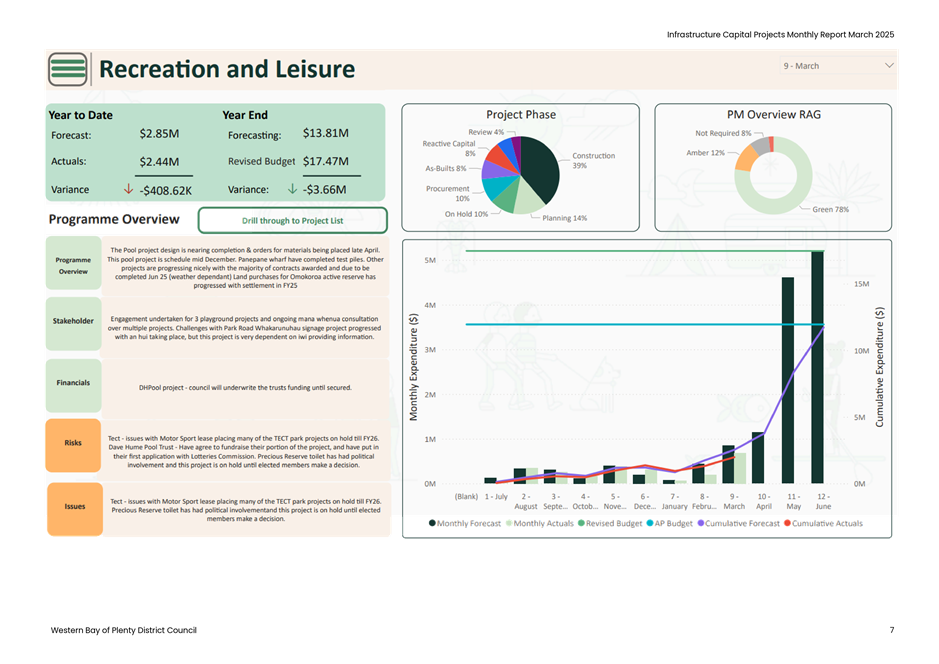
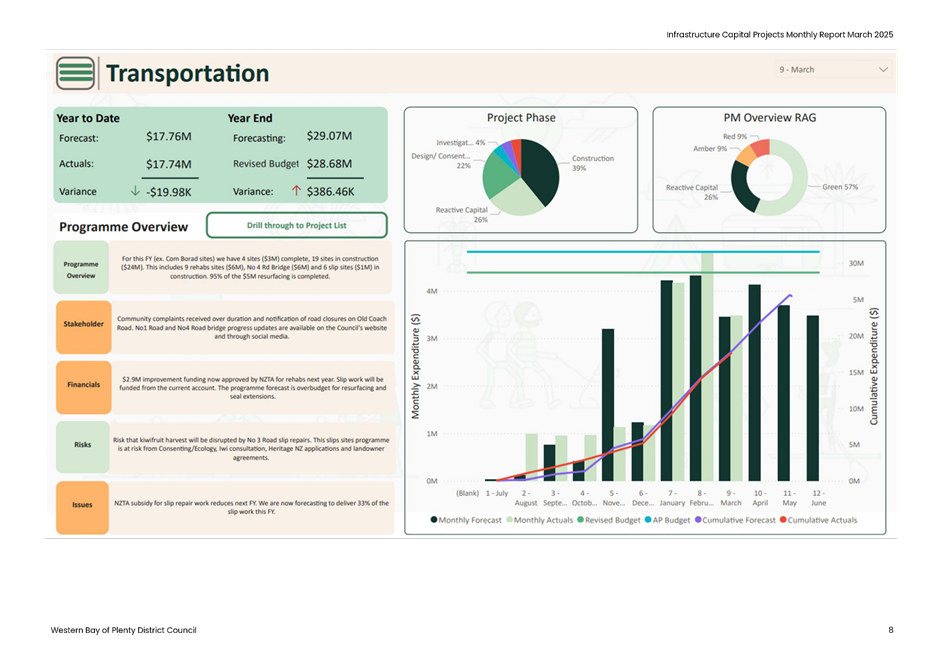
The Scorecard Report provides an overview of key achievements, update on Strategic Priorities, Capital Works Programme and Quarterly Development Trends for the period from 1 January to 31 March 2025.
OPERATIONAL RISK AND STATUS TABLE
The operational risk table has been developed to show:
· Project or activity;
· Brief description of the risk and why it has arisen;
· Type of risk (e.g., timing, financial, service delivery);
· Project or topic status update;
· Items that the Committee needs to be aware of; and
· Traffic light system:
Green: Operational item, for information;
Orange: Potential to escalate, Council needs to be aware; and
Red: High risk, Council direction may be required.
This is an up-to-date status and forward-looking report and may supersede the comments in the Scorecard Report. Additional information and topics may be provided at the meeting.
|
Projects and Monitoring Meeting Agenda |
10 June 2025 |
|
Risk Type and Risk Level |
|
|
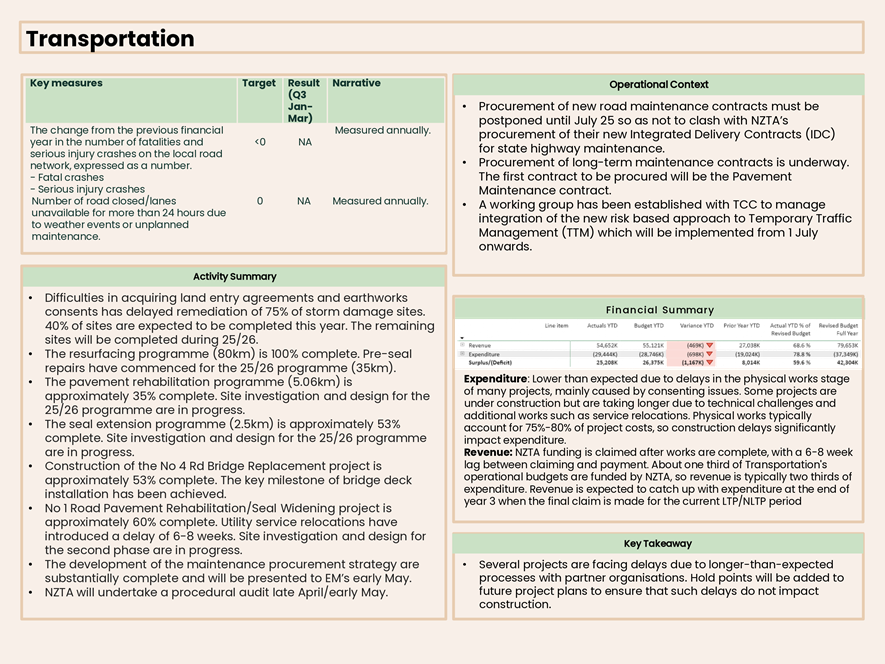
Transportation Maintenance Activity Development of eight ‘Request for Tender’ (RFT) documents for new long-term maintenance contracts is well advanced. The first RFT (Pavement Marking) will be advertised early June. Construction of this year’s resurfacing programme is 100% complete (80km). Investigation, design, and consenting of storm damage remedial works continues. One site is currently under construction. NZTA have confirmed that FAR 51% + 30% is extended until 30 June 2026. Three pavement rehabilitation packages totalling 5.06km have been awarded and construction is underway at three rehab sites. Two rehab sites are complete. Construction of a seal extension project at Rotoehu Road is well advanced. Investigation and design of next year’s (25/26) capital works programme is underway. |
Funding vs LOS |
|
No. 1 Road Pavement Rehabilitation and Seal Widening (RP300 – 1930) RP580 – 1960 (Stage 3) Construction is well advanced and is currently focussed on the stormwater upgrades at discharge C (at #73 No 1 Road). Relocation of Chorus telecom cables is almost complete; pavement works will recommence mid-June. Minimal disruption to kiwifruit harvest traffic which is expected to subside mid-June. RP0 – 580 (Stage 2) Investigation and design are underway. Construction will be undertaken early during 2025/26. Procurement may be negotiated with current contractor to minimise delays. A speed Indicator Device (SiD) and other traffic
controls have been installed to encourage drivers to abide by the 50kph speed
limit. |
Weather |
|
No. 4 Road Bridge Reinstatement Construction is well advanced. The bridge abutments are complete, and the bridge beam and deck sections have been installed. The bridge is expected to open to traffic mid-July if guardrail materials ordered from UK are delivered as anticipated. The riverbed scour was deeper than anticipated. After discussions with BoPRC the decision was made to undertake remedial works under emergency provisions. |
Weather Material Supply |
|
SH2 Ōmokoroa Road Interim Intersection Upgrade Works Works completed to a level whereby we have a functional temporary roundabout, to allow traffic to be shifted. The temporary roundabout has been in place from 7 March, with a focus currently on the southern side of SH2. An alternative pavement design, using structural asphalt is utilised which accelerates construction (and enables savings on both cost and time) and minimises disruption to the public. The services work will begin on Ōmokoroa Road near the Industrial Road roundabout, and the crews will work their way forward towards Prole Road. Land Purchase The two land parcels required for the temporary roundabout construction have been acquired, with one more land requirement (400m2) required for construction of the roundabout at Francis Road. The agreement has been drafted and compensation agreed, additional costs regarding shifting of shelterbelts/ driveway being negotiated. No impact on construction programme currently. Stormwater Discharge The temporary stormwater pond for the Industrial Road has been completed, which handles stormwater for the project works from Prole Road to the Industrial Road. With this pond being completed, Council can complete the earthworks on Industrial and Ōmokoroa Roads. Overhead Power Supply Shifting of the overhead power lines on the SH was completed last year, allowing works to progress at the roundabout. Similar requirements on Ōmokoroa Road have been scheduled for August 2025. The Powerco betterment (whereby 33kv cables are included in
construction to futureproof power provision to Ōmokoroa), is tied into
the project. Fibre Optics The fibre optic works are progressing. There is a significant amount of work that needs to occur outside of the site along SH2 which HEB have been assisting with by providing traffic management to expedite the works. Project completion is estimated to be March 2026. |
Services, especially Network Utility (PowerCo), and their ability to resource and keep to programme. Weather
|
|
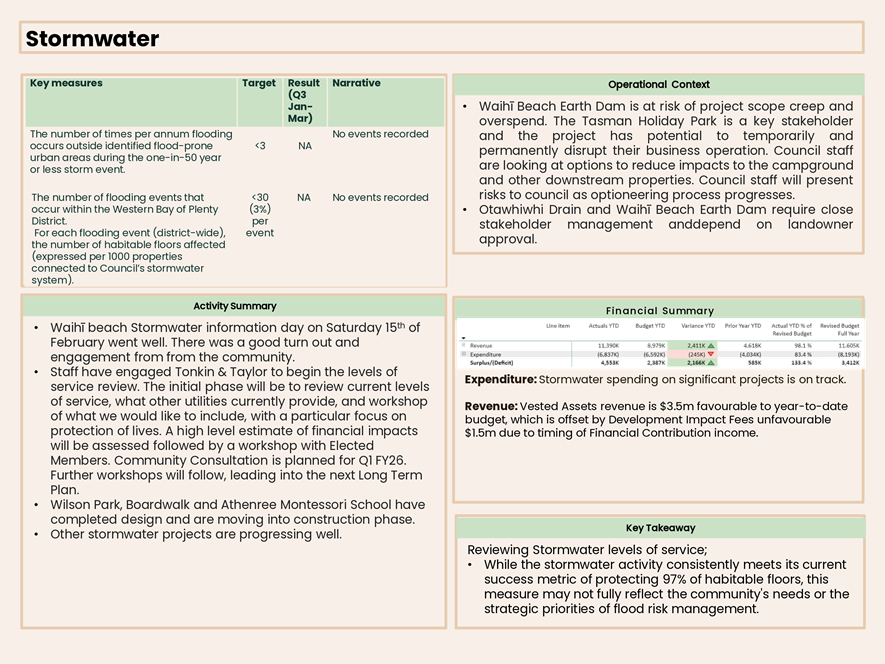
Waihī Beach Stormwater Significant progress has been made on the maintenance programme and most activities has been completed. Staff have progressed a number of sites to developed design. Significant projects underway with feasibility assessments – most notably the Waihī Beach dam removal and One Mile Creek improvements. Smaller projects have been packaged up and are expected out to market mid-June. Waihī Beach Wastewater Treatment Plant Staff continue to work through the detail for the repair and upgrade of the Waihī Beach Wastewater Treatment Plant. Steady progress has been made on the design, which includes re-establishment of a single cell HDPE lined SAS lagoon with improved aeration and refurbished decant facility. Detailed design is now complete and the focus has moved on to procurement of the physical works. |
Further Site Deterioration Weather |
|
Katikati Wastewater Treatment Plant (WWTP) Outfall Pipeline Katikati Wastewater Advisory Group – Te Waiora to discuss the issues and available options. Land discharge options are currently being investigated for potential future discharge, however, following consultation with WWAG, Water Services will be in a better position to make recommendations on the most appropriate solution. The WWTP is struggling to meet compliance for nitrogen removal and needs to be upgraded. The upgrade works have been tendered as a design and build contract and awarded to APEX Water. Construction is progressing well with an estimated completion of the works in August 2025. Te Ohu Waiora has been established to develop a future directions report. Through this group, disposal solutions will be developed and recommended to Council. This will provide direction and inform a consenting process. |
Financial timing Regulation Enforcement Reputation |
|
Te Puke Wastewater Treatment Plant (WWTP) This project remains a concern and high risk. A specific PPG has been established to support this project with independent specialists relating to probity and technical. The contract with Councils design consultant has been terminated. Council has procured the services through an Early Contractor Involvement (ECI) process to assist the design and build. Alternative technology has been investigated through ECI contractor that appears to be a viable technical solution with significant cost savings. Council is currently seeking legal advice on converting the ECI contract to a Design and Build contract. A separate report will be presented to Council to discuss this further and seek approval to start physical works. Consent – The earthworks consent has been obtained. This allows earthworks to start once the design is complete. The discharge consent condition deadlines will not be met, and a consent variation has been approved to extend the timeframes for meeting the discharge conditions. Consultation – Targeted consultation will be required for the final design. Iwi –Significant progress has been made with the relationship with iwi and how we can work together to enable a positive outcome for all involved. |
Compliance Reputation Finance Legal |
|
Rangiuru Business Park Quayside Properties Ltd continue to progress development of the Rangiuru Business Park. Quayside delivered contracts on behalf of Council which are well established and nearing completion. Staff continue in discussions with Quayside Properties Ltd regarding the Rangiuru Financial Contributions methodology and other requirements outlined in the district plan/plan change. The methodology for the financial contributions requires approval before 224 can be issued. |
On track |
|
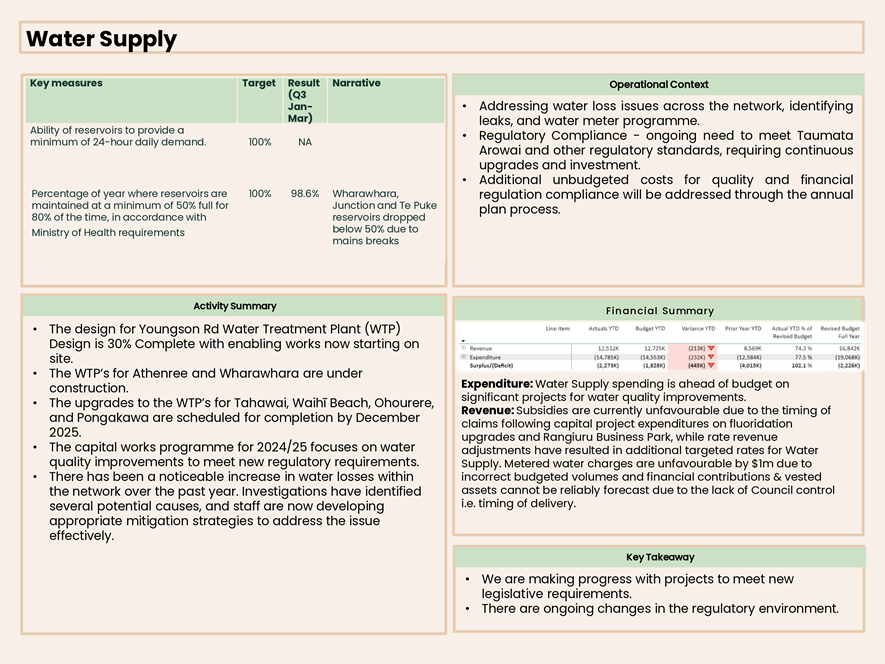
Drinking Water Compliance The implementation of new legislation regarding drinking water has required Council to improve various components of the drinking water system, including its treatment. It should be noted that none of Councils supplies are compliant with the protozoa requirement. This will be resolved once UV installations are complete. The UV installations are budgeted for in future years and staff are fast tracking the implementation with the completion of the work around January 2026. Fluoride update Athenree and Wharawhara WTP upgrade works (which
includes fluoridation) design and build contract has been awarded to Apex
Water. Completion of works is expected around June 2026 for Athenree WTP and
July 2026 for Wharawhara WTP. The Ministry of Health have approved a new
compliance date of 31 January 2026 for the Wharawhara and Athenree plants. |
Regulation enforcement Project Timing |
|
Heron Crescent Final building consent inspections have passed, and practical completion has moved forward one week, to 12 June 2025. 22 of the 26 units are allocated and tenants will begin moving in from 17 June, following the blessing on 16 June 2025. |
On track |
|
Te Ara Mātauranga - Waihī Beach Library Practical completion is 12 June 2025. The new library fit-out will begin 19 June and the old library will be removed from the Community Centre by 16 June 2025. |
On track |
|
Resource Consents of Interest · Te Puna Industrial Ltd- Notified Land use application (joint BOPRC and WBOPDC). Joint hearing commenced 9 July 2024 and was adjourned on 11 July 2024 to allow further information and clarification on the proposal to be provided by the Applicant and the Councils (WBOPDC and BOPERC). All information has been provided by the Applicant and the Councils (WBOPDC and BOPRC). Timing for recommencement of the hearing unknown at this stage. · Glen Isla Protection Society Inc - a resource consent application for a 200m-long revetment wall (within the Three Mile Creek reserve and adjacent 9, 11, 13, 15, 16, 14 and 12 Glen Isla Place & above mean high water springs) for coastal erosion protection purposes has been received. All requested further information has been provided and the application has been publicly notified. A hearing has been scheduled for August 2025. · A second Waihi Beach seawall application (approximately 200m-long wall located between 17 - 41 Shaw Road) has been lodged by the Waihi Beach Protection Society Inc. This proposal requires District and Regional Council consents given the location of the seawall below mean high water springs. A further information request has been made however this has both been fully responded to by the Applicant. · Bluehaven (Bell Road) – An application is to be made under the
Fastrack Approvals Act 2024 at the end of 2025. Land area of 335ha across two
blocks targeting over 2000 homes, 80ha of employment land, using the
fast-track approval process. The completed development may be 10 years away
but looking at 2025-2026 to get through fast-track approvals. Key staff from
BOPRC and WBOPDC are forming a working group to work with the developer and
his team. The Councils and the Applicant have shared their respective
lists of experts who are being engaged to assess effects to inform the
process which will be administered by the Environmental Protection Act and
decided by an expert panel. Omokoroa Developments · 60 Prole Road (Blackridge/ Sabre) for 11 dwellings/lots (Stage 1). Comprehensive Consent (Land Use and Subdivision and urban design/typologies) has been considered and approved. · 149 Prole Road (Trinity Lands/ Lighthouse Group) for 71+ dwellings/lots. Comprehensive Consent (Land Use and Subdivision and urban design/typologies) is currently with Council and processing. · 62 Prole Road (Neil Group) for 84 lots (2 Stages). Subdivision Consent (lots only, no typologies presented) has also been received and currently processing. · Omokoroa Town Centre (JACE Investments) have resource consent but are currently seeking a variation to the layout. The application is currently on-hold for further information. Te Puke Developments · Vercoe/Zest Development (Macloughlin Road) has resource consent approval for a 380 lot subdivision. The consent holders have submitted a variation to Stage 1 of this approved consent which is currently processing. |
Public interest |
|
Regulatory Consenting – market and external impacts Meeting budget for the regulatory activity will continue to be a challenge for the 24/25 year as external factors continue to impact business. The building sector (in particular) is still being impacted by the current economic climate and this is represented in reduced volumes of applications against those projected for the building activity for the 24/25 year. Unbudgeted legal costs and building claims (historic claims through Leaky homes process, and related claims) continue to impact the regulatory budget delivery against projections. Management of staffing and contractor cost is being closely controlled within the activities, with savings being applied to those activities in line with a downturn. Resource Management and Building Control Act reforms
are both projected in the future, but are not anticipated to impact the
regulatory activity in this financial year. Building Services · There is still an overall 15% decline in applications (a combination of new consents and amendments) for building services. As building services represents the highest revenue generating activity for regulatory this is having an impact on the overall regulatory financial position · There has been a noted increase in illegal building work as people continue to pre-empt government reforms. As compliance is generally rates funded this change is likely to have an impact on budgets. Resource Consents and development Engineering · There is a positive increase in consent application volumes for the resource consent activity (40%) - showing early signs of improvement in the economy and increased development activity. There is a noticeable “lag” in this positive sign being represented as an upturn in the building sector and consenting for new buildings. · These activities are showing positive revenue, and it is anticipated this trend will continue positively as signalled by the development community. |
Financial/Legislated/legal |
Attachments
1. Q3
2025 Scorecard ⇩ 
2. March
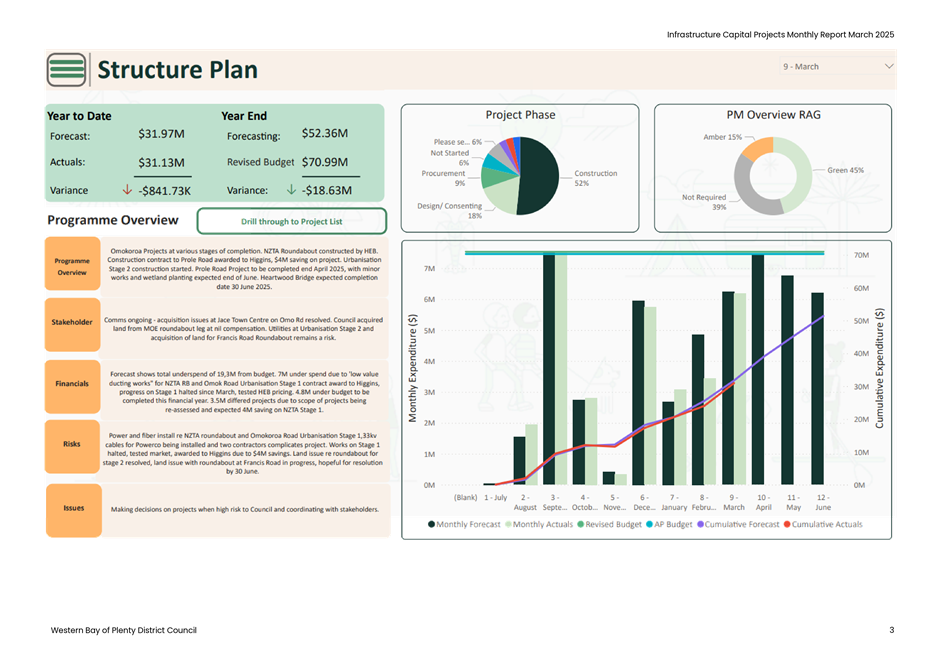
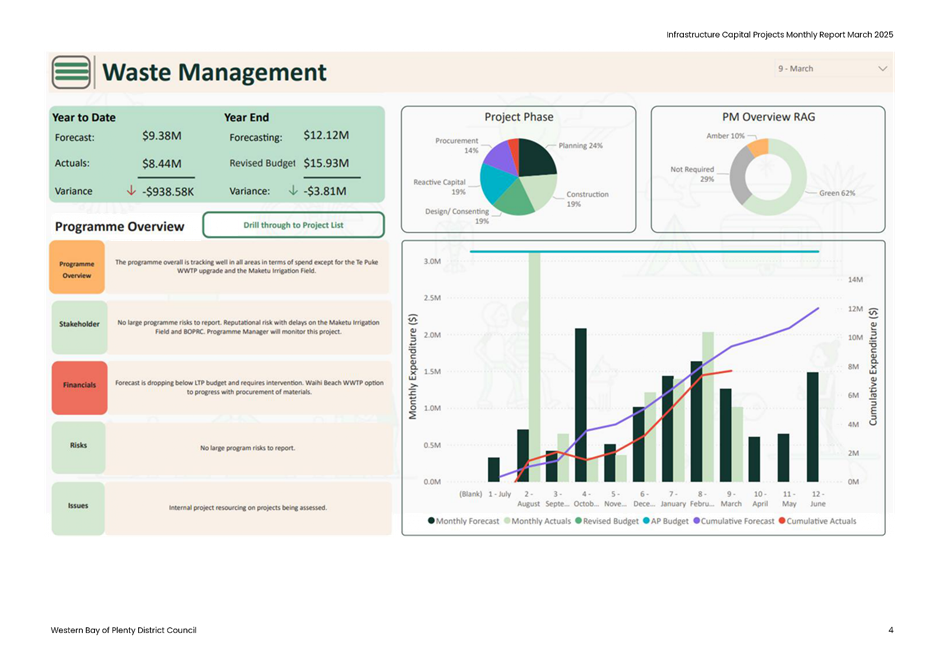
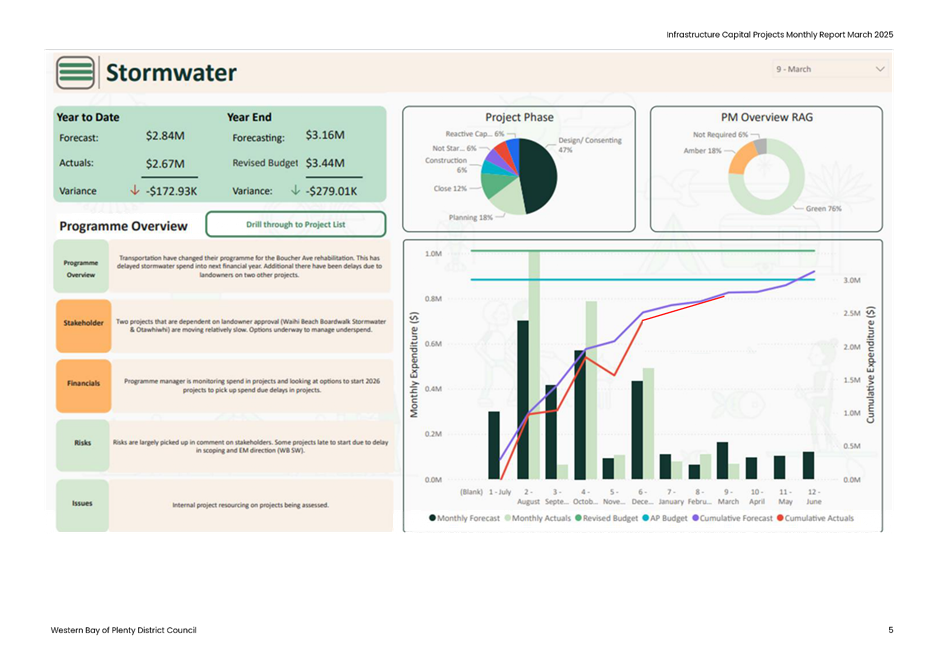
2025 - Infrastructure Capital Projects Monthly Report ⇩ 
|
10 June 2025 |
11 Information for Receipt
11.1 Katikati Wastewater Future Directions
File Number: A6754501
Author: Tanya Coupe, Project Co-ordinator Infrastructure - Asset & Capital
Authoriser: Coral-Lee Ertel, Infrastructure Capital Delivery Manager
Executive Summary
The purpose of this information report is to provide Council with a progress update on the work being undertaken by Te Ohu Waiora to investigate an alternative option for the disposal of treated wastewater from the Katikati wastewater treatment plant.
Background
1. The Katikati outfall is a PVC pipe approximately 12km in length installed circa 1976. The outfall runs from the Katikati wastewater treatment plant, under Tauranga harbour and Matakana Island, discharging treated effluent approximately 600m from the Matakana Island shoreline. The pipeline was expected to last until 2036 however recent failures and testing has indicted the remaining life is much less. Council subsequently decided to include funding in the Long-Term Plan for pipeline renewal or to implement of an alternative disposal method.
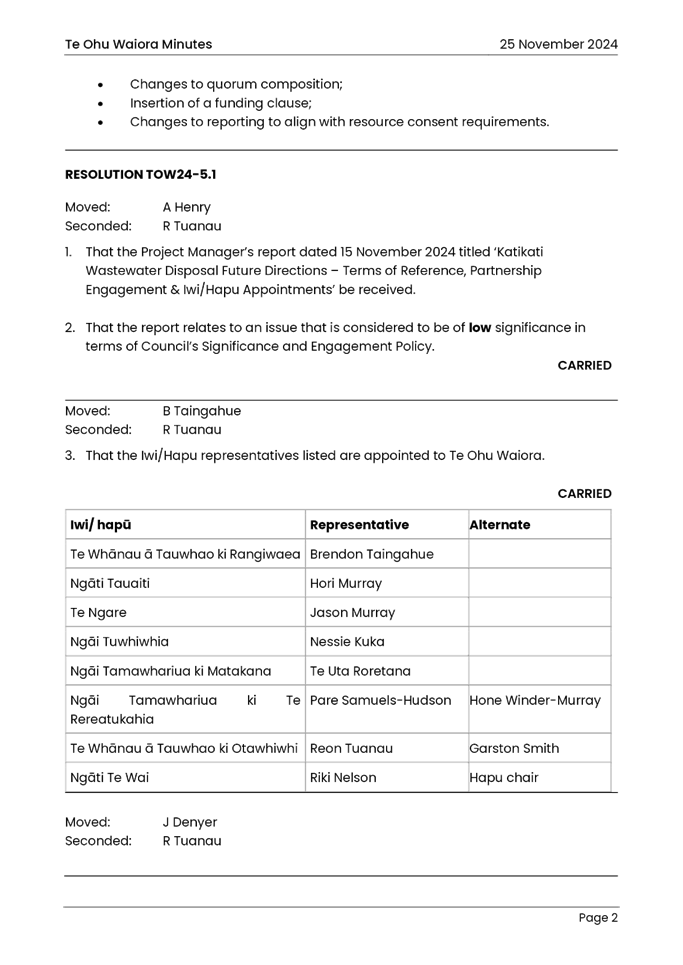
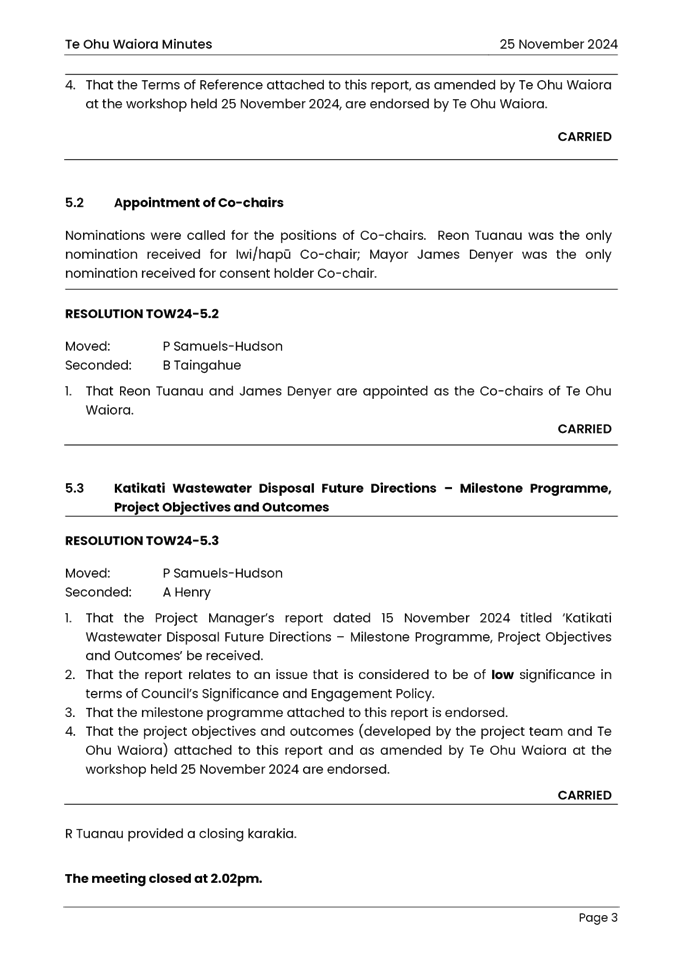
2. Council’s discharge consent for the WWTP requires a Future Directions Report which considers long term viable options for disposal of treated wastewater from the Katikati wastewater treatment plant. An advisory group of Elected Members, Council staff and tangata whenua called Te Ohu Waiora, was formed to investigate and recommend a preferred option.
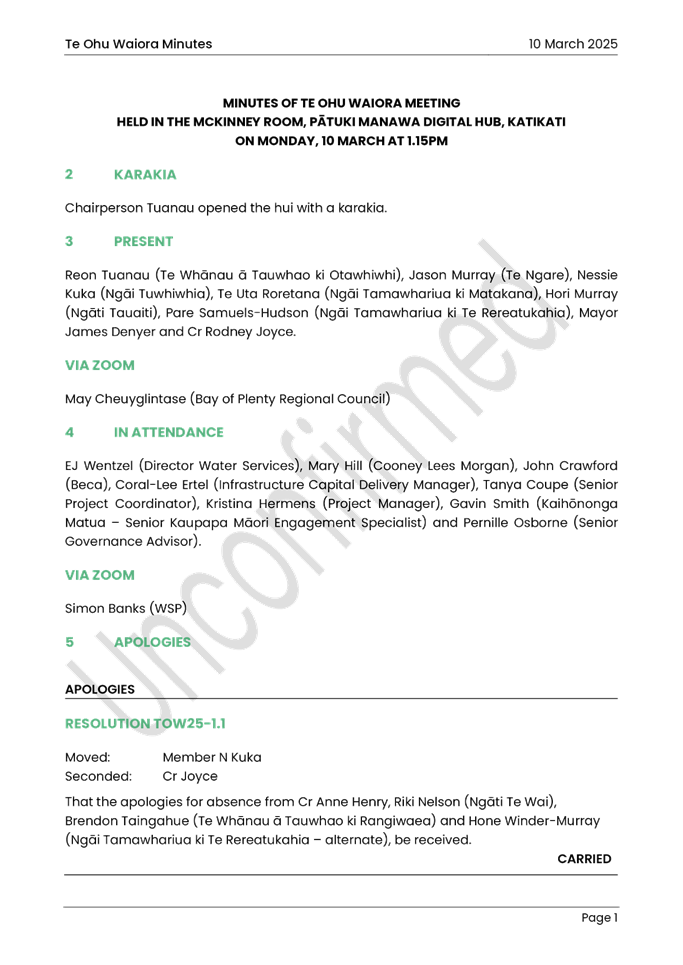
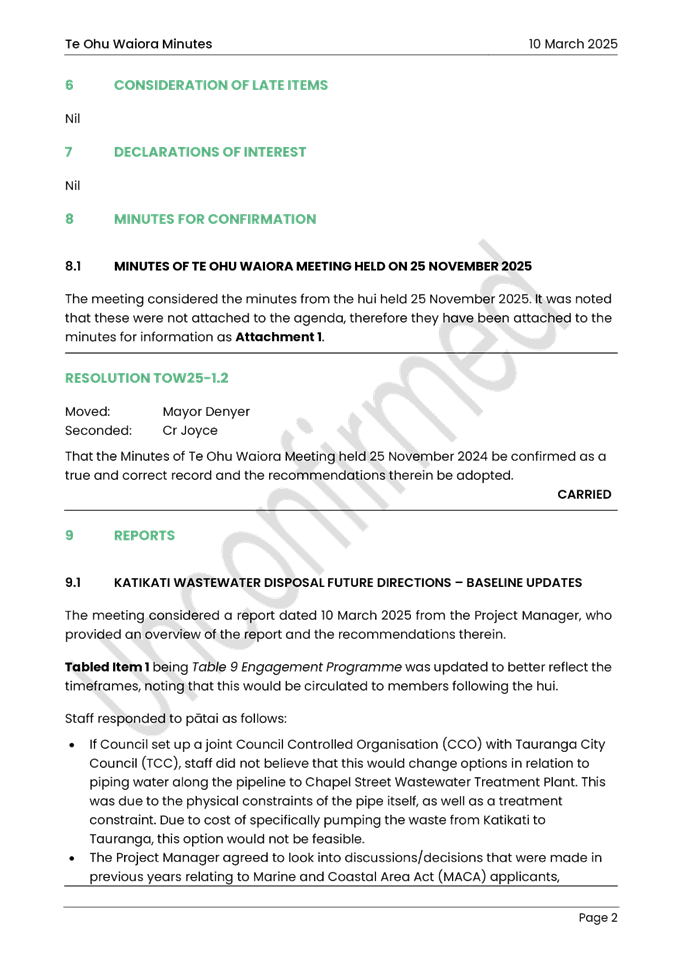
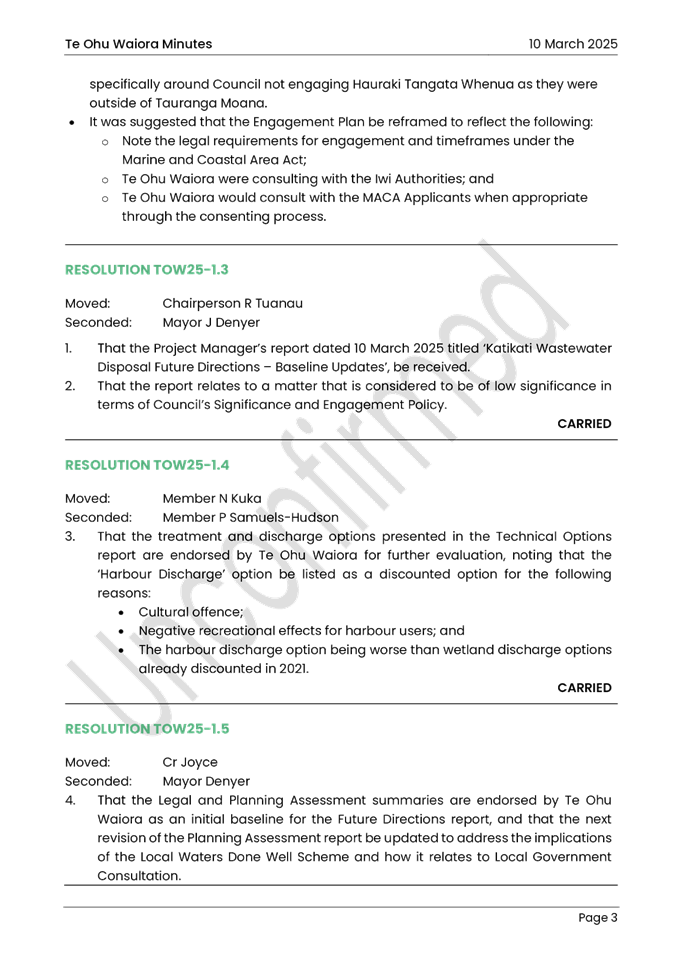
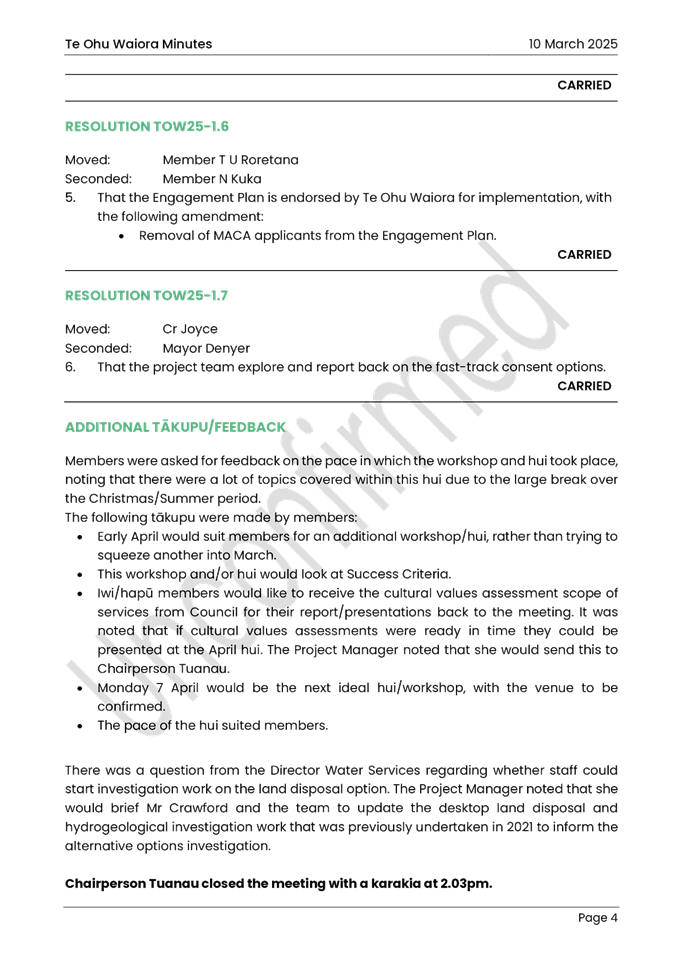
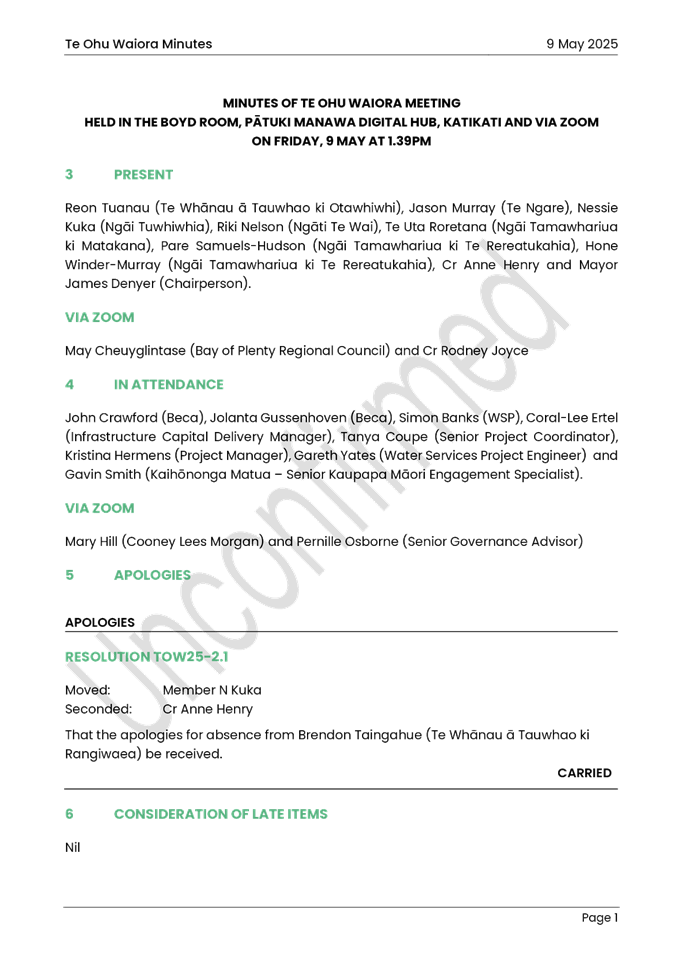
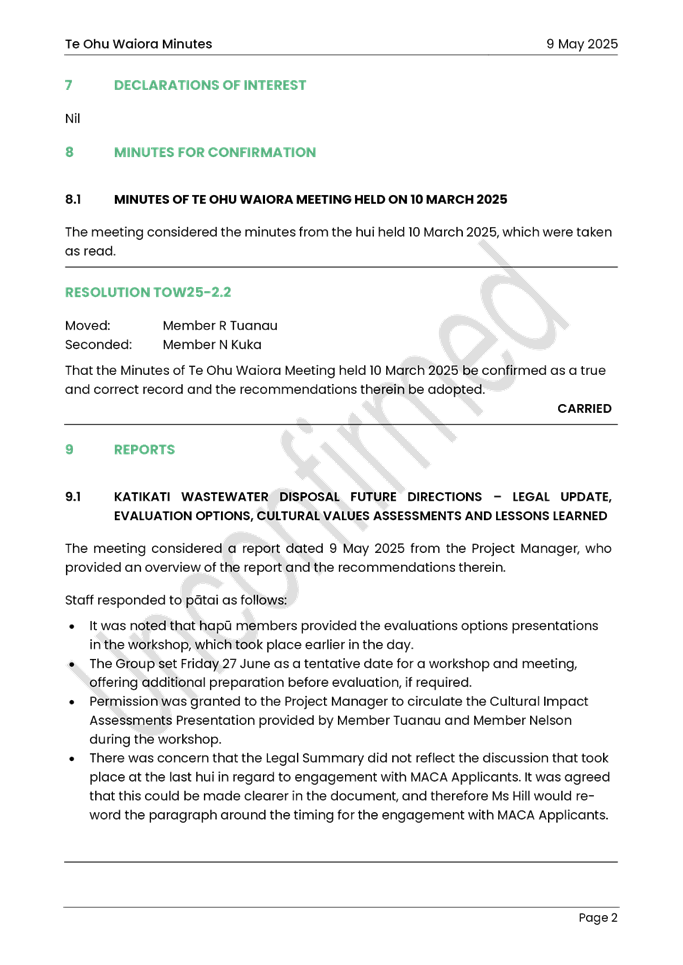
3. Several hui and workshops have been held to review baseline updates, legal and planning framework, stakeholder engagement, cultural values assessments and technical options.
4. Disposal and treatment options for evaluation have been agreed by Te Ohu Waiora. The next hui will review the evaluation criteria. Further hui planned for June – August 2025 will undertake an options evaluation and implementation pathway which will inform the Future Directions Report.
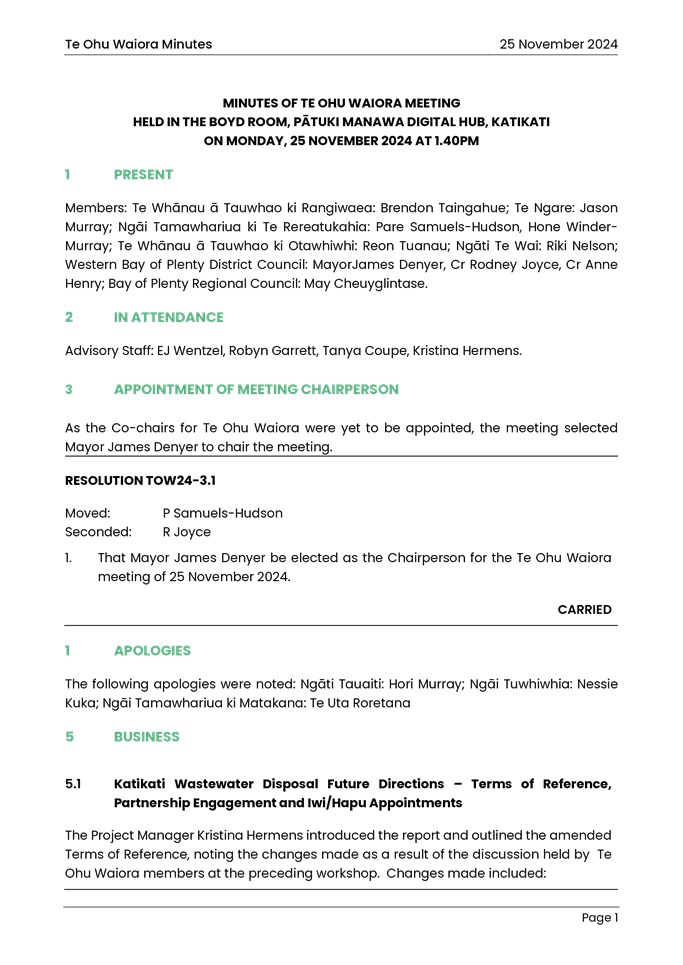
5. Minutes of Te Ohu Waiora meetings to date are attached for reference. A verbal update on progress to date, options considered and evaluation criteria was presented at the workshop on 5 June 2025.
6. A report will be submitted to Projects and Monitoring Committee on 14 August 2025 to enable endorsement of the options evaluation and recommended Future Directions Report.
1. Te Ohu Waiora Hui – Minutes - 25 November 2024 ⇩
2. Te Ohu Waiora Hui Minutes - 10 March 2025 ⇩
3. Te Ohu Waiora Hui – Minutes - 9 May 2025 ⇩