|
Council Te Kaunihera
CO25-1 Friday, 14 November 2025, 2.30pm Council Chambers, 1484 Cameron Road, Tauranga
|
|
Council Te Kaunihera
CO25-1 Friday, 14 November 2025, 2.30pm Council Chambers, 1484 Cameron Road, Tauranga
|
|
14 November 2025 |
Council
Membership:
|
Chairperson |
Mayor James Denyer |
|
|
|
|
Members |
Cr Shane Beech Cr Tracey Coxhead Cr Grant Dally Cr Darlene Dinsdale Cr Graeme Elvin Cr Rodney Joyce Cr Margaret Murray-Benge Cr Laura Rae Cr Allan Sole |
|
Quorum |
Five (5) |
|
Frequency |
Six weekly |
Role:
The Council is responsible for:
· Ensuring the effective and efficient governance and leadership of the District.
· Ensuring that all functions and powers required of a local authority under legislation, and all decisions required by legislation to be made by local authority resolution, are carried out effectively and efficiently, either by the Council or through delegation.
Power to Act:
To exercise all non-delegable functions and powers of the Council including, but not limited to:
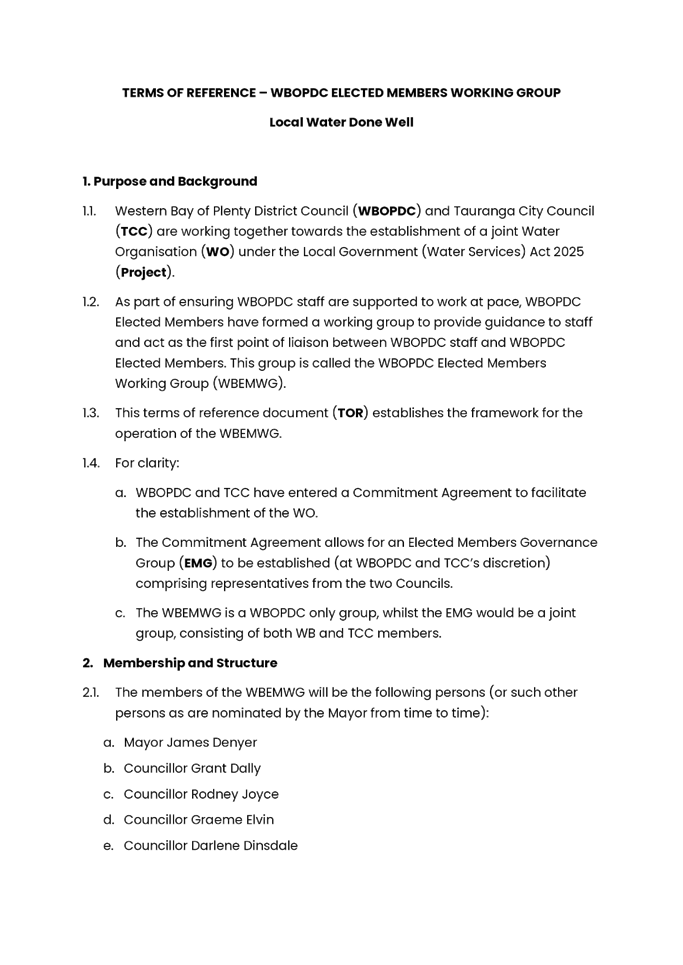
· The power to make a rate;
· The power to make a bylaw;
· The power to borrow money, purchase, or dispose of assets, other than in accordance with the Long Term Plan;
· The power to adopt a Long Term Plan, a Long Term Plan Amendment, Annual Plan or Annual Report and to receive any related audit report;
· The power to appoint a chief executive;
· The power to adopt policies required to be adopted and consulted on under the Local Government Act 2002 in association with the Long Term Plan or developed for the purpose of the Local Governance Statement;
· The power to adopt a remuneration and employment policy;
· The power to approve or change the District Plan, or any part of that Plan, in accordance with the Resource Management Act 1991;
· The power to approve or amend the Council’s Standing Orders;
· The power to approve or amend the Code of Conduct for Elected Members;
· The power to appoint and discharge members of committees;
· The power to establish a joint committee with another local authority or other public body;
· The power to make a final decision on a recommendation from the Parliamentary Ombudsman where it is proposed that Council not accept the recommendation.
· To exercise all functions, powers and duties of the Council that have not been delegated, including the power to compulsorily acquire land under the Public Works Act 1981.
· To make decisions which are required by legislation to be made by resolution of the local authority.
· To authorise all expenditure not delegated to officers, Committees or other subordinate decision-making bodies of Council, or included in Council’s Long Term Plan or Annual Plan.
· To make appointments of members to Council Controlled Organisation Boards of Directors/ Trustees and representatives of Council to external organisations.
· To monitor the performance of and make decisions on any matters relating to Council Controlled Organisations (CCO), including recommendations for
· modifications to CCO or other entities’ accountability documents (i.e. Letter of Expectation, Statement of Intent), including as recommended by the Strategy and Policy Committee.
· To approve joint agreements and contractual arrangements between Western Bay of Plenty District Council and Tauranga City Council and/or any other local authority including the requirement to review the terms of any such agreements or contractual arrangements.
· To approve the triennial agreement.
· To approve the local governance statement required under the Local Government Act 2002.
· To approve a proposal to the Remuneration Authority for the remuneration of Elected Members.
· To approve any changes to the nature and delegations of Committees.
Procedural matters:
Approval of elected member training/conference attendance.
Mayor’s Delegation:
Should there be insufficient time for Council to consider approval of elected member training/conference attendance, the Mayor (or Deputy Mayor in the Mayor’s absence) is delegated authority to grant approval and report the decision back to the next scheduled meeting of Council.
Power to sub-delegate:
Council may delegate any of its functions, duties or powers to a subcommittee, working group or other subordinate decision-making body, subject to the restrictions on its delegations and any limitation imposed by Council.
|
Council Agenda |
14 November 2025 |
Notice is hereby given that a Meeting of Council will
be held in the Council Chambers, 1484
Cameron Road, Tauranga on:
Friday, 14 November 2025 at 2.30pm
2 Present - Ngā mema kei konei
5 Consideration of Late Items - Ngā take tōmuri
6 Declarations of Interest – Ngā tukitukinga
7 Public Excluded Items - Ngā take tapu
8 Public Forum - Wāhanga tūmatanui
10 Information for Receipt - Kōrero te whiwhia
|
Whakatau mai te wairua Whakawātea mai te hinengaro Whakarite mai te tinana Kia ea ai ngā mahi
Āe |
Settle the spirit Clear the mind Prepare the body To achieve what needs to be achieved. Yes |
2 Present - Ngā mema kei konei
5 Consideration of Late Items - Ngā take tōmuri
6 Declarations of Interest – Ngā tukitukinga
7 Public Excluded Items - Ngā take tapu
8 Public Forum - Wāhanga tūmatanui
|
14 November 2025 |
9 Reports - Ngā pūrongo
File Number: A7022409
Author: Robyn Garrett, Governance Manager
Authoriser: Miriam Taris, Interim Chief Executive Officer
Executive Summary
The Making and Attesting of the Declaration of Councillor Margaret Murray-Benge (to be witnessed by the Mayor).
Kaimai General Ward
Cr Margaret Murray-Benge
1. Declaration
- Margaret Murray-Benge - Councillor - 14 November 2025 ⇩ 
|
14 November 2025 |
9.2 Local Waters Done Well - endorsement of summary plan and appointment of members for the Elected Members Governance Group
File Number: A6997372
Author: Ariell King, Programme Manager - Water Organisation Establishment
Authoriser: Adele Henderson, Programme Director - Water Organisation Establishment
Executive Summary
1. This report outlines the next steps in establishing a Multi-Council Water Organisation (WO) for the Western Bay of Plenty District Council (WBOPDC) and Tauranga City Council (TCC), in response to the Government’s Local Water Done Well (LWDW) reform programme. The WO is scheduled to become operational on 1 July 2027.
2. The report details the governance structure, project phases, and workstreams required for WO establishment, including due diligence, legal and governance arrangements, workforce planning, digital transformation, compliance, asset management, and financial strategy.
3. The due diligence phase, unique to WBOPDC and TCC, will be completed by March 2026 and will inform the final decision to proceed. The establishment planning phase will ensure readiness for WO setup, including legal incorporation, strategic document finalisation, recruitment, and stakeholder engagement.
4. Funding for these activities is included in the Water Services Establishment Budget with funding allocated for the new digital platform. Next steps involve joint hui with Tangata Whenua, council reports on digital and stormwater workstreams, and meetings of the joint Elected Members Governance Group (EMG) and the Western Bay of Plenty District Council Elected Member Working Group (WBEMWG).
|
1. That the Programme Manager - Water Organisation Establishment’s report dated 14 November 2025 titled “Local Waters Done Well - Endorsement of summary plan and appointment of members for the Elected Members Governance Group” be received. 2. That Council endorses the “Multi-Council Water Organisation Summary Plan (including Due Diligence)” (Attachment 1 of this report). 3. That Council appoints the following elected members to the joint Elected Member Governance Group: · Mayor James Denyer · Councillor Grant Dally · Councillor Rodney Joyce · Councillor Graeme Elvin · Councillor Darlene Dinsdale 4. That Council agrees to the appointment of Lyall Thurston as the independent facilitator for the Joint Elected Member Governance Group. 5. That Council agrees that the elected members on the Elected Member Governance Group are also the members on the Western Bay of Plenty District Council Elected Members Working Group (WBEMWG). 6. That Council approves the “Western Bay of Plenty District Council Elected Members Working Group – Terms of Reference” (Attachment 2 of this report). 7. That Council endorses partnering with IAWAI for the replacement of the Watercare IT system that is no longer being supported from August 2026, noting that a business case and supplier recommendations will come to Council for a decision in December 2025. 8. Council supports paying meeting fees and negotiated additional resourcing to enable Tangata Whenua participation in establishment planning for the proposed Multi-Council Water Organisation, as anticipated in the “Multi-Council Water Organisation Summary Plan (including Due Diligence)” (Attachment 1 of this report). 9. Notes that the Tangata Whenua meeting fee will be in line with other agreed meeting fees, and delegates to the Chief Executive to approve the meeting fees and additional resourcing costs (funded from the Water Organisation Establishment Budget). |
Background
5. Western Bay of Plenty District Council (WBOPDC), in partnership with Tauranga City Council (TCC), is progressing the establishment of a Multi-Council Water Organisation (WO) in response to the Government’s Local Water Done Well (LWDW) reform programme. The WO has a ‘go live’ date of 1 July 2027.
6. An executed Commitment Agreement between WBOPDC and TCC provides the framework for how the two councils will work together to establish the WO, ahead of it becoming operational on 1 July 2027. The Commitment Agreement was signed in September by both Council’s following the adoption of the Water Services Plan.
7. As outlined in the Water Service Delivery Plan (WSDP), Council included a Due Diligence phase. It is intended to complete this phase the end of March 2026. The Commitment Agreement sets out a process to facilitate due diligence, allowing for information sharing, and cost sharing between the councils. It also contains provisions allowing for exit from the Commitment Agreement if required.
8. As noted in the WBOPDC WSDP due diligence is a process to gain further information; identify issues that need to be addressed in the formation documents, put in place mitigations to manage risks or address concerns, seek clarity and agreement among the parties and enable the Council to make a final decision on whether to establish WO.
9. The Commitment Agreement also set out the governance structure to complete the due diligence phase and establish the WO. Part of this structure is an Elected Members Governance Group (EMG).
Discussion
Multi- Council Water Organisation Summary Plan (including Due Diligence)
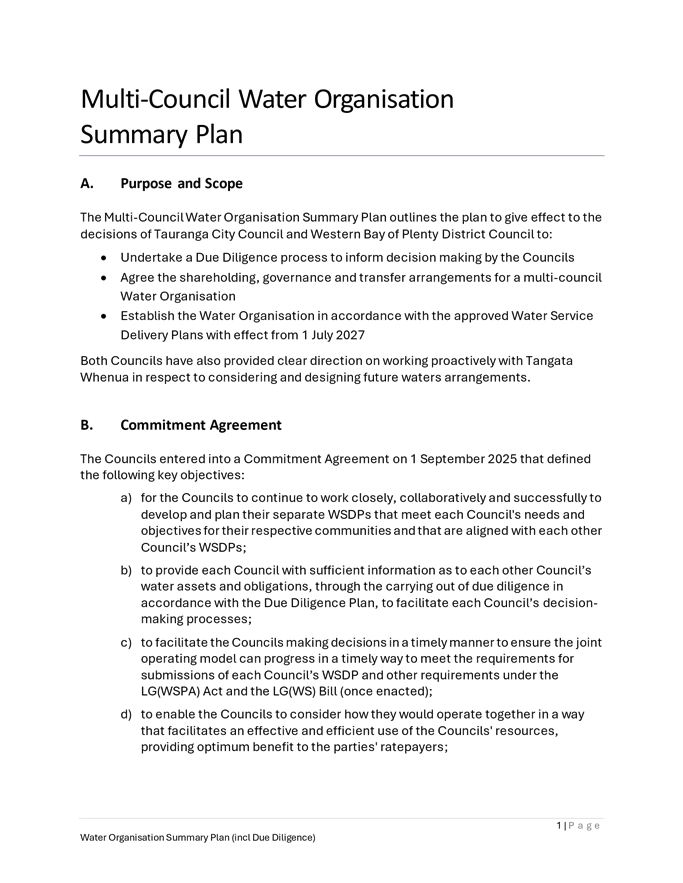
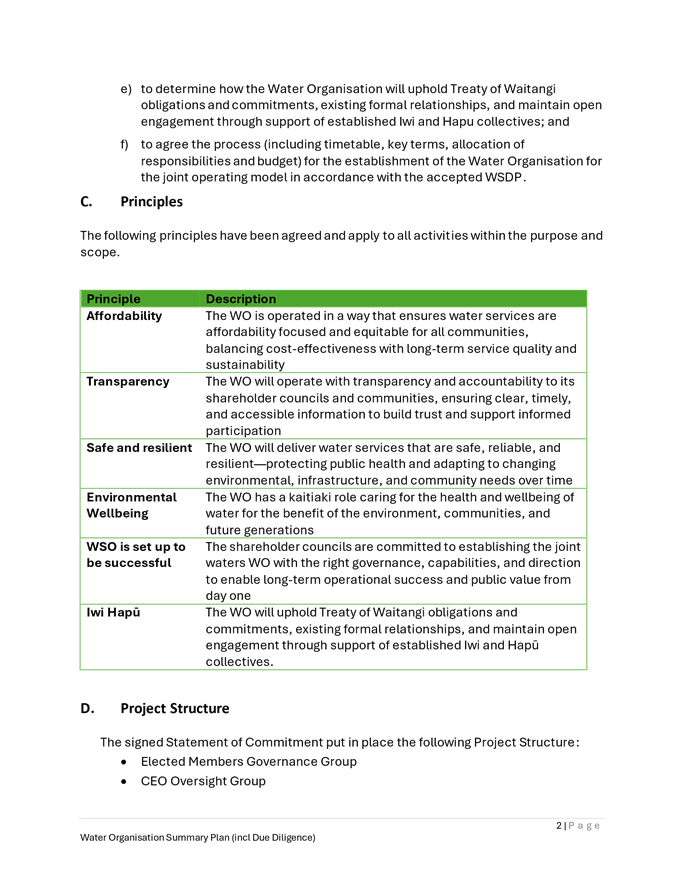
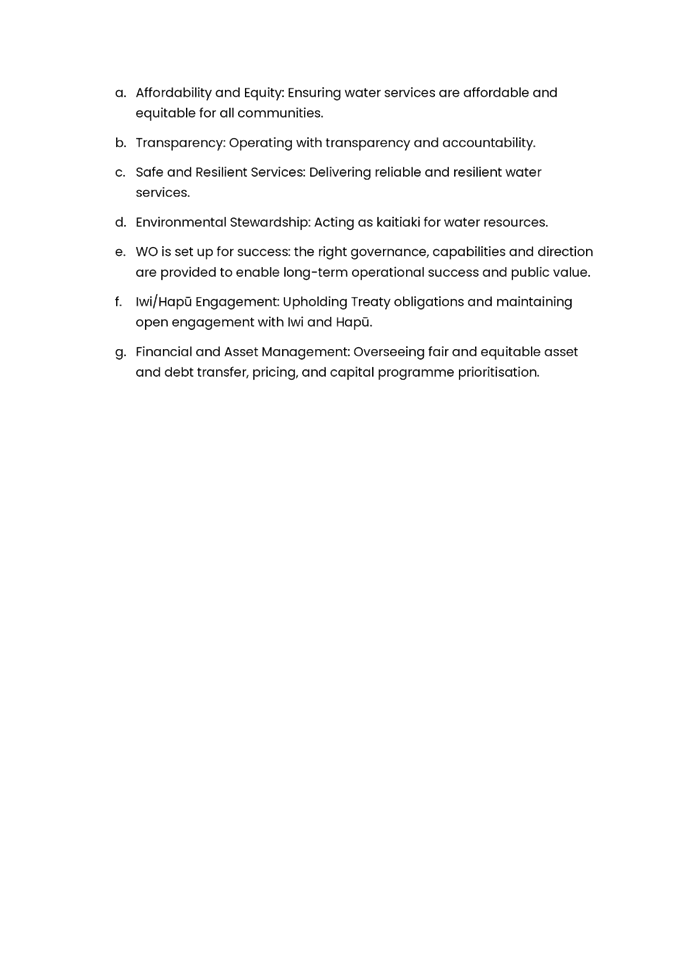
10. The Multi-Council Water Organisation Summary Plan (Including Due Diligence) (the Summary Plan) sets out the major project phases and workstreams required to establish the WO. It is guided by the Commitment Agreement and based on the following principles:
· Affordability – cost effective, equitable and sustainable.
· Transparency – the WO will operate transparently and be accountable to its shareholding Councils and communities.
· Safe and resilient – protect public health and adapt to changing needs over time.
· Environmental Wellbeing – preserve the health and wellbeing of water for future generations (kaitiaki role).
· WO set up to succeed – governance, capabilities and clear objectives.
· Iwi and Hapū – uphold Treaty of Waitangi and work with Iwi and Hapū.
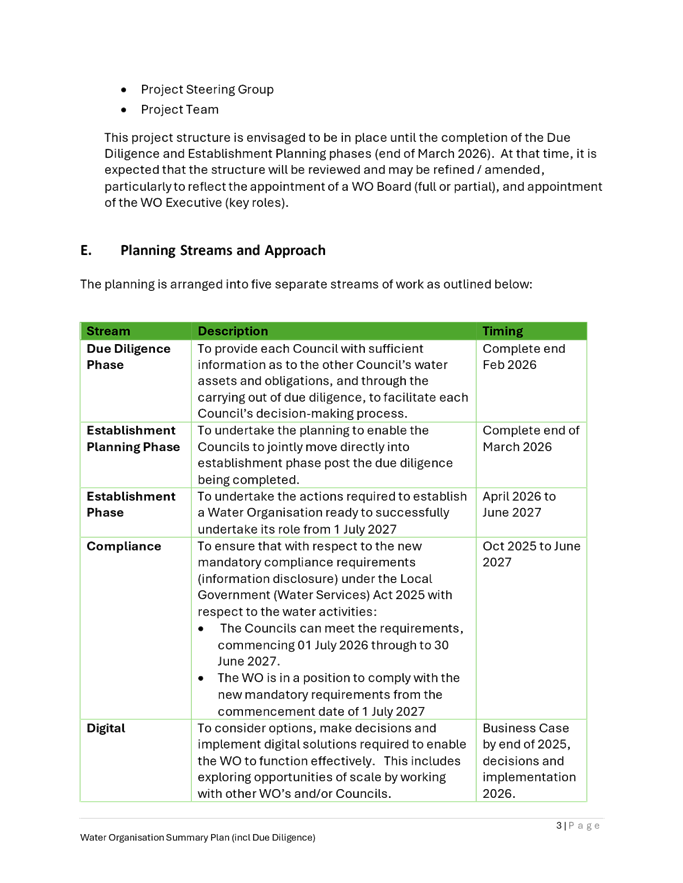
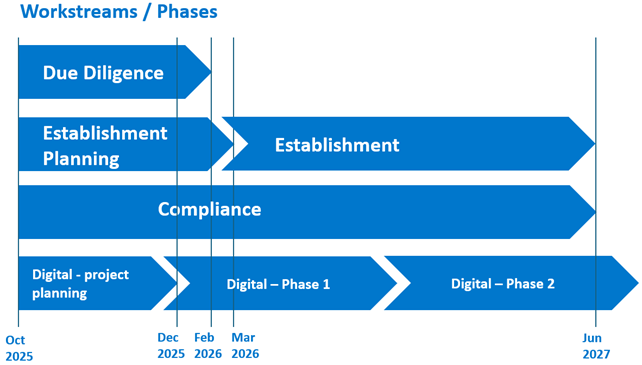
11. The Summary Plan has been developed by WBOPDC and TCC staff. The high-level workstreams and project phases are shown in the figure below. The full Summary Plan is provided as Attachment 1, with this report providing an overview of the plan.
1.
2.
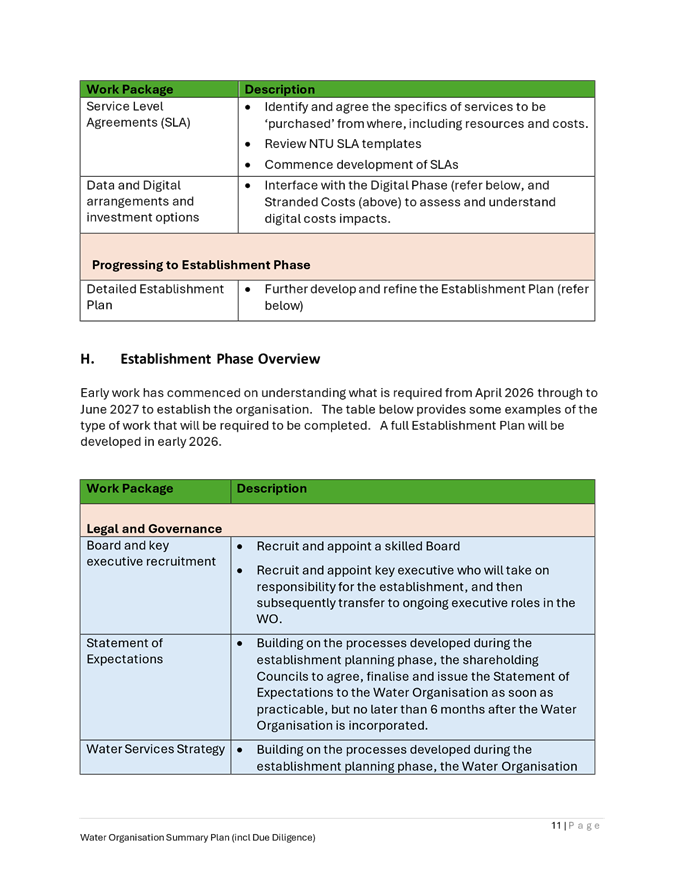
12. The Summary Plan also includes an Establishment Planning phase to ensure readiness for WO setup post-March 2026. Establishment Planning includes:
· Tangata Whenua partnership: aligning existing policies and agreements.
· Legal and governance: developing foundational documents (e.g. Constitution, Statement of Expectations) and voting structures.
· People and relationships: workforce planning (e.g. high-level functional design) and staff communication and change management processes.
· Digital: to consider options and opportunities to explore scale with other water service providers.
· Compliance: Overview of legislative requirements for operations (for Council and the WO)
· Asset Management Operations and Stormwater (AMOS)
· Finance: refining understanding of the allocated overhead model
· Detailed workstream planning: preparing for the Establishment phase.
13. If Council decides in March 2026 to continue with its plan to establish a WO, it will move into the Establishment phase of the project. The Establishment phase involves legal incorporation, finalising strategic documents (e.g. Water Services Strategy, Transfer Agreement), recruitment of a skilled board and executives, and stakeholder engagement. Tangata Whenua continue to have a key role throughout this phase.
14. The Summary Plan also addresses the digital work required by WBOPDC and TCC to ensure the continuation of water service delivery. Digital transformation is critical regardless of whether WBOPDC establishes a WO or not.
15. Tangata Whenua engagement is a priority. The Summary Plan responds with work packages for joint engagement planning, partnership alignment, governance input, and cultural branding. WBOPDC and TCC propose reimbursing Tangata Whenua for their meeting costs and additional specialist work so that they are enabled to provide input into the project.
Due Diligence Phase
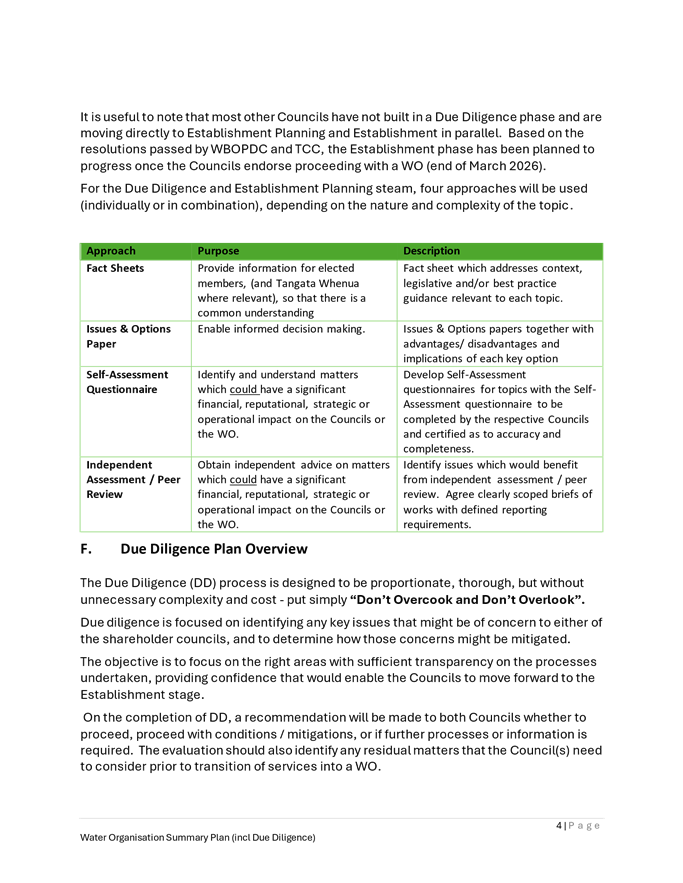
16. This project phase is unique to WBOPDC and TCC, where most councils forming a WO have moved to directly to Establishment Planning and Establishment (delivering the tasks in these phases in parallel) without further due diligence. However, WBOPDC and TCC will not begin the Establishment phase until both councils endorse progressing with a WO (March 2026).
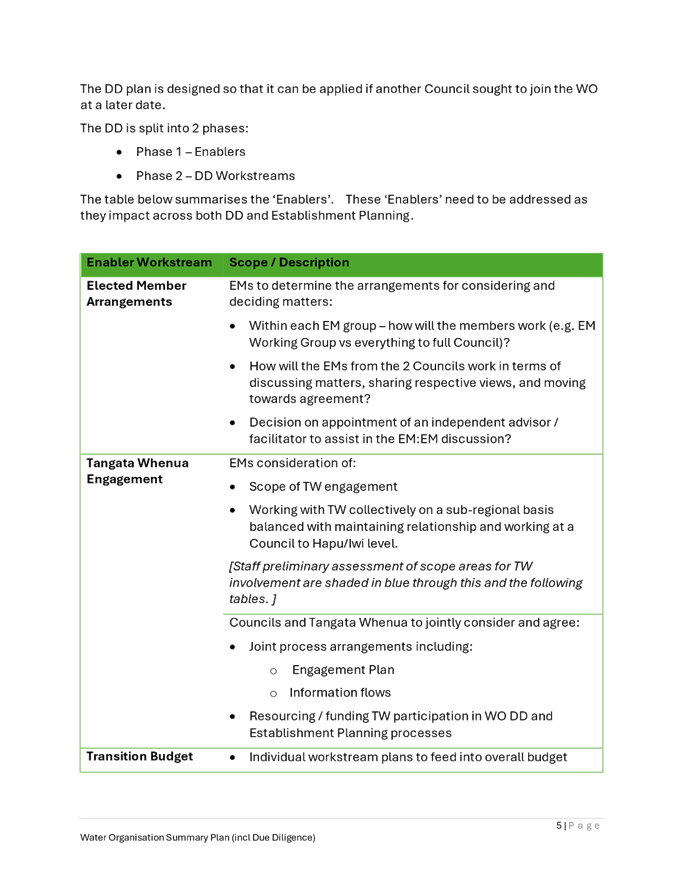
17. The Due Diligence work is broken down into two elements. Enabler workstreams allow the work in both the Due Diligence and Establishment Planning phases to progress. The enabler workstreams are:
· Elected Members arrangements: considering how Elected Members will make decisions and progress work at both intra and inter-council levels. As noted above, the Commitment Agreement provided a governance structure including the establishment of an Elected Members Governance Group (EMG). It is also proposed to form a WBOPDC Elected Member Working Group (WBEMWG) discussed below.
· Tangata Whenua engagement: WBOPDC and TCC are committed to working together with Iwi and Hapū across the sub-region, whilst also maintaining individual council to Iwi/Hapū relationships. This process is discussed in more detail later in this report.
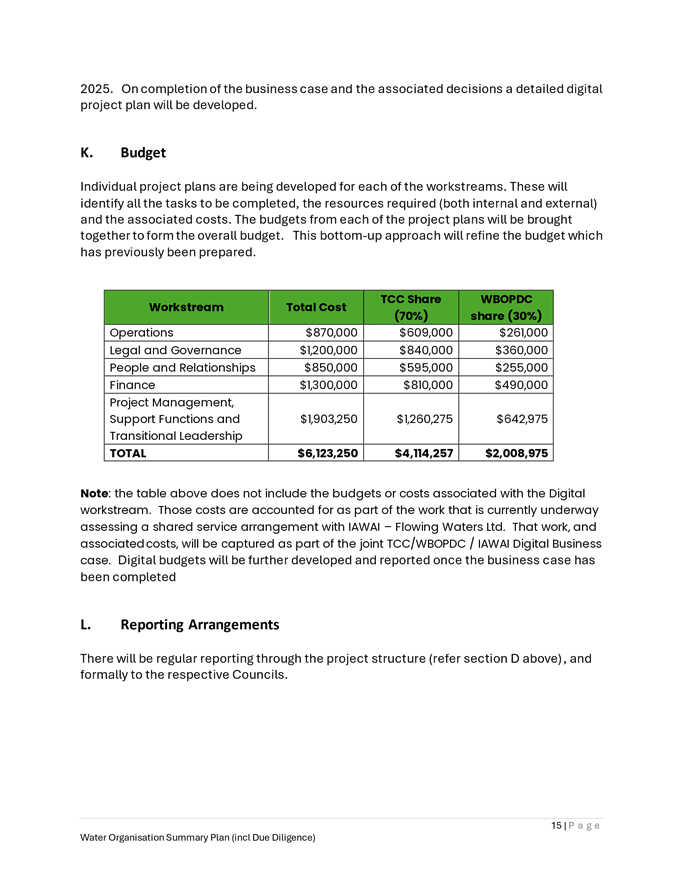
· Transition budget: a high-level budget is provided in the Summary Plan, and further work is underway to develop detailed budgets for each workstream in the Due Diligence and Establishment Planning phases.
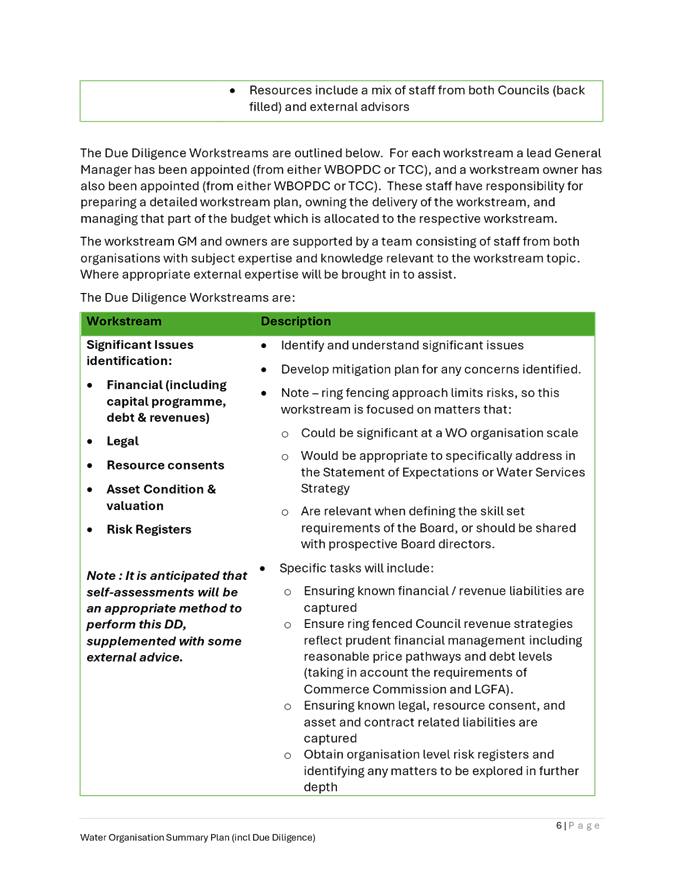
18. Due Diligence workstreams are specific to the due diligence process and are focused on informing each council, ahead of the March 2026 decision on whether to proceed with establishing a WO. The following matters are included:
· Significant issues: identifying and understanding significant issues (if any) and developing mitigation plans for any concerns identified. As ring-fencing arrangements will lessen risks, this workstream is focussed on identifying big issues which may be significant at a whole of WO scale or need to be addressed in the Statement of Expectations or Water Services Strategy or will be relevant to the set up and/or operation of the future WO Board.
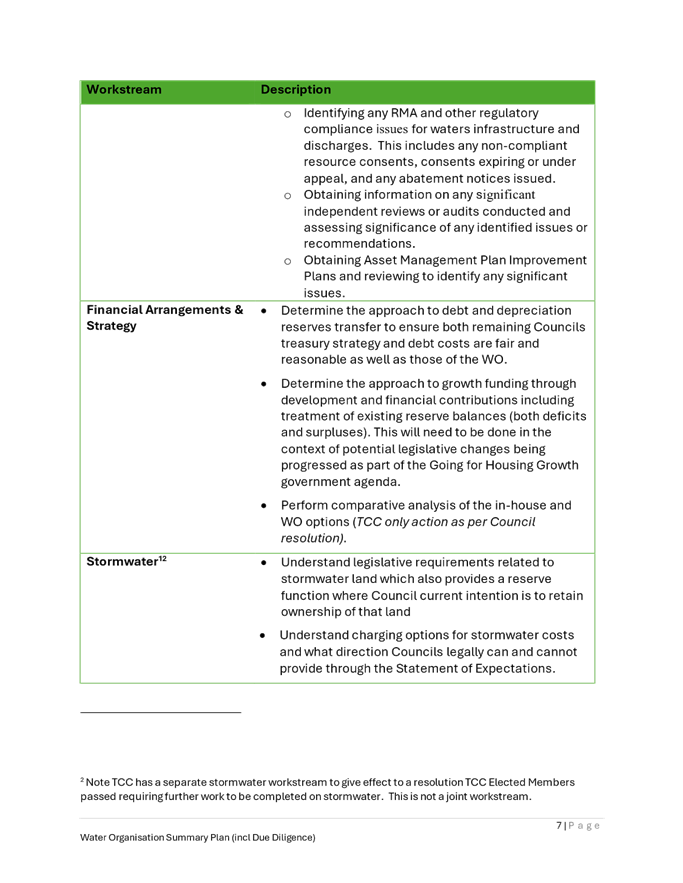
· Financial arrangements and strategy: determining the approaches to the transfer of debt and depreciation reserves, and to growth funding via development and financial contributions. TCC are also required to complete a comparative financial analysis.
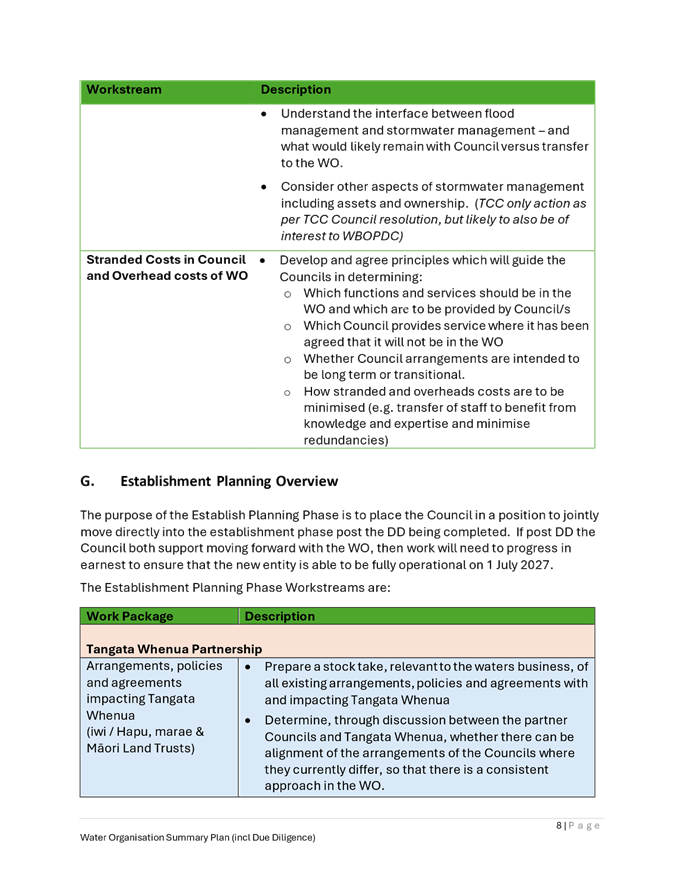
· Stormwater: the plan includes a package of work that is required to address the requirement for TCC to make a decision on the preferred option for delivering stormwater, including future charging options (as they relate to the Local Government Water Services Act 2025), and implications for asset ownership and transfer. WBOPDC has already made a decision on the preferred option for stormwater (set out below for reference). Relevant information and advice that TCC receive on this matter will be provided at the Council meeting on 16 December as well as a response to the matters identified for further work in the WBOPDC resolution regarding stormwater on 5 August 2025 (Resolution CL25-10.2 – CL25-10.7):
· Agreed that developed stormwater infrastructure (manholes, pipes, networked infrastructure) predominantly in urban environments should be considered for transfer to the joint water service organisation as part of the due diligence process and that non-urban stormwater infrastructure will be retained by Western Bay of Plenty District Council (WBOPDC) and be managed in conjunction with the primary interface of transport infrastructure.
· Agreed that assets (including land) where a significant purpose is recreation, and open space, should remain with the Council and should not be planned to transfer to the joint Water Service organisation.
· Direct that the Water Services Delivery Plan (WSDP) financial analysis be based on the above stormwater assets transferring although further work needs to be undertaken to determine the treatment of specific stormwater assets and services consistent with principles set out in the Water Services Delivery Plan (WSDP).
· Agree that specific advice around the treatment of these assets be reported back prior to the receipt of the report from due diligence.
· Stranded costs for Council and overhead costs for the WO: this workstream results in the development and agreement of principles to guide which functions and services are provided directly by the WO versus WBOPDC and/or TCC, and (where functions and services stay with councils) which council provides what (WBOPDC or TCC). It is focussed on fairness, minimisation of stranded costs and overhead costs for both the councils and the WO and setting up the WO to succeed.
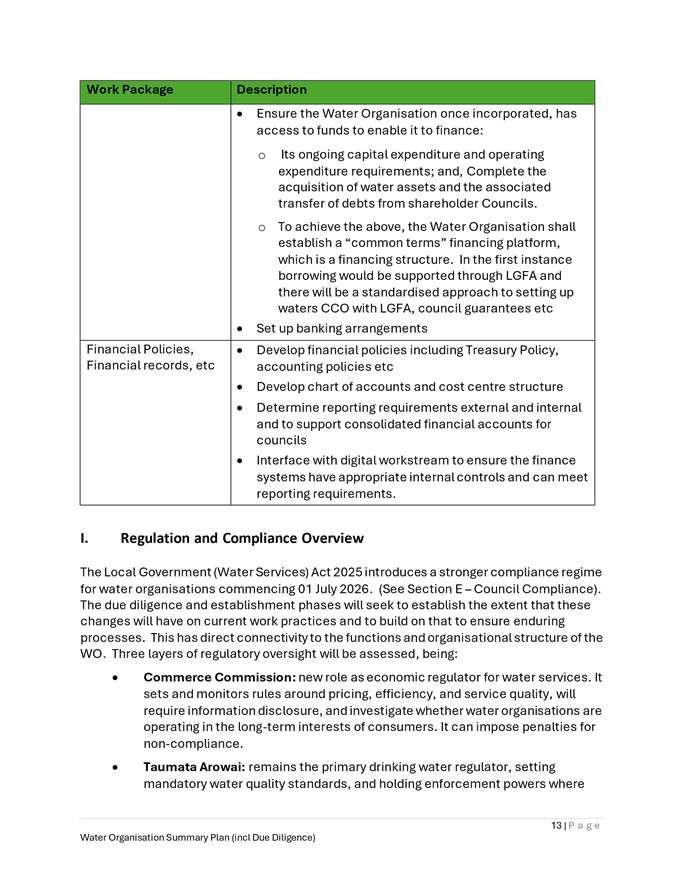
19. Ensuring the WO is ready to meet regulatory and compliance requirements is an ongoing workstream that links and overlaps with other project workstreams. The Local Government (Water Services) Act 2025 introduces a stronger compliance regime for WOs commencing on 1 July 2026. This new approach includes three layers of regulatory oversight:
· Commerce Commission: new role as economic regulator.
· Taumata Arowai: primary drinking water regulator.
· Regional Councils: continue to regulate environmental effects.
20. The Due Diligence and Establishment Planning phases will seek to establish the extent that these changes will have on current work practices, followed by further work to prepare the WO for these changes.
Establishment Planning Phase
21. The purpose of the Establishment Planning phase is to place WBOPDC and TCC in a position where the councils can seamlessly move to the Establishment Phase following March 2026. Splitting Establishment Planning and Establishment into two separate phases minimises expenditure ahead of the councils making their final decisions, whilst still ensuring that TCC and WBOPDC can meet a ‘go live’ date of 1 July 2027.
22. The following matters are included in this phase:
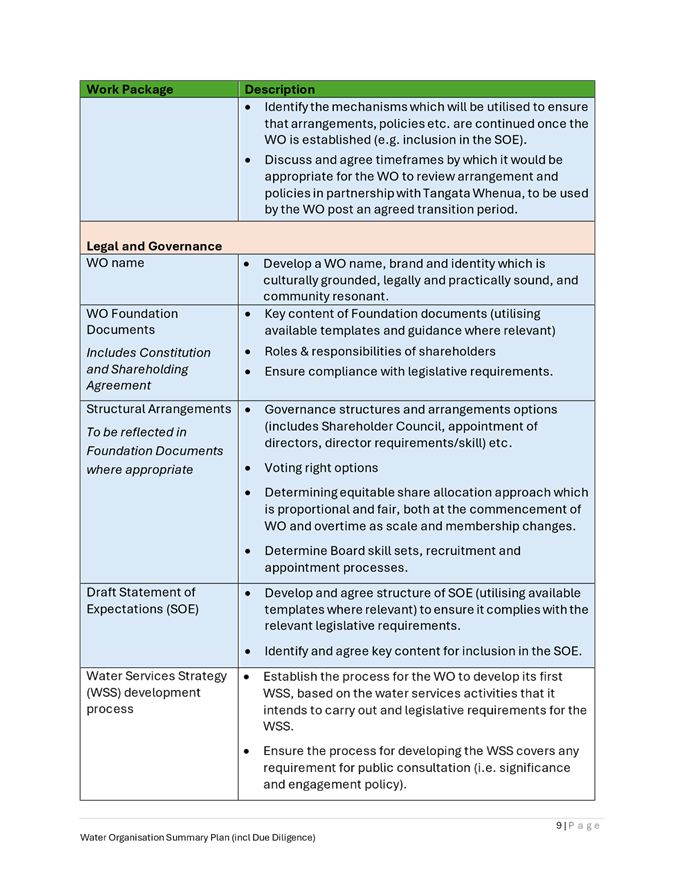
(a) Tangata Whenua partnership: considering existing policies, arrangements and agreements with Iwi and Hapū, and how these might transfer across to a WO (recognising that there may be work required to align arrangements, where TCC and WBOPDC have different approaches). Note: Tangata Whenua will also participate in other work, such as much of the legal and governance workstream.
(b) Legal and governance: this will include developing a name and brand for the WO, along with foundational documents (e.g. Constitution, draft Statement of Expectations) and structural arrangements, such as considering options for voting rights and whether TCC and WBOPDC form a Shareholders’ Forum.
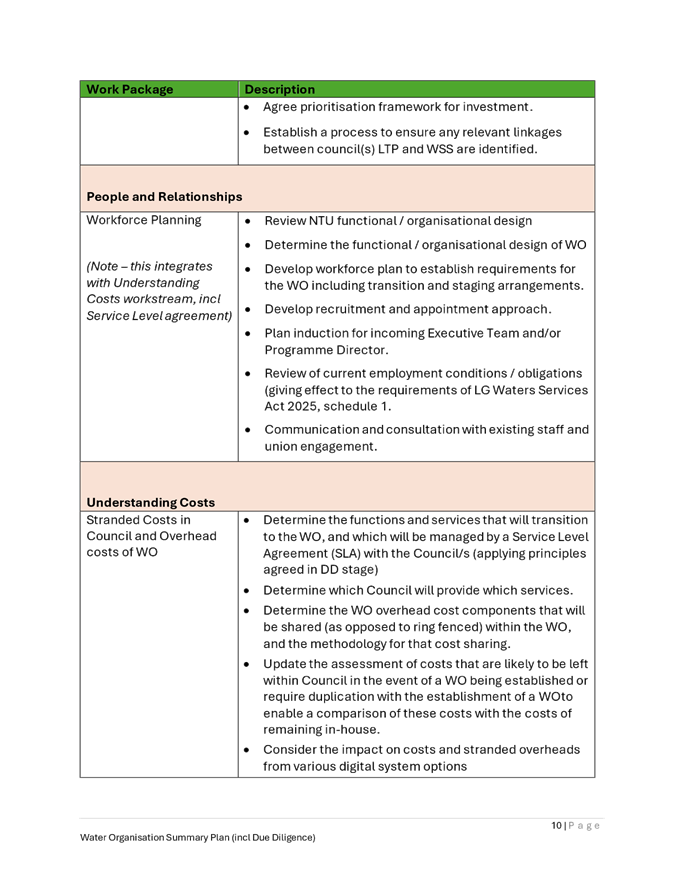
(c) People and relationships: early workforce planning, considering factors such as transition and staging arrangements, the organisational design of the WO and communication and engagement with existing staff at both councils.
(d) Understanding costs: building on, and complementing, the work in the Due Diligence phase regarding stranded costs, overhead costs, and service delivery arrangements, as well as interfacing with the Digital project phase to assess and understand digital costs.
(e) Developing a detailed plan for the Establishment Phase.
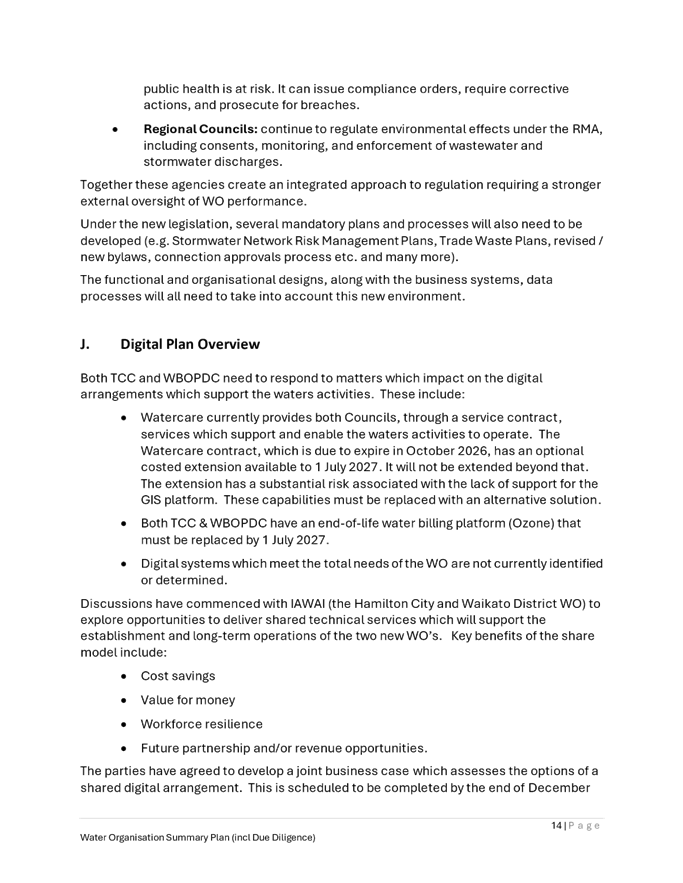
23. WBOPDC and TCC already share digital and contractual arrangements in the water delivery area. Both councils currently purchase services through Watercare and in turn, receive work order management, GIS and Asset Management services.
24. Watercare have given notice that their service will expire at the end of the contract, 30 September 2026. The geospatial system (GIS) will be out of support from August 2026, representing risk for both councils.
25. It is prudent to move forward on the replacement in advance of the establishment of the WO to ensure that services can continue. In addition, as other councils are working towards their WO, there is an opportunity to engage with other multi-council entities about the opportunity to have scale in a new IT system.
26. To enable efficiencies, discussions have commenced with IAWAI – Flowing Waters Limited (the WO formed by Hamilton City Council and Waikato District Council) exploring opportunities for shared investment in technical services to support establishment and long-term operations of the two new WOs (IAWAI and the proposed TCC and WBOPDC WO). Potential benefits of shared services with IAWAI include shared cost of investment, ongoing cost savings, value for money, workforce resilience, opportunities for future partnership and/or revenue.
27. A report to Council in December 2025 will present a business case and seek approval to:
· Enter into a MoU with IAWAI
· Proceed with Phase 1 of the digital project, which is the exit from Watercare (supported by a Business Case).
28. Budget is allocated for Phase 1. If Council approves Phase 1, it will run from January to October 2026 and enable exit from Watercare platform. TCC and WBOPDC share a joint contract for operational work which is managed via the Watercare system and exit costs from Watercare will be shared between the councils. A shared model with IAWAI provides efficiencies and sharing of set up costs.
29. Phase 2 will address the need to establish a potential new billing systems for water delivery. More information on Phase 2 will be available in the December 2025 Council report. A decision on Phase 2 is not required until April 2026.
Elected Member Governance Group and Working Group
30. The Commitment Agreement sets out the governance structure to complete the due diligence phase and establish the WO. Part of this structure is an Elected Members Governance Group (EMG).
31. The proposed membership of the EMG is:
(a) EMG Chair: James Denyer
(b) Grant Dally
(c) Rodney Joyce
(d) Graeme Elvin
(e) Darlene Dinsdale
32. An independent facilitator, Lyall Thurston, has been engaged for the Elected Member Governance Group to assist in navigating key matters through the due diligence phase.
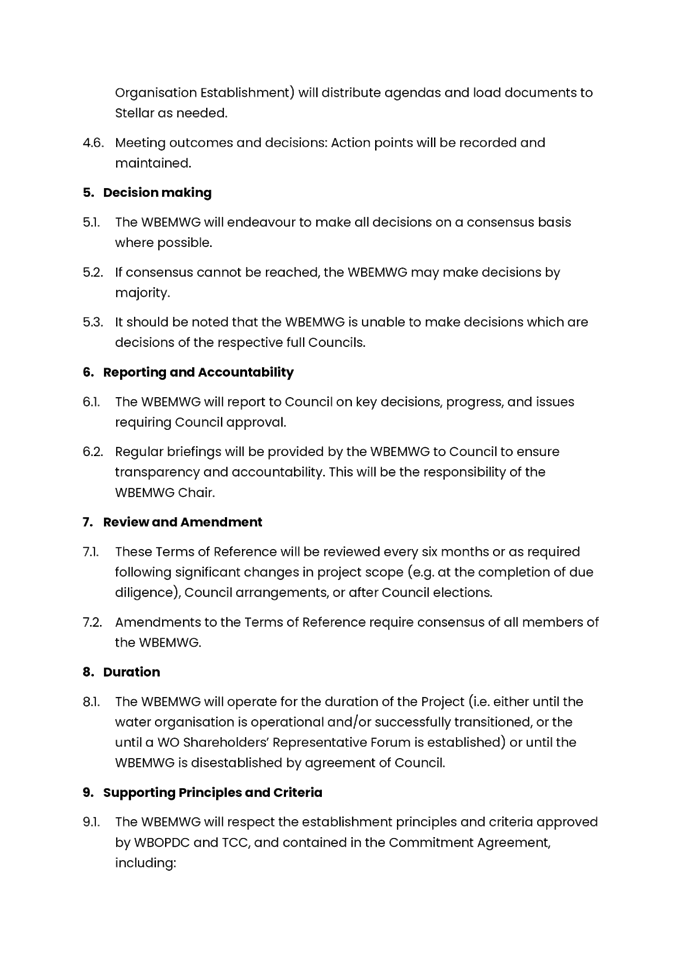
33. The report also recommends establishing a Western Bay of Plenty District Council Elected Members Working Group (WBEMWG) and adopting a Terms of Reference (ToR) (Attachment 2). It is recommended that the members of the EMG are also the members of the WBEMWG.
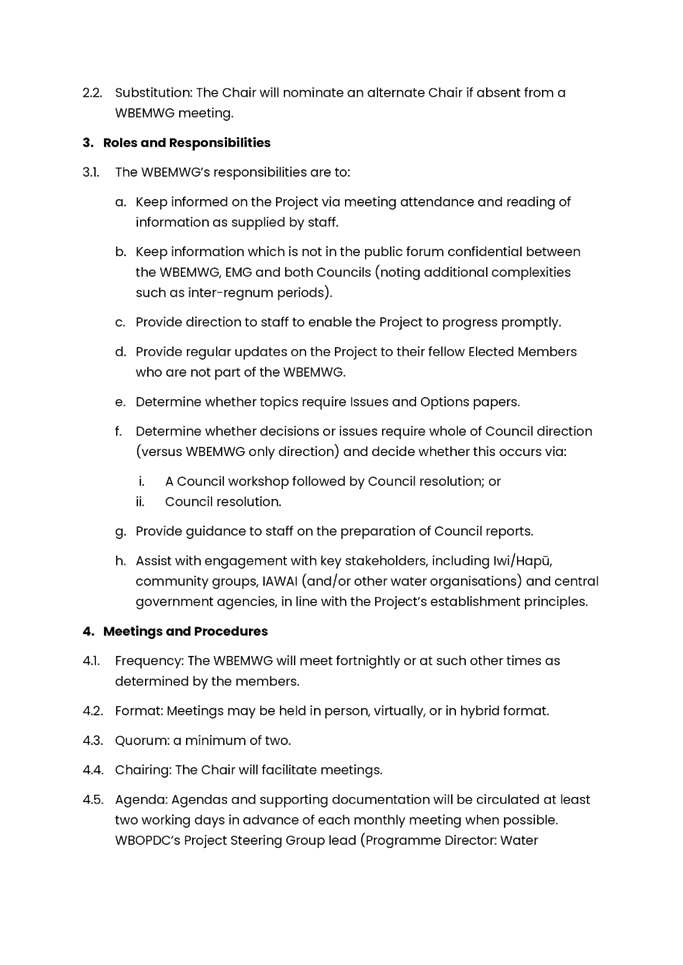
34. The proposed responsibilities for the WBEMWG are to:
· Keep informed on the Project via meeting attendance and reading of information as supplied by staff.
· Keep information which is not in the public forum confidential between the WBEMWG and both Councils where appropriate.
· Provide direction to staff to enable the Project to progress promptly.
· Provide regular updates on the Project to their fellow Elected Members who are not part of the WBEMWG.
· Determine whether topics require Issues and Options papers.
· Determine whether decisions or issues require whole of Council direction (versus WBEMWG only direction) and decide whether this occurs via:
(a) A Council workshop followed by Council resolution; or
(b) Council resolution.
· Provide guidance to staff on the preparation of Council reports.
· Assist with engagement with key stakeholders, including Iwi/Hapū, community groups, IAWAI (and/or other water organisations) and central government agencies, in line with the Project’s establishment principles.
Engagement with Tangata Whenua
35. The Commitment Agreement requires the development of a Tangata Whenua Partnership Plan. This plan will be completed in partnership with Tangata Whenua.
36. A joint hui with Elected Members, Iwi and hapu from WBOPDC and TCC is being arranged to discuss Tangata Whenua involvement in the establishment of a Water Organisation as well as agreeing a subgroup to work alongside Council staff through the Due Diligence and Establishment Planning Phase.
37. This report recommends paying meeting fees and negotiated additional resourcing to enable Tangata Whenua participation with delegation given to the Chief Executive to approve the meeting fees and additional negotiated resourcing. The SmartGrowth schedule of fees is proposed as the basis for this remuneration.
Establishment Phase
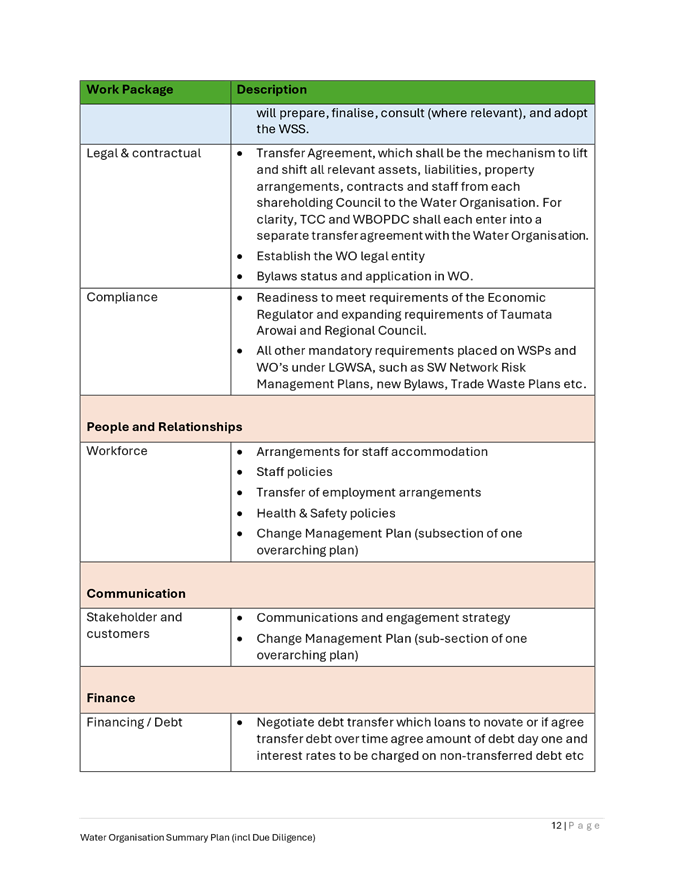
38. The Establishment Phase is when work commences to actively stand-up the WO ahead of the ‘go live’ date of 1 July 2027. This requires incorporation of the WO as a legal entity and employment of crucial governance and staff positions. This includes appointing a skilled board and critical executive roles. Tangata Whenua continue to contribute to some of the outputs under this phase of the project. The Establishment Phase also includes (but is not limited to):
· Finalising the Statement of Expectations.
· Finalising and executing the Transfer Agreement (based on principles agreed to in earlier project phases).
· Transfer of employment arrangements.
· Communicating and engaging with stakeholders and customers, as part change management plan.
· Setting up financing and debt arrangements and developing financial policies.
· Finalising and adopting the Water Services Strategy.
Significance and Engagement
39. The Local Government Act 2002 requires an assessment of the significance of matters, issues, proposals and decisions in this report against Council’s Significance and Engagement Policy. Council acknowledges that in some instances a matter, issue, proposal or decision may have a high degree of importance to individuals, groups, or agencies affected by the report.
40. In terms of the Significance and Engagement Policy this decision is considered to be of low significance with no further public consultation required due to prior engagement completed. The recommended decisions flow from previous decisions and are in accordance with the Commitment Agreement. It is recognised that the decision to establish a Water Organisation is noted as high significance.
Engagement, Consultation and Communication
41. Taking into consideration the above assessment, that the decisions are of low significance, staff are of the opinion that no further engagement is required prior to making a decision and not required under legislation.
Statutory Assessment
42. Council’s decision to progress establishment of a WO is in response to the coalition government’s LWDW reform programme:
· The Water Services Acts Repeal Act 2024 (enacted in February 2024) dealt with the repeal of previous legislation relating to water services entities.
· The Local Government (Water Services Preliminary Arrangements) Act 2024 (enacted in September 2024) introduced the Local Water Done Well framework, the requirements for Water Services Delivery Plans, and the preliminary arrangements for the new water services.
· The Local Government (Water Services) (Repeals and Amendments) Act 2025 and the Local Government (Water Services) Act 2025 (enacted August 2025) work together to establish the enduring regulatory framework for water services delivery, including new governance arrangements, economic regulation, and consumer protection measures.
Funding/Budget Implications
43. Costs of Due Diligence and the requirements in the Summary Plan are included in the Water Services Establishment Budget of $3.8m (loan funded and transferred to the Water Organisation). This includes $1.8m provided in relation to the new IT platform.
44. Workstreams are currently finalising their due diligence and establishment budgets. Any funding shortfall, including for the Phase 2 Digital Platform would be requested through the Annual Plan process.
Next Steps
45. Next steps include:
· A combined hui with TCC, WBOPDC and Tangata Whenua from the TCC/WBOPDC rohe.
· A report to the Council meeting on 16 December on the digital workstream. This report will present a business case and seek approval to:
(a) Enter an MoU with IAWAI.
(b) Proceed with Phase 1 of the digital project, which is the exit from Watercare.
· A report to the Council regarding stormwater and addressing the matters required from the earlier Council resolution.
· WB Elected Member Working Group meetings as required to progress Due Diligence with Council staff.
· Joint Elected Members Governance Group meetings with TCC.
1. Summary
Plan - Multi-Council Water Organisation ⇩ 
2. Terms
of Reference - WBOPDC Elected Member Working Group ⇩