|
Audit, Risk and Finance Committee Kōmiti Arotake Tūraru me Ahumoni
ARF24-1 Tuesday, 27 February 2024, On
conclusion of the Projects Council Chambers,1484 Cameron Road, Tauranga
|
|
Audit, Risk and Finance Committee Kōmiti Arotake Tūraru me Ahumoni
ARF24-1 Tuesday, 27 February 2024, On
conclusion of the Projects Council Chambers,1484 Cameron Road, Tauranga
|
|
27 February 2024 |
Audit, Risk and Finance Committee
Membership:
|
Chairperson |
Cr Murray Grainger |
|
Deputy Chairperson |
Cr Tracey Coxhead |
|
Members |
Cr Richard Crawford Cr Grant Dally Mayor James Denyer Cr Anne Henry Cr Rodney Joyce Cr Margaret Murray-Benge Deputy Mayor John Scrimgeour Cr Allan Sole Cr Don Thwaites Cr Andy Wichers Stuart Henderson – Independent Member |
|
Quorum |
Seven (7) |
|
Frequency |
Quarterly |
Role:
The main purpose of the Committee is to assist Council in providing oversight of matters relating to the quality and integrity of financial reporting, independence and performance of the external auditors, effectiveness and objectivity of the internal audit programme, and oversight of business risks and compliance activities.
Scope:
Responsibilities:
· Assist Council in fulfilling its responsibilities for financial statements and external financial reporting.
· Monitor the Council’s external and internal audit process and the resolution of any issues that are raised.
· Review key formal external accountability documents such as the Annual Report in order to provide advice and recommendation in respect to the integrity and appropriateness of the documents and the disclosures made.
· Provide a forum for communication between management, internal and external auditors and the governance level of Council.
· Ensure the independence and effectiveness of Council’s internal audit processes, with oversight of the internal audit programme and findings.
· Oversee the development of the Council’s Annual Report.
· Oversee the development and management of financial policies and delegations.
· Monitor existing corporate policies and recommend new corporate policies to prohibit unethical, questionable or illegal activities.
·
Support measures to improve management performance and internal controls.
Responsibilities:
Audit (internal and external):
· Ensure appropriate accounting policies and internal controls are established and maintained and
· assist Council in ensuring the effective and efficient management of all business risks.
· Ensure an appropriate framework is maintained for the management of strategic and operational risk (including risk appetite). Review risk including technical insurance matters
· and participation in national risk management practices, health and safety risk management and implementation of risk management processes.
· Review the effectiveness of the Long Term Plan audit or any audit relating to an amendment to the Long Term Plan
· Review the effectiveness of the annual audit.
· Monitor management response to audit reports and the extent to which the external audit recommendations concerning internal accounting controls and other matters are implemented.
· Monitor the delivery of any internal audit work programme and implementation of any significant recommendations including control risk, accounting and disclosure practices.
· Engage with Councils external auditors regarding the external work programme and agree the terms and arrangements of the external audit in relation to the Annual Report.
· Engage with internal and external auditors on any specific one-off audit assignments.
· Review the effectiveness of the control environment established by management including the computer information management systems controls and security. This also includes a review/monitoring role for relevant policies, processes, and procedures.
Risk management:
· Review the Risk Management Framework, and associated procedures to ensure they are current, comprehensive and appropriate for the effective identification and management of Council’s financial and business risks including fraud and cyber security.
· Review the effectiveness of the system for monitoring Council’s financial compliance with relevant laws, regulations and associated government policies.
· Review whether a sound and effective approach has been followed in establishing Council’s business continuity planning arrangements.
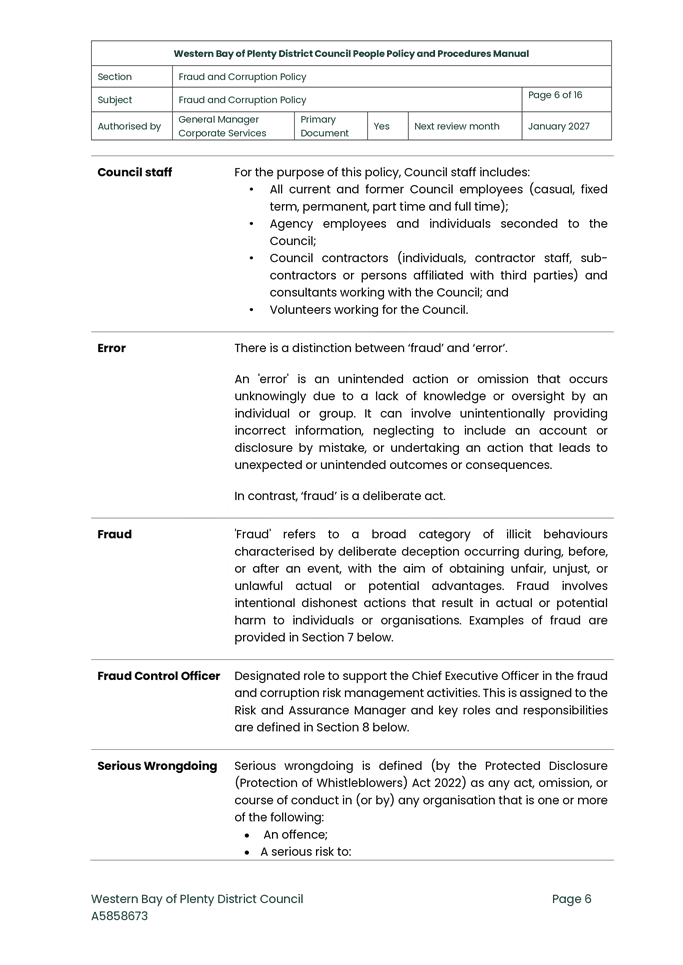
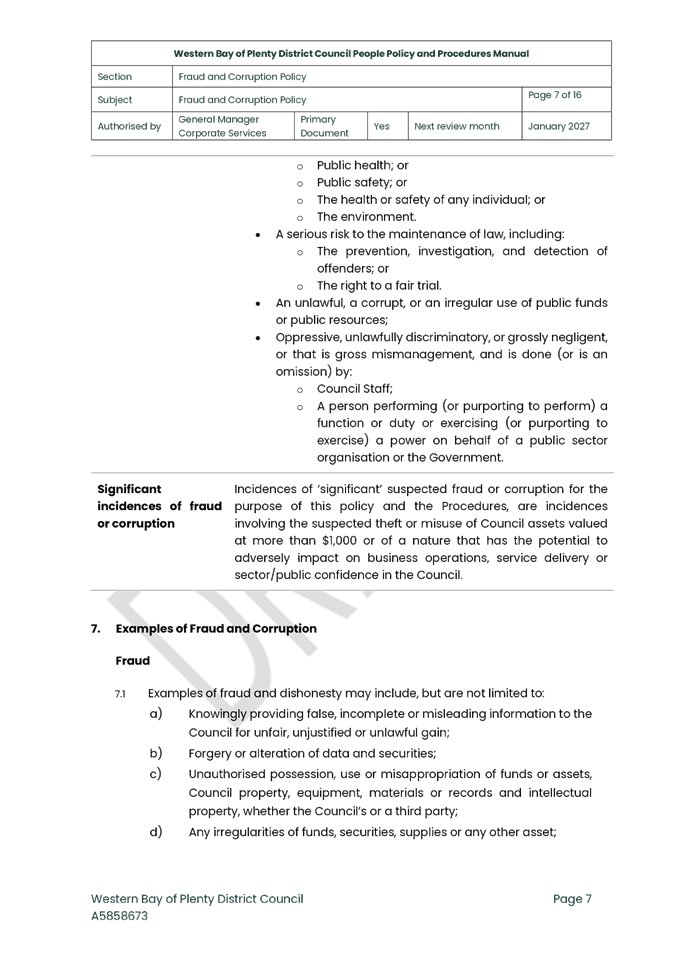
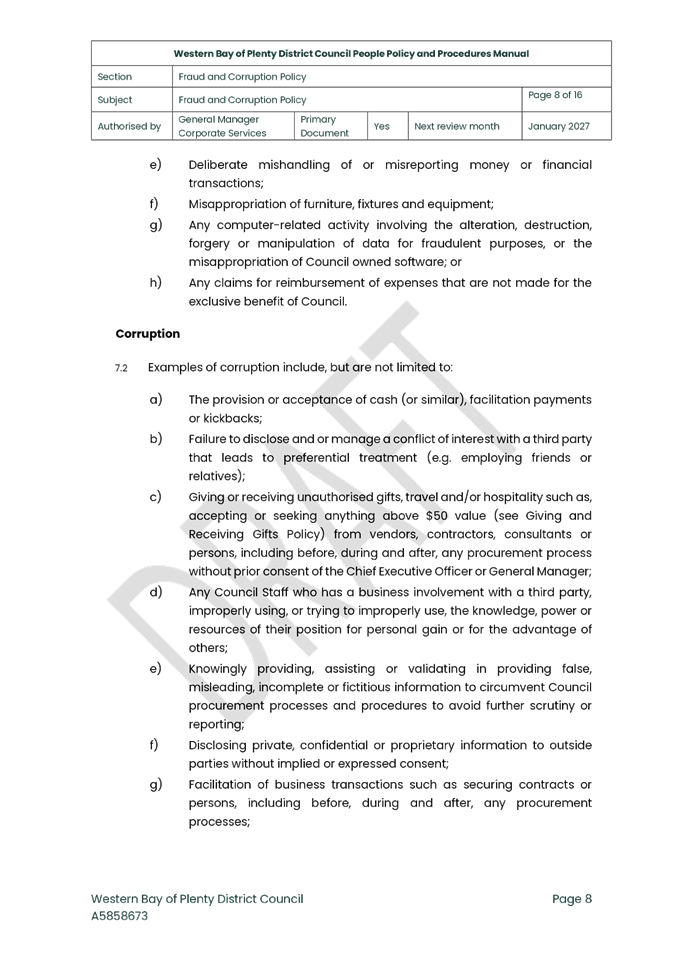
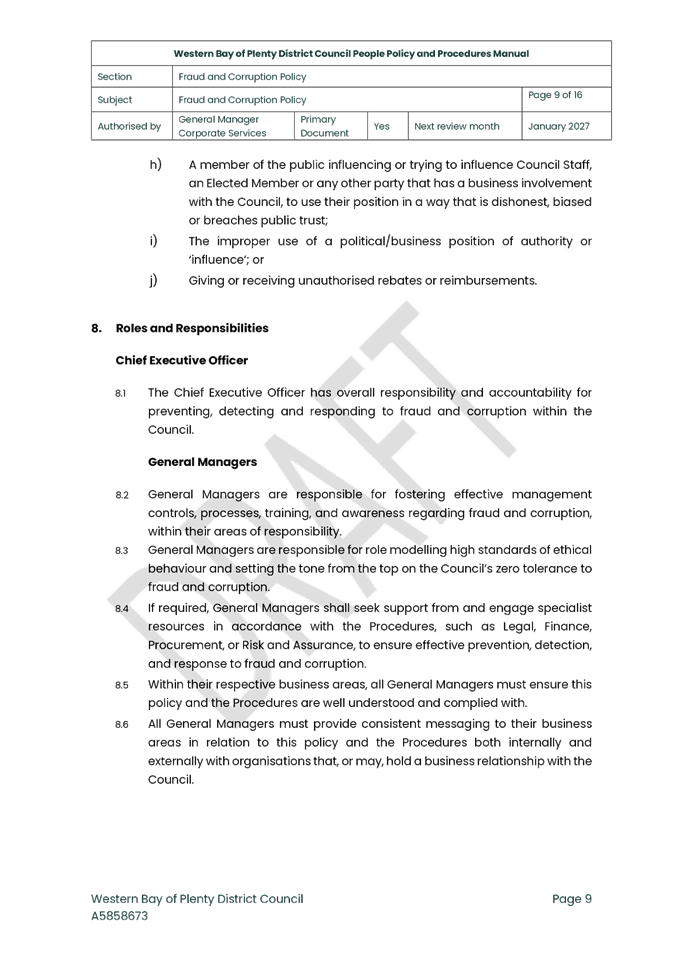
· Review Council’s Fraud Policy to determine that Council has appropriate processes and systems in place to capture and effectively investigate fraud related information.
Financial:
· To monitor the operational performance of Council’s activities and services against approved levels of service.
· Monitor financial performance against any Council approved joint contracts with other local authorities.
· Report financial outcomes and recommend any changes or variations to allocated budgets including both operational and capital expenditure.
· Provide oversight of legal risks, claims or proceedings (excluding the approval of any legal settlements).
· Recommend the adoption of the Annual Report and the approval of the Summary Annual Report to Council.
Power to Act:
The Committee is delegated the authority to:
· Receive and consider external and internal audit reports.
· Receive and consider staff reports on audit, internal control and risk management policy and procedure matters as appropriate.
· To approve the Auditors engagement and arrangement letters in relationship to the Annual Report.
Power to Recommend:
To make recommendations to Council and/or any Committee as it deems appropriate.
Power to sub-delegate:
The Committee may delegate any of its functions, duties or powers to a subcommittee, working group or any other subordinate decision-making body, subject to the restrictions on its delegations and provided any sub-delegation includes a statement of purpose and a specification of task.
|
Audit, Risk and Finance Committee Meeting Agenda |
27 February 2024 |
Notice is hereby given that a Audit, Risk and Finance Committee Meeting will be held in the Council Chambers,1484 Cameron Road, Tauranga on: Tuesday, 27 February 2024 on conclusion of the Projects and Monitoring Committee Meeting starting at 9.30am
10.2 Risk and Assurance Report February 2024
10.3 Financial Performance Update Quarterly Report 31 December 2023
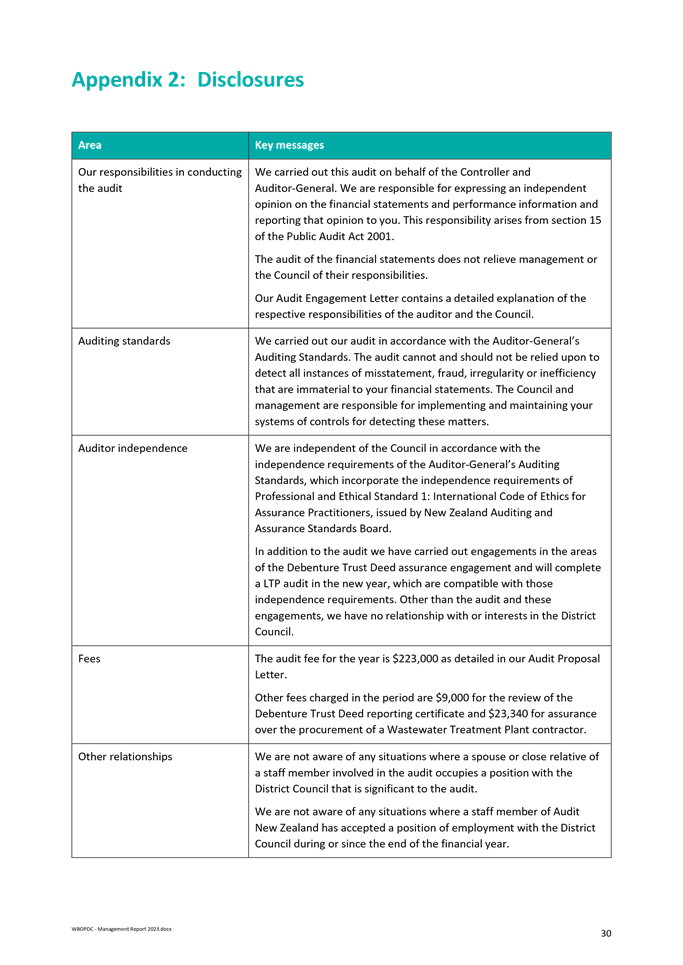
10.4 Final Audit Management Report 2023
10.5 Sensitive Expenditure Policy
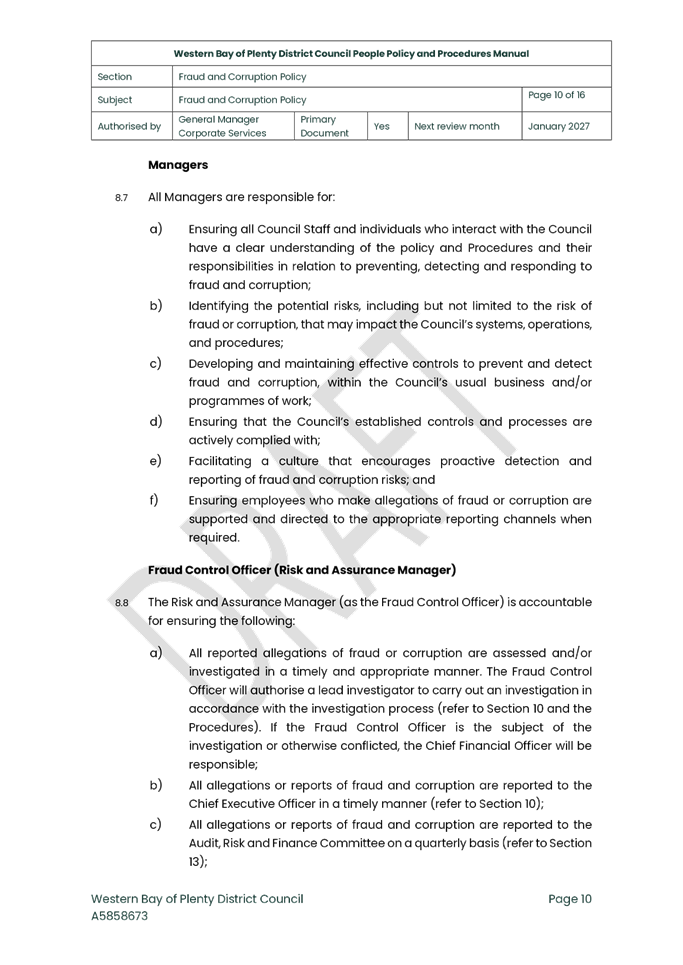
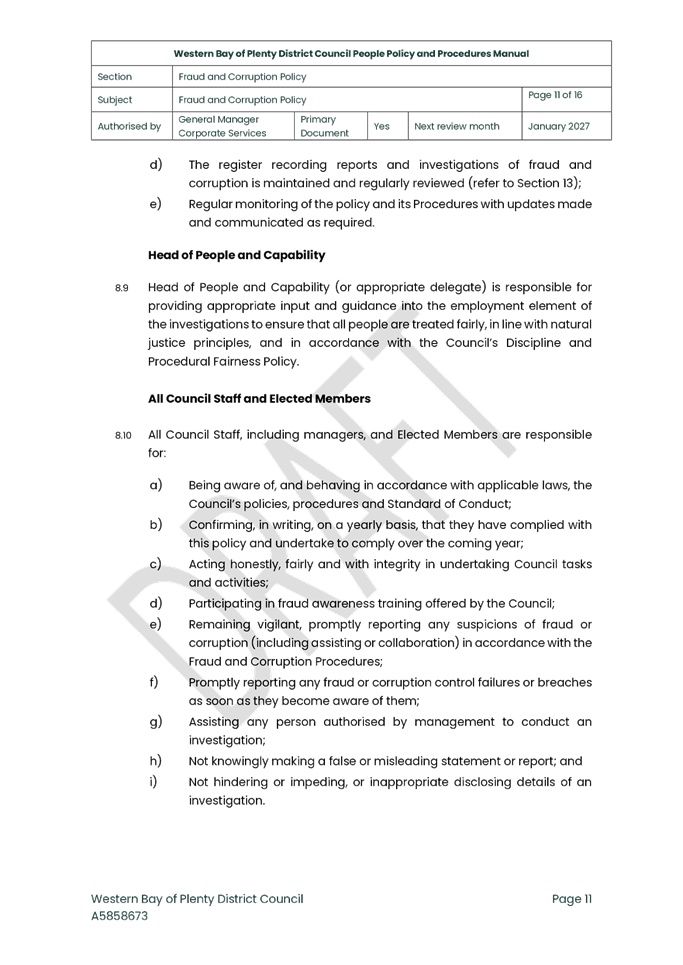
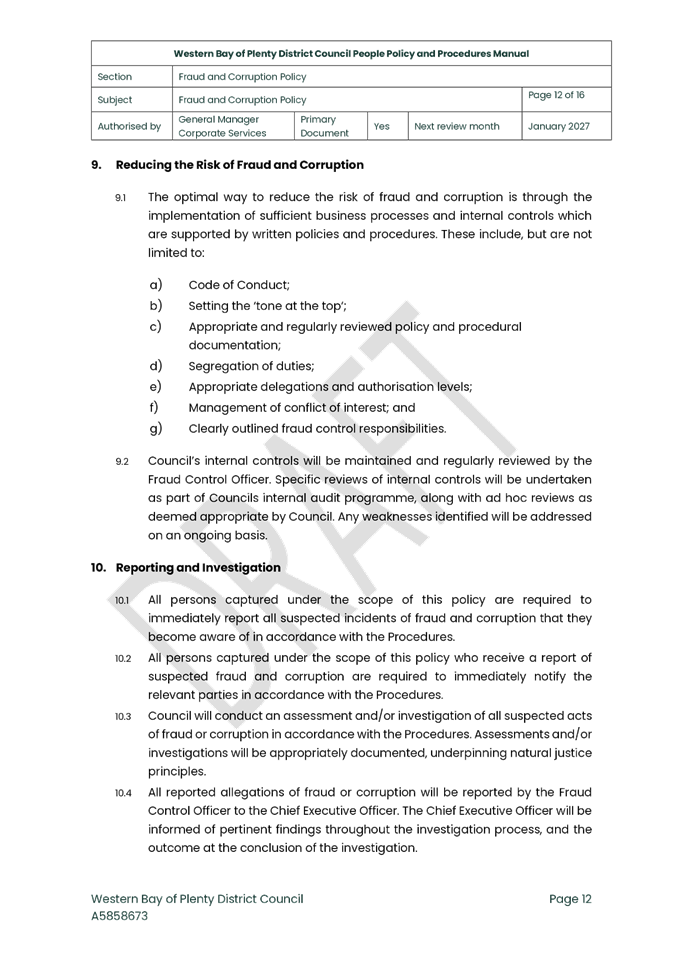
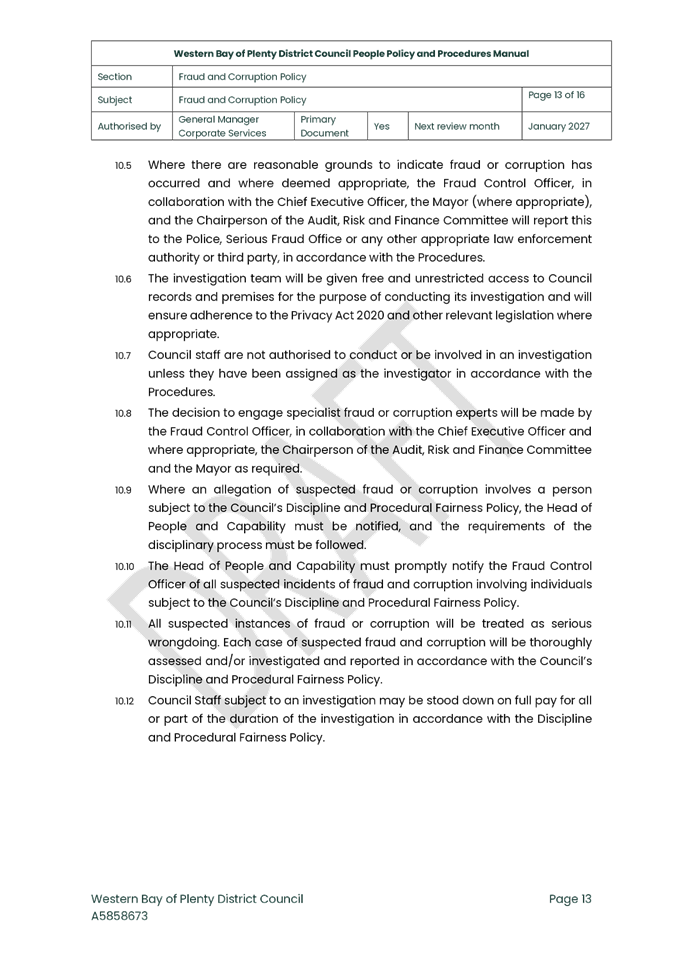
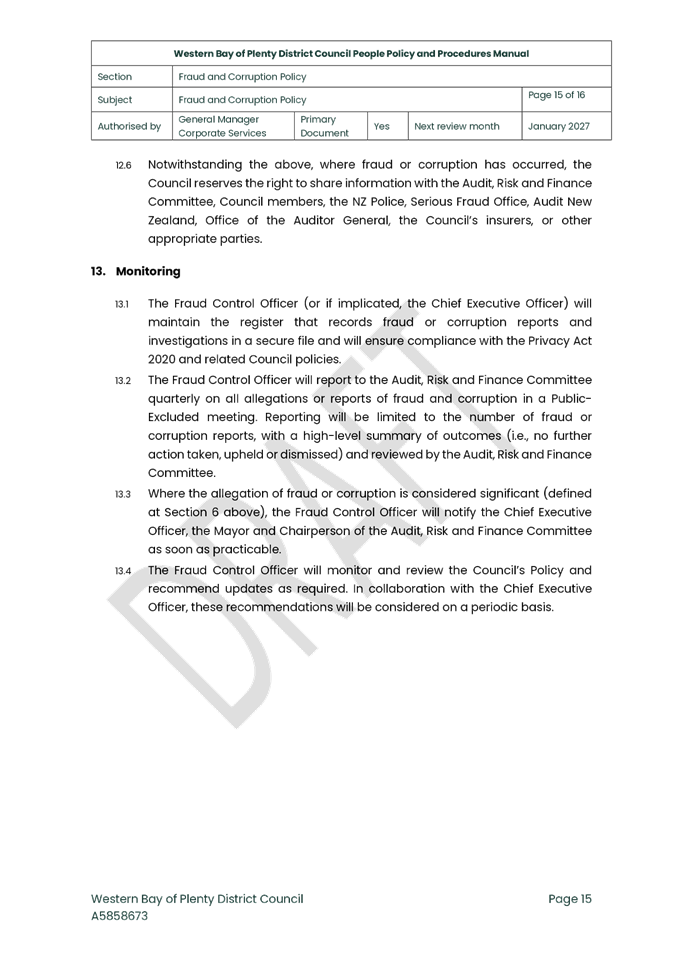
10.6 Fraud and Corruption Policy
11.1 Audit, Risk and Finance Committee Work Programme
12 Resolution to Exclude the Public
12.1 Outstanding Recommendations Register January 2024
12.2 Confidential Risk and Assurance Report February 2024
12.3 Litigation and Issues Watch Register Update February 2024
|
Whakatau mai te wairua Whakawātea mai te hinengaro Whakarite mai te tinana Kia ea ai ngā mahi
Āe |
Settle the spirit Clear the mind Prepare the body To achieve what needs to be achieved. Yes |
2 Present
Members are reminded of the need to be vigilant and to stand aside from decision making when a conflict arises between their role as an elected representative and any private or other external interest that they may have.
A period of up to 30 minutes is set aside for a public forum. Members of the public may attend to address the Board for up to five minutes on items that fall within the delegations of the Board provided the matters are not subject to legal proceedings, or to a process providing for the hearing of submissions. Speakers may be questioned through the Chairperson by members, but questions must be confined to obtaining information or clarification on matters raised by the speaker. The Chairperson has discretion in regard to time extensions.
Such presentations do not form part of the formal business of the meeting, a brief record will be kept of matters raised during any public forum section of the meeting with matters for action to be referred through the customer relationship management system as a service request, while those requiring further investigation will be referred to the Chief Executive.
|
27 February 2024 |
File Number: A5929949
Author: Clint Boyle, Health, Safety and Wellbeing Lead
Authoriser: Adele Henderson, General Manager Corporate Services
Executive Summary
This report provides a summary quarter ending December 2023:
· An overview of our proposed strategic direction; and
· The progress against the health, safety and wellbeing strategy and work programme.
· The health and safety performance across the organisation for the previous quarter;.
|
That the Health, Safety and Wellbeing Lead’s report dated 27 February 2024 titled ‘Health and Safety Report’ be received.
|
Strategic Direction
Our focus continues areas include building knowledge, understanding and behaviours of our people in managing health, safety, and wellbeing at work via implementation of our Health, Safety and Wellbeing Strategy.
 |

Our focus areas and activities align to the strategic direction for 2024, include:
· Continuing to regularly provide information, guidance, and support on relevant matters to our people.
· Developing robust and efficient systems and processes to ensure our contractors are representing Council well in our communities and delivering safe outcomes. Consideration will be given during this process to the social procurement model, and the implications presented by that model.
· Establishing and instilling a series of proactive safety behaviours within our teams to continue to drive a positive safety culture.
· Acting on the report on the mental health and wellbeing risks that our work presents for our people.
· Developing a wellbeing strategy to reduce the impact of wellbeing for our people.
· Continuing to develop positive working partnerships with our key contractors.
· Developing user friendly and informative reporting and management tools for our leaders to manage health and safety within and for their teams.
· Further improvements to our health, safety and wellbeing systems and processes.
EVents of note
We encountered two non-work-related events within our facilities in the quarter which were significant in nature, and had the potential for more severe outcomes. While work of Western Bay or related contractors did not contribute to these events at all, there is still some learnings to be taken away from them to improve the site safety moving forward.
|
Site |
What Happened |
Contributing Factors |
Corrective Actions |
|
Katikati Wastewater Treatment Plant |
A member of the public slipped and fell into a treatment pond after business hours, while trying to rescue their dog who had entered the facility. Both were able to safely remove themselves from the pond with only minor injury sustained. |
Not work related, however it occurred at one of our sites. Dog chased a rabbit, finding a small gap in the perimeter fencing. No signage indicating the high hazard nature of the facility. |
Hazard signage has been installed. Perimeter fencing has been reassessed and improved where necessary. Review of the available pond exit systems (in progress). |
|
Te Puna Quarry Park |
A group of primary school aged children and parents/teachers became disoriented within the Park having followed trapping lines during a school excursion. The group reacted well once they identified they had gone off the public tracks. Police and Land Search and Rescue were engaged to facilitate a safe exit, which occurred without injury or incident. |
Not work related, however it occurred at one of our sites. There was no signage indicating that the track was not for public access. The maps available did not represent the accurate location for the group when lost. |
Recommended that signage is installed at all pest control track access points. Review of booking processes for school groups (in progress). Review of site maps to be included in the review of the TPQP Reserve Management Plan. |
training
Several of our people completed First Aid training in the December 23 quarter. Our sites are well covered from a First Aid perspective.
Many of our people attended the Protecting our Crowded Places from Attack webinar, hosted by Taituarā. This webinar aimed to support local government organisations with identifying and responding to threats or incidents that may occur at Council run events and/or workplaces. This was helpful in ensuring that our systems and processes consider the most up to date guidance and information in this area.
HAZARD AND RISK MANAGEMENT
Our risk assessment is based on the table below.
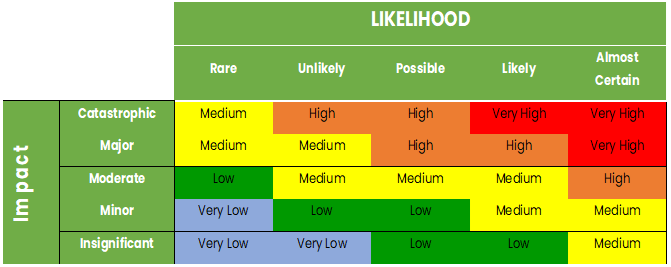
The risk matrix was presented to and accepted by SLT in 2023 to manage health and safety risk.
The table below represents our risks rated as high from our Critical Risk Register
The aggressive customer risk was presented in the last Audit Risk and Finance Committee report. Mitigations and controls have been put in place, and we are seeing a reduction in the number of events. It is likely that this risk will be down graded for our next report if this trend continues.
|
Critical Risk |
Current Risk Rating |
How it’s controlled |
|
Aggressive customers |
High |
§ Design improvements for relevant sites § Security guard deployed where relevant § Panic alarm installed (some sites) § Remote lockable doors installed § De-escalation/Dealing with Aggressive People training provided § Body Worn Cameras where relevant § Two way radio in place (Regulatory) § Managing Aggressive People Policy in place § Emergency response procedures at each site |
|
Mental health and wellbeing |
High |
§ Mental health and wellbeing policy § EAP offering to our people § Full hazard identification, risk assessment and control § implementation project under way |
REVIEW OF PERFORMANCE
Summary - Event Type
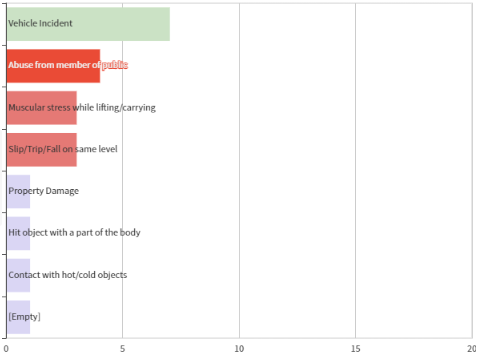
Total event numbers decreased for the December 2023 quarter. The number of physical injuries sustained also decreased, however, we experienced an increase in vehicle related events. (This includes intimidation-based events with no physical incident).
As previously outlined, we sustained one MTI in the quarter. The person has since fully recovered and was able to work full duties throughout their rehabilitation.
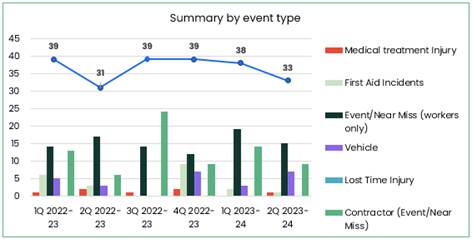
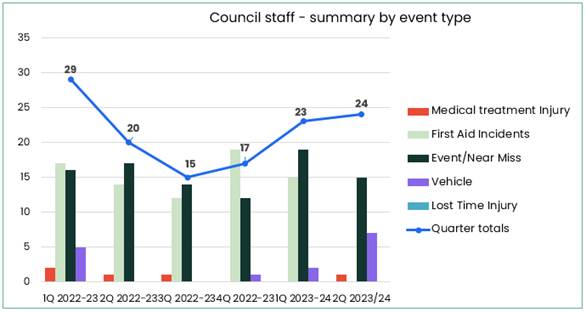
Our People Events - Trends
Reports of exposure to aggressive/abusive behaviour continued to decrease. Feedback from our people indicates that attitudes and interactions within our communities have generally improved, with less aggressive behaviour observed across the board. The focus on this hazard, and the amendments and improvements made through the course of 2023 have assisted with reducing the prevalence of these events also, with our people better equipped and more confident in ensuring potential episodes are stopped before they can begin.
As noted, vehicle related events were the most common event type through the quarter. Many of these were near misses rather than physical events, however it is positive to note that our near misses continue to be reported. There were no injuries sustained because of these events.
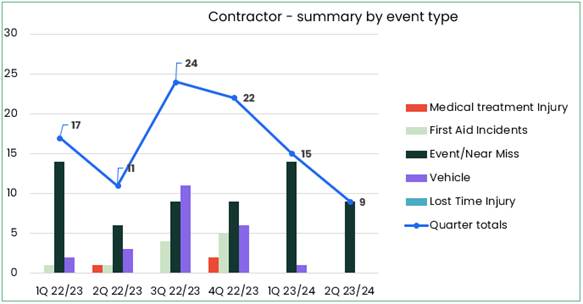
Contractor Events
Contractor events continue to trend down, and again there were no significant events. Council staff continue to increase visibility with inspecting the works of our contractors, contributing to safer works occurring in our communities.
Contractor management is a key component to the overall health and safety strategy. These proactive activities form a key part in ensuring that we are maintaining sufficient oversight and due diligence on our contractors working in our communities.
Cause of event
Driving our vehicles contributed the highest number of events throughout the December quarter. 28% of our vehicle events resulted in a collision/damage to the vehicle, albeit minor in nature. These collisions were at low speed and did not cause injury to any of our people.
Note: The graphs below represent mechanisms of events experienced by Council people and does not include contractors.
Lead Indicators
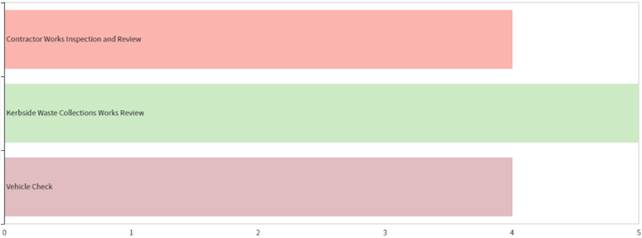
We observed a 30% increase in the number of inspections undertaken through the quarter compared to the previous quarter. These inspections are designed to identify issues before they result in an event. The inspections completed did not highlight any obvious areas for improvement.
As a reminder:
Contractor Works Inspection and Review Reviewing the works conducted by our contractors within our communities from a safety perspective.
Critical Risk Review – Vehicle Operation An extension to the Critical Risk review outlined in this report, this check seeks to evaluate the controls expected to be in place and adhered to, to reduce the likelihood of an event due to vehicle operation.
Kerbside Waste Collection Works Review A quick visual assessment of the conduct and behaviour of our kerbside contractor undertaking works on our behalf.
Vehicle Check A visual assessment of operational condition of the vehicles that our people drive to conduct day to day business.
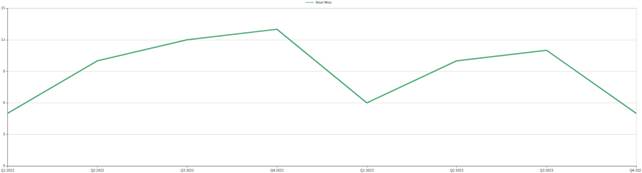
Near Miss Reporting Events that did not result in an injury or property damage but could have done so with a slight change in conditions.
Inspections
Near Miss Reporting
Lag Indicators (Accident/Incident Frequency Rates)
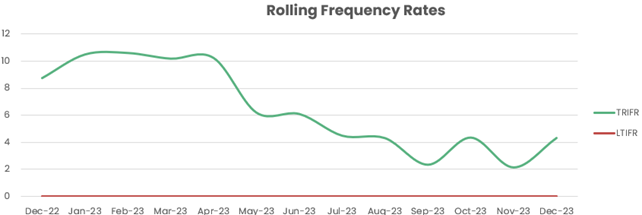
Total Recordable Injury Frequency Rate (TRIFR) increased due to the MTI sustained in the quarter. The TRIFR remains at an acceptably low rate however, continuing to demonstrate injury severity remaining low and good injury management processes.
Lost Time Injury Frequency Rate (LTIFR) remains at 0.00.
WELLBEING
Our mental health and wellbeing hazard and risk project was the main wellbeing activity that occurred in the quarter.
|
27 February 2024 |
10.2 Risk and Assurance Report February 2024
File Number: A5929993
Author: Azoora Ali, Chief Financial Officer
Authoriser: Adele Henderson, General Manager Corporate Services
Executive Summary
The Risk and Assurance report is to provide the committee with information on the risk management and internal audit activities since the last Audit, Risk and Finance Committee meeting held on 7 November 2023. Council needs to consider the emerging risks and potential impacts for both the current financial year and the Long Term Plan 2024-34 during its development.
|
That the Chief Financial Officer’s report dated 27 February 2024 titled ‘Risk and Assurance Report February 2024’ be received.
|
Background
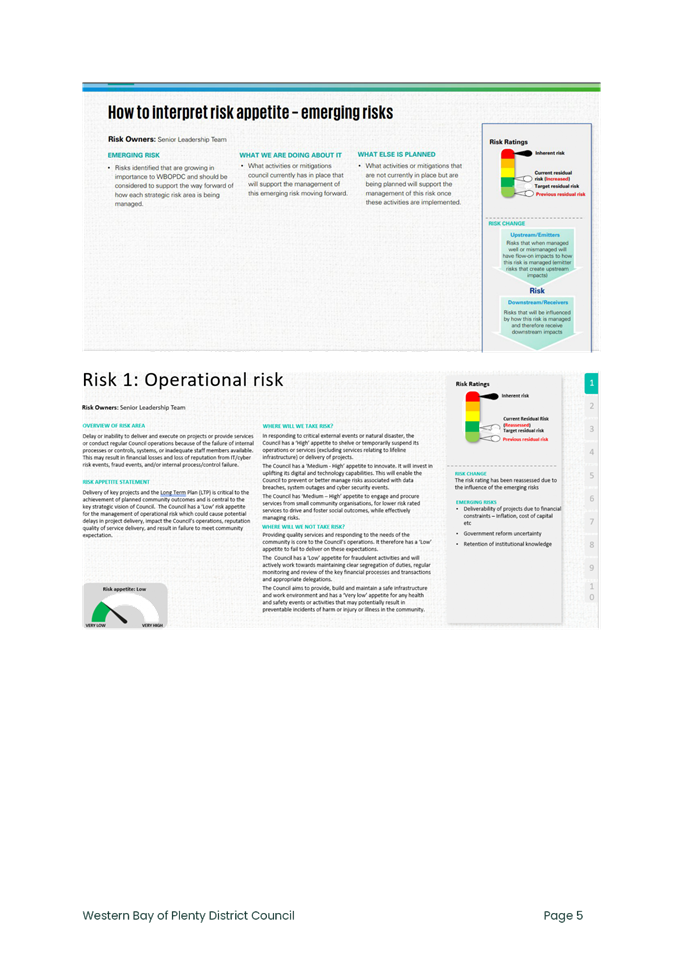
1. The Risk and Assurance Report February 2024 provides an update on:
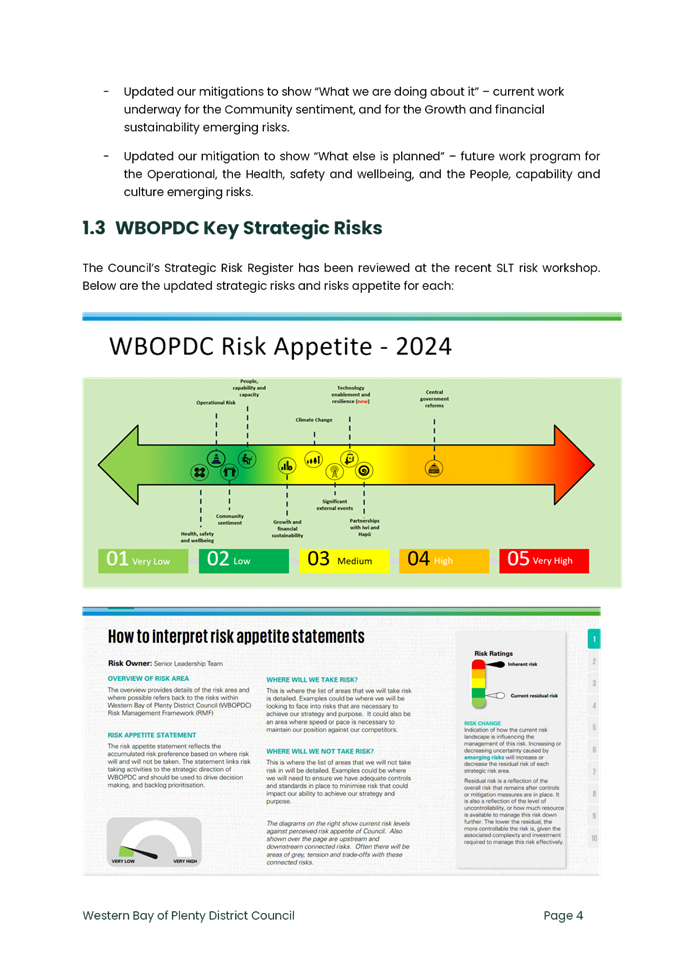
· Western Bay of Plenty District Council Strategic Risk Register;
· Emerging Risks and it’s linkage to Council Strategic Risks; and
· Internal Audit Plan 2023/24 to 2025/26.
2. There have been some changes to WBOPDC ‘s strategic risks since it was last reported at the last Committee meeting. To ensure that our strategic risks are managed proactively, Risk and Assurance have carried out quarterly risk workshops with SLT prior to the Committee meeting.
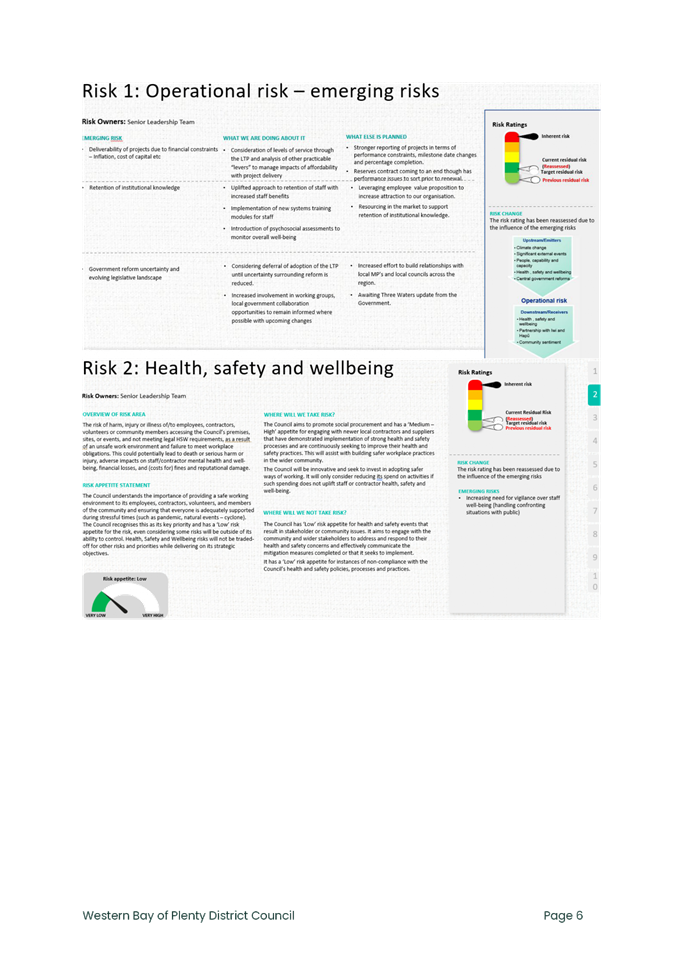
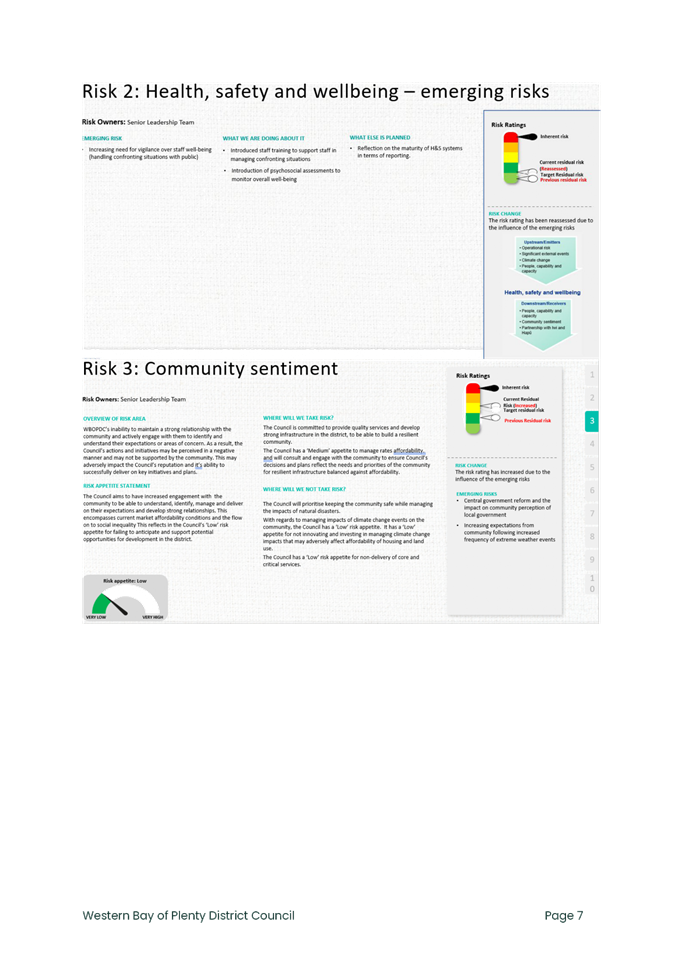
4. Across the risks there are a number of key themes:
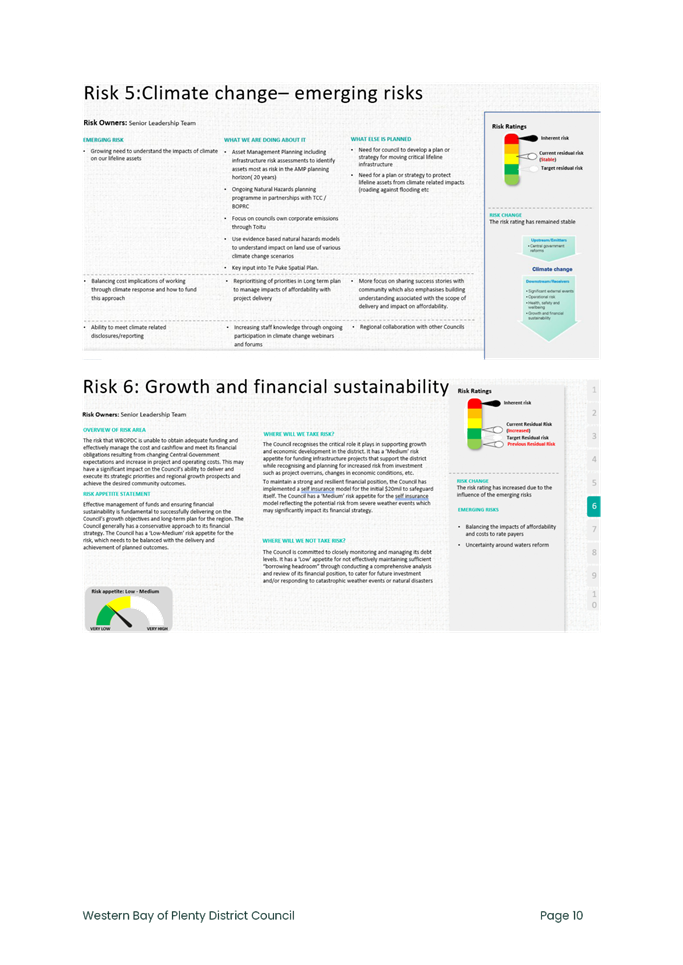
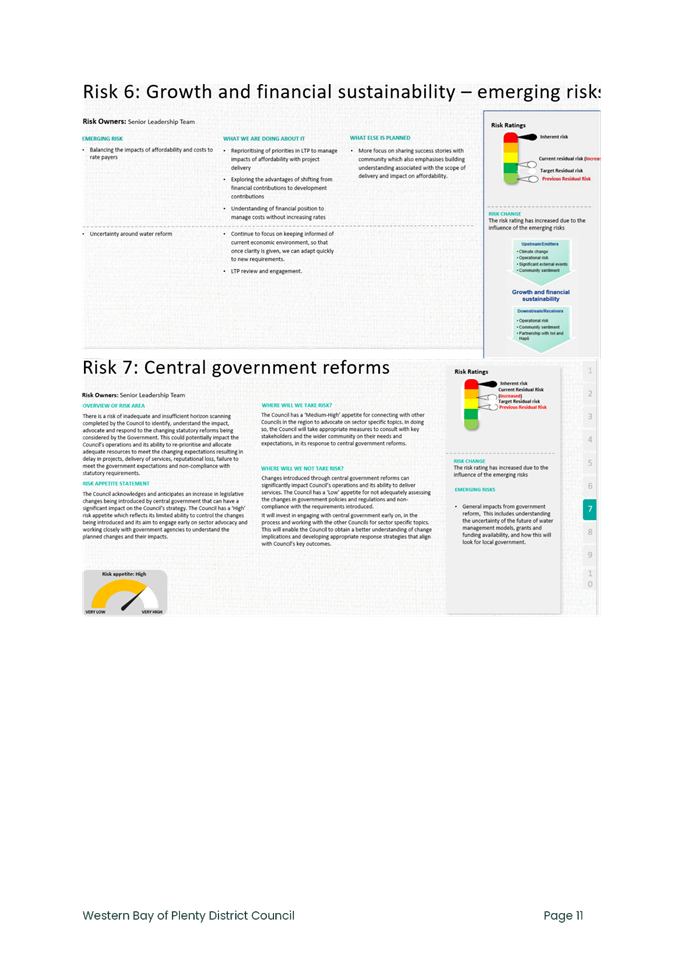
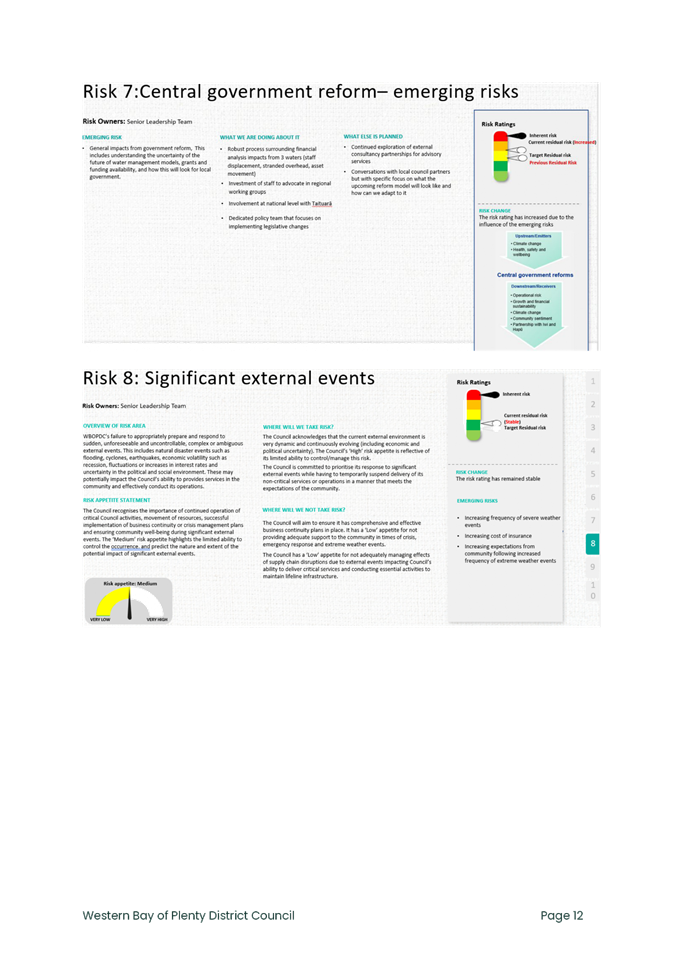
a) Change in government and anticipated changes to government reforms (including resource management and three waters). These may have significant impacts on Council operations and decisions.
b) Affordability concerns for our ratepayers due to rising inflation, increasing interest rates, and deterioration of the economy. These factors impact ratepayers directly and also our rates that need to be levied.
c) The deliverability of programmes, which are being impacted by a wide range of factors including increasing costs, staff capacity and capability, availability of skilled contractors and the distraction from potential reforms.
d) The
need for digital connectivity between Council and Community that will require
embracing of new technologies.
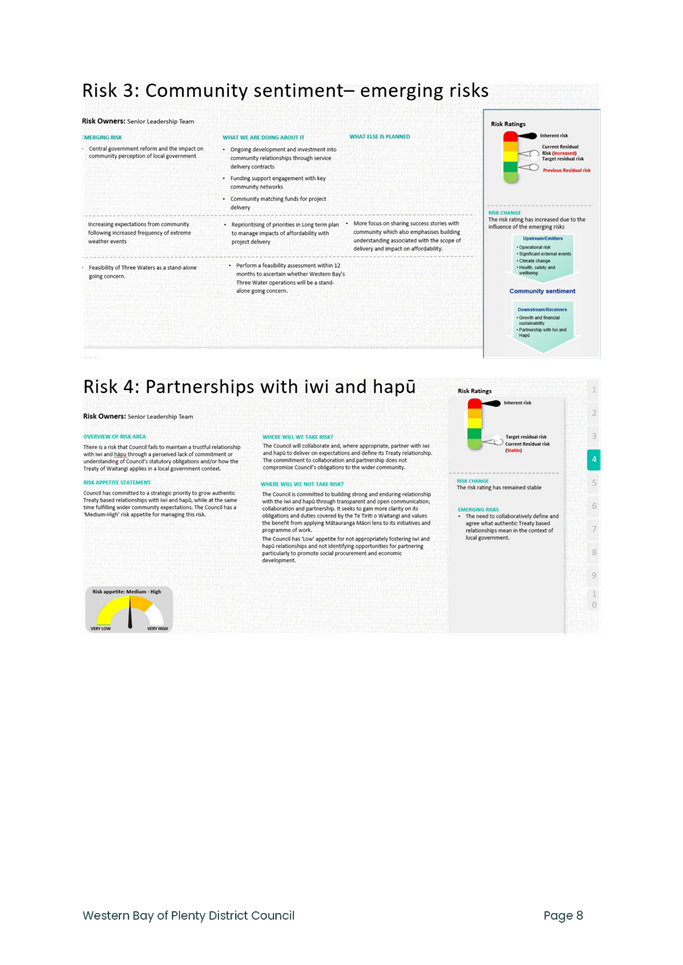
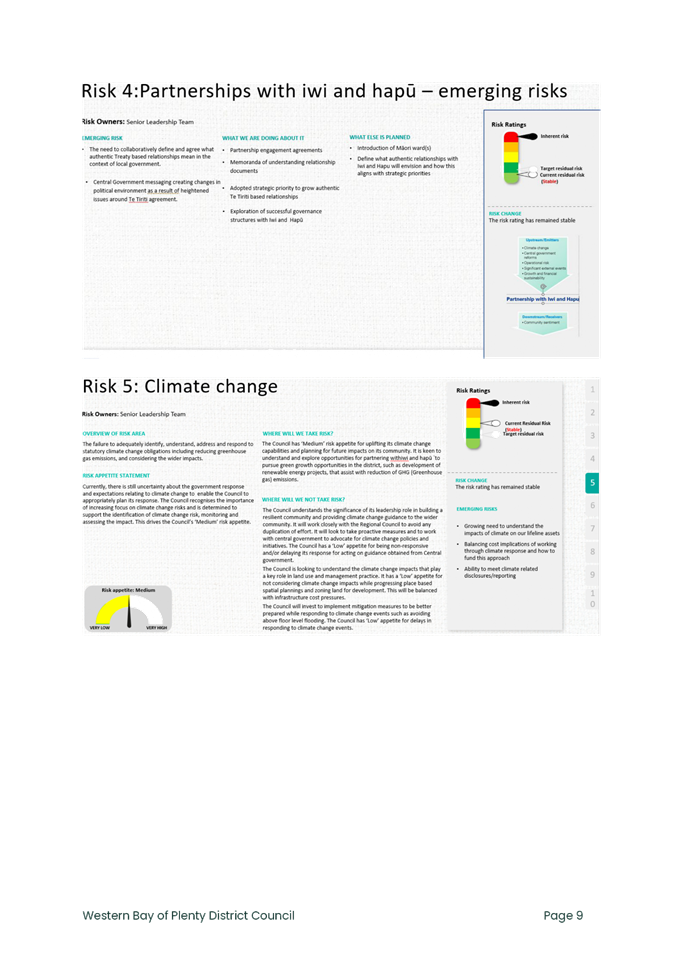
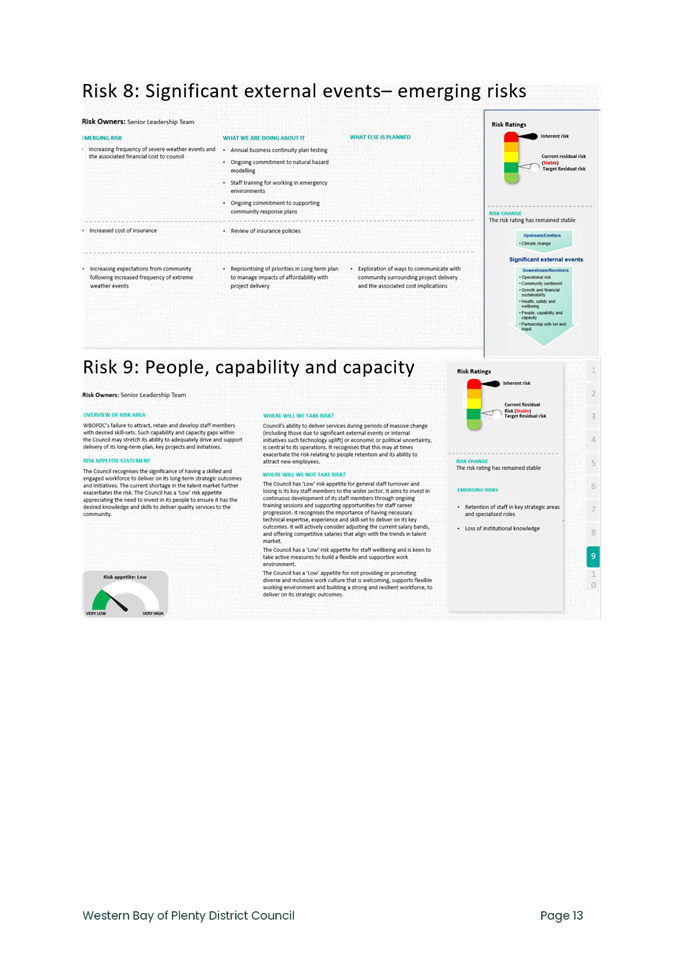
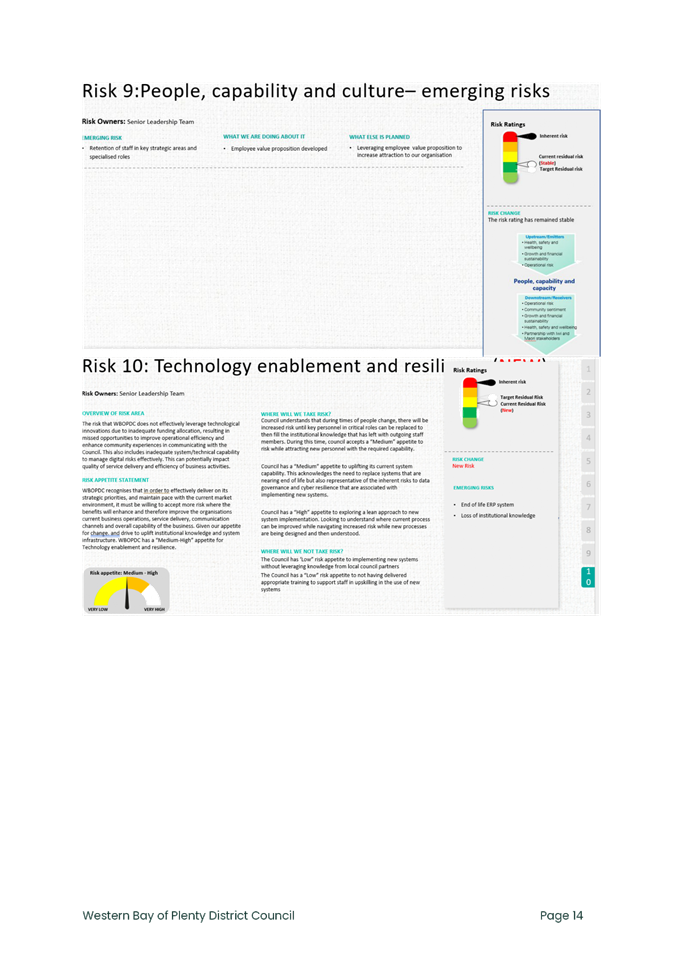
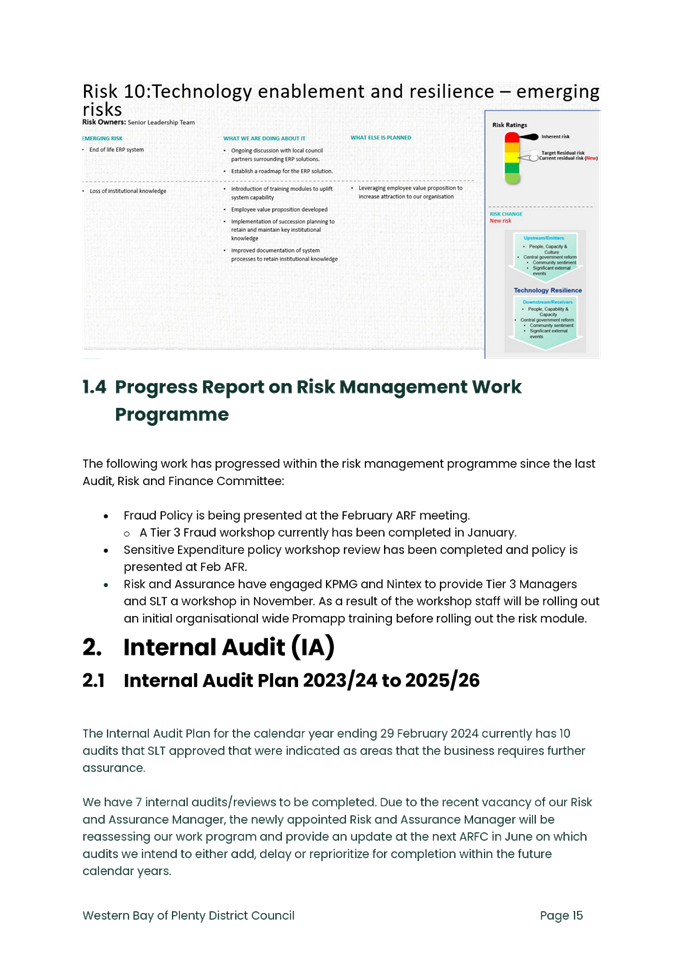
5. There has been an update in the emerging risks section of the report. These are captured following each strategic risk. The following new emerging risks have been identified since the last committee update including mitigations underway for each emerging risk:
a) Operational Risks
· Stronger reporting of projects in terms of performance constraints, milestone date changes and percentage completion.
· Reserves contract coming to an end though has performance issues to sort prior to renewal?
· Resourcing in the market to support retention of institutional knowledge.
· Awaiting Three Waters update from the Government.
b) Health, safety and wellbeing
· Reflection on the maturity of H&S systems in terms of reporting?
c) Community Sentiment:
· Uncertainty on legislation being planned to be repealed by central government and the impact on community perception of local government.
· Feasibility of Three Waters as a stand-alone going concern.
d) Partnerships with Iwi and Hapū
· Central Government messaging creating changes in political environment as a result of heightened issues around Te Tiriti agreement.
e) Growth and Financial sustainability
· Uncertainty around waters reform would necessitate further LTP review and engagement.
f) Technology enablement and resilience
· Establish a roadmap for the ERP solution.
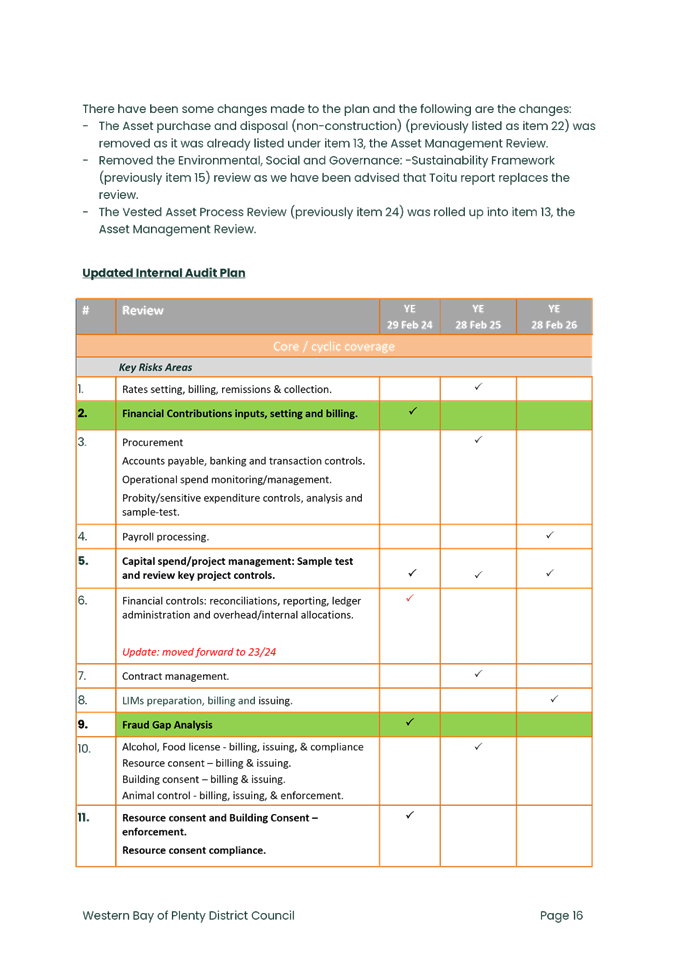
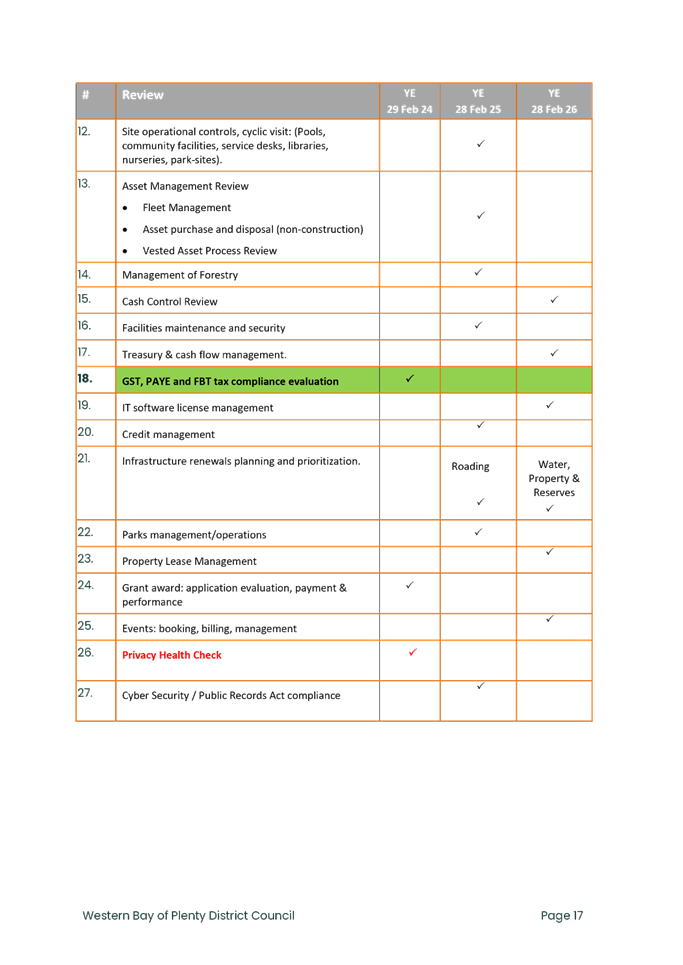
6. The internal audit plan has highlighted two audits and assurances that have been completed for GST and FBT tax compliance evaluation. These two reports will be presented at the February 2024 ARFC meeting.
1. Risk
and Assurance Report February 2024 ⇩ 
|
27 February 2024 |
10.3 Financial Performance Update Quarterly Report 31 December 2023
File Number: A5929982
Author: Sarah Bedford, Finance Manager
Authoriser: Adele Henderson, General Manager Corporate Services
Executive Summary
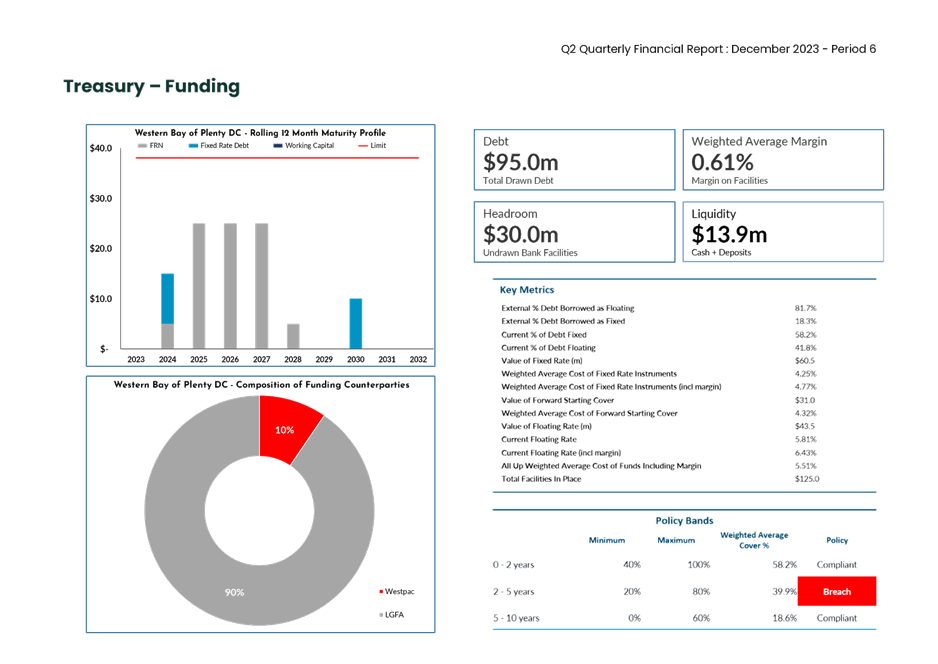
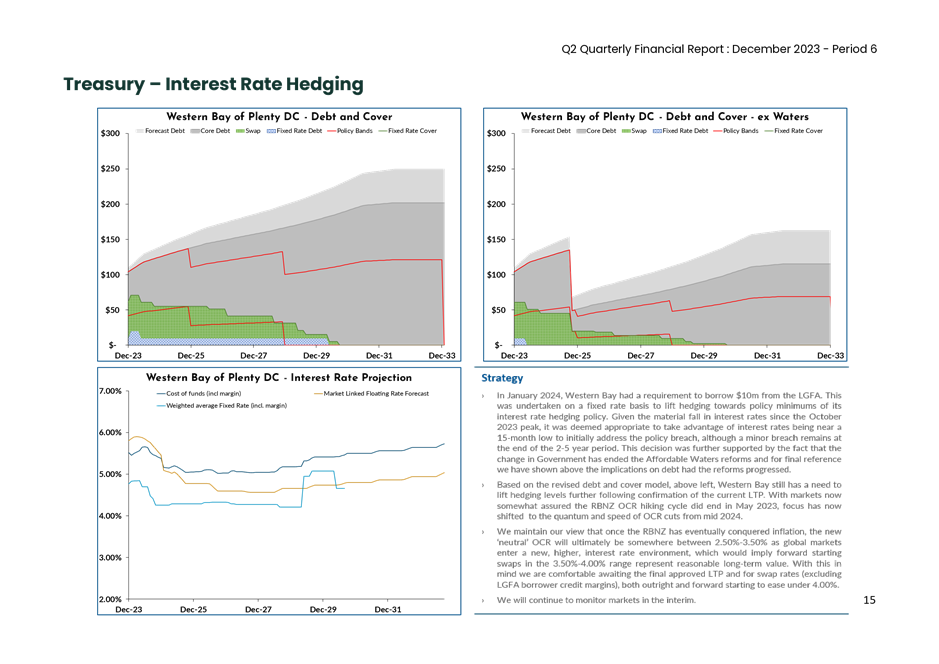
This report provides the Audit, Risk and Finance Committee with the current Treasury Policy breaches in relation to interest rate hedging, which had been identified in previous financial reports.
|
That the Finance Manager’s report dated 27 February 2024 titled ‘Financial Performance Update Quarterly Report 31 December 2023’ be received.
|
Summary - financials
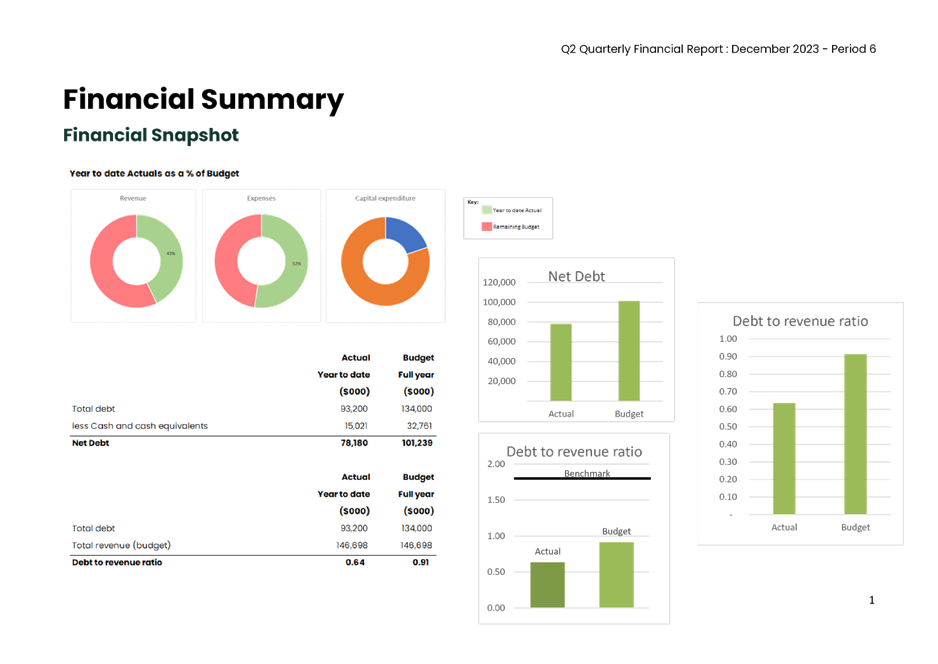
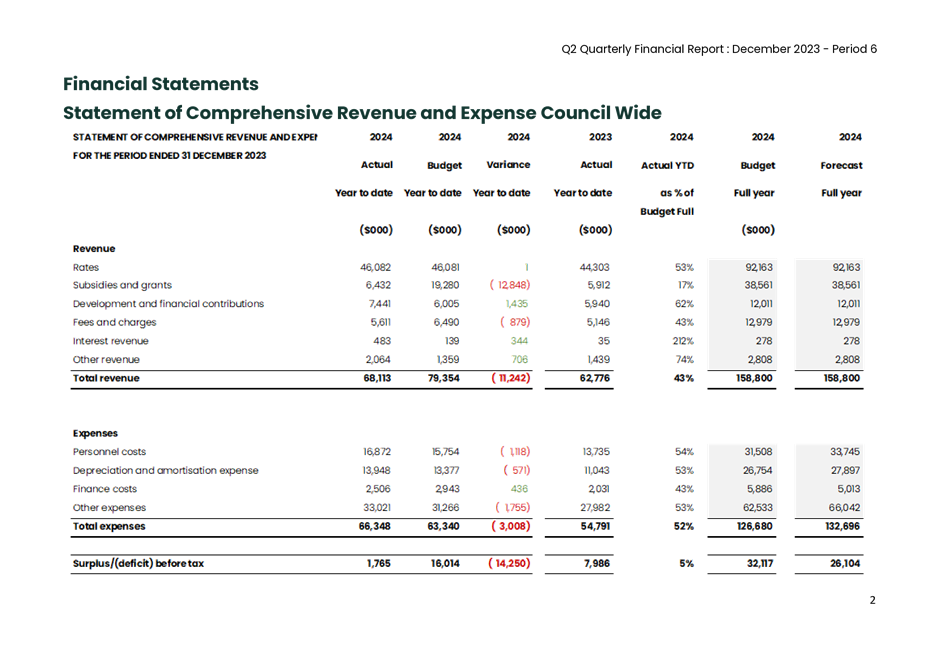
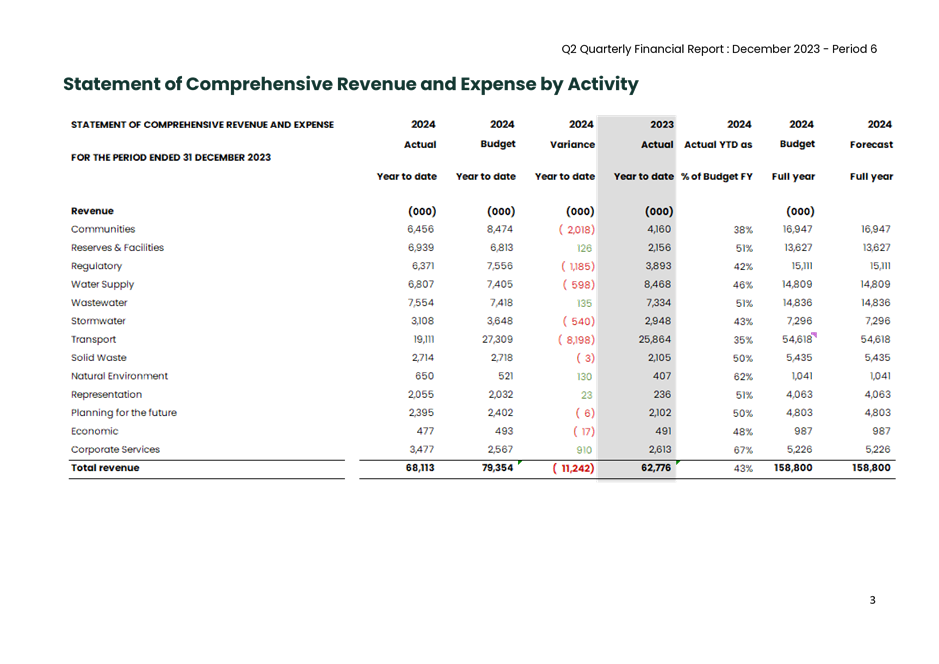
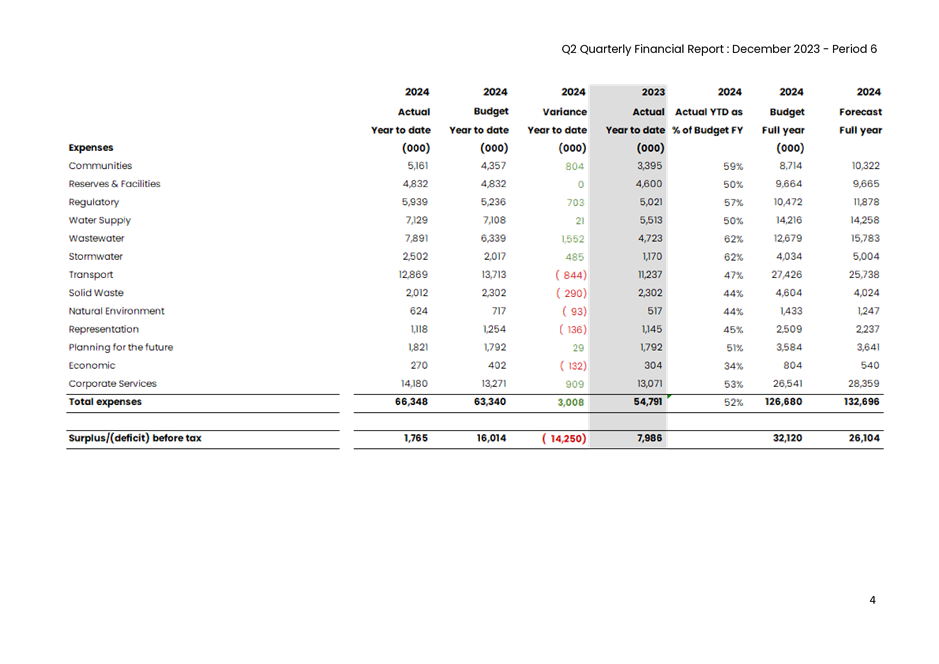
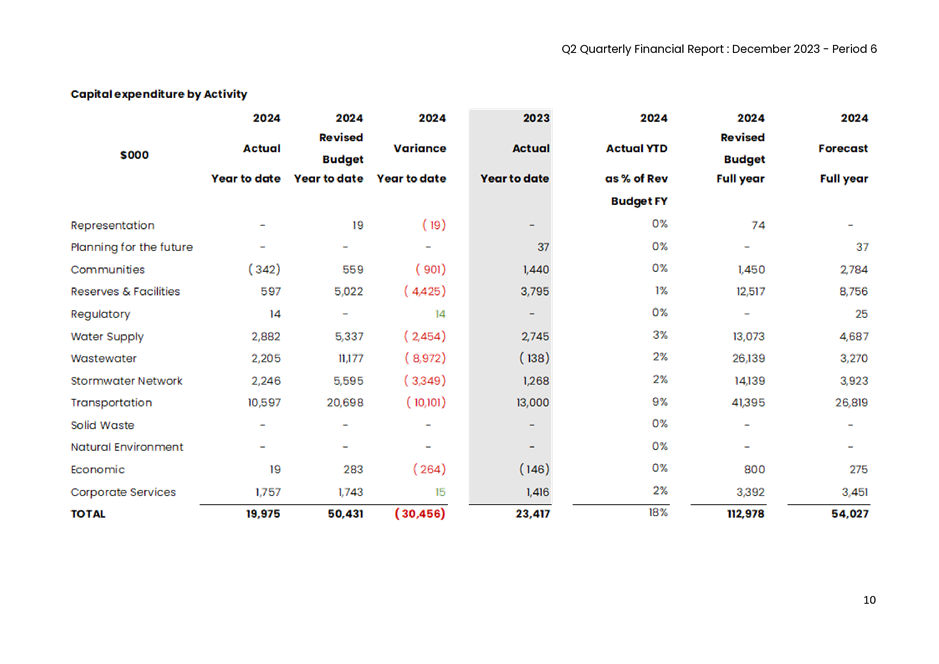
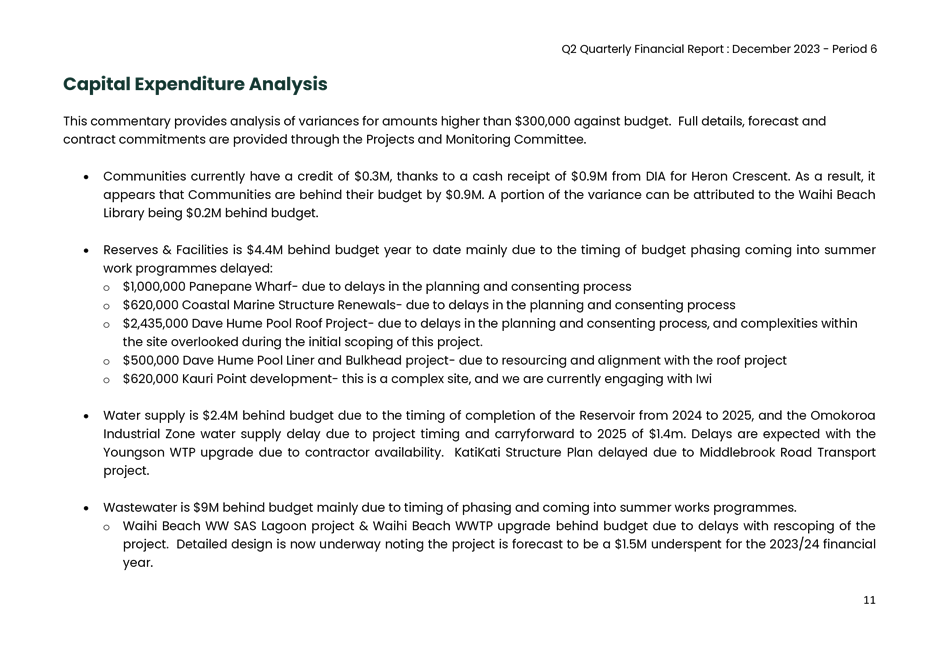
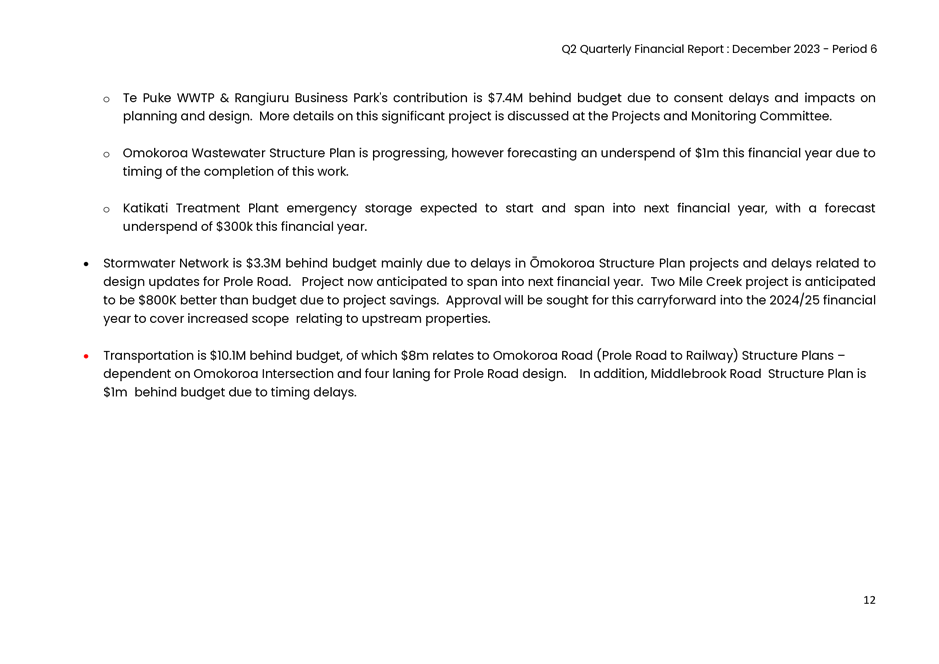
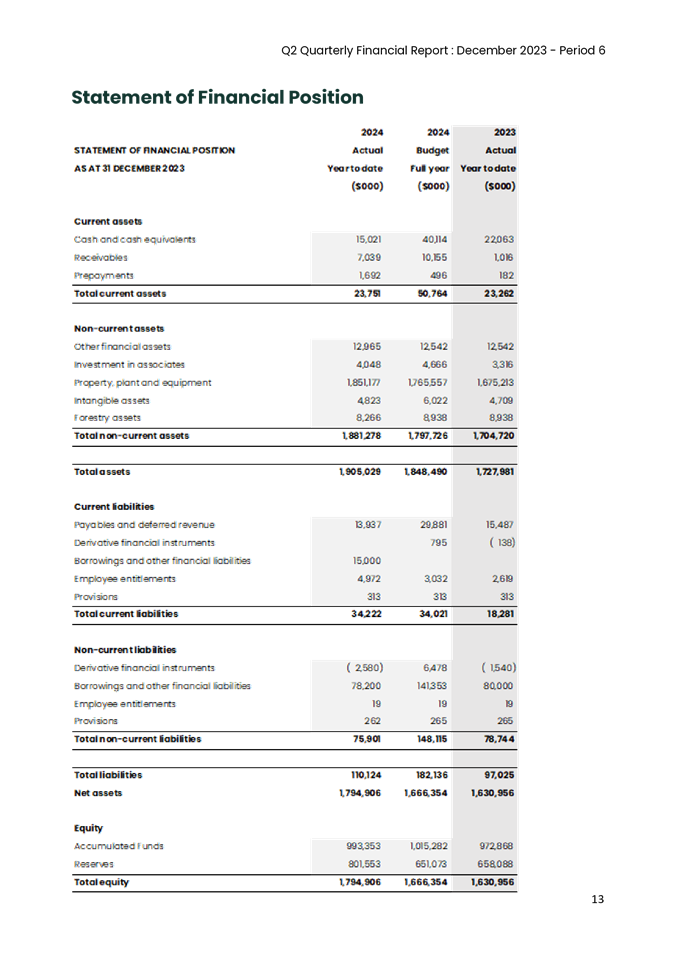
1. The following is a summary of the financial performance for the period ended 31 December 2023 along with associated financial statements. (Refer to Attachment 1).
2. The current capital budgets are as per the adopted annual plan and approved carryforward funding from the prior year.
3. The below table is a summary of financial performance for the 6 months ended 31 December 2023.
|
Statement of comprehensive revenue and expense |
Actual $000’s |
Budget YTD $000’s |
Variance $000’s |
|
Revenue |
68,113 |
79,354 |
(11,243) |
|
Expense |
66,348 |
63,340 |
(3,008) |
|
Surplus/(deficit) |
1,765 |
16,014 |
(14,250) |
|
Total Revenue - Actual vs Budget |
43% |
||
|
Total Expenses - Actual YTD vs Budget YTD |
52% |
||
|
Statement of financial position |
Actual YTD
|
Budget Full Year $000’s |
|
|
Assets |
1,905,029 |
1,848,490 |
|
|
Liabilities |
110,124 |
182,136 |
|
|
Equity |
1,794,906 |
1,666,354 |
|
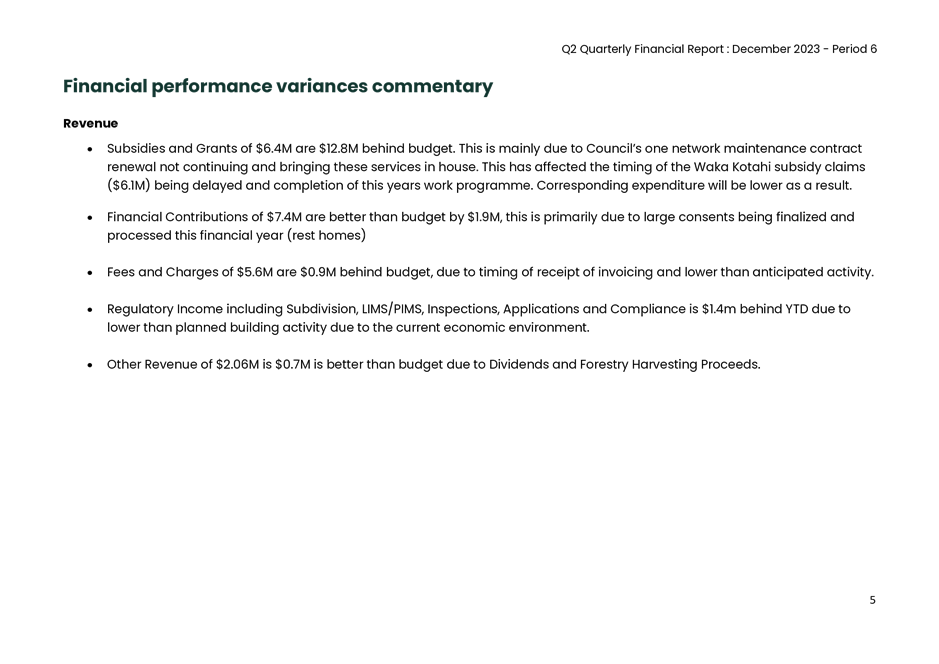
4. Financial Performance – For the 6 months ended 31 December 2023 Council returned a surplus of $1.7M, noting this was lower than budget. This is due to lower than planned Subsidies and Grants from Waka Kotahi ($6m), lower Fees and Charges revenue, and lower Regulatory revenue as a result of the current economic climate.
1. Financial
Performance December 2023 ⇩ 
|
27 February 2024 |
10.4 Final Audit Management Report 2023
File Number: A5939199
Author: Sarah Bedford, Finance Manager
Authoriser: Adele Henderson, General Manager Corporate Services
Executive Summary
1. The purpose of this report is to provide Elected Members an opportunity to review the Audit Management Report on the audit of Western Bay of Plenty District Council for the year ended 30 June 2023.
|
That the Finance Manager’s report dated 27 February 2024 titled ‘Final Audit Management Report 2023’ be received. |
Background
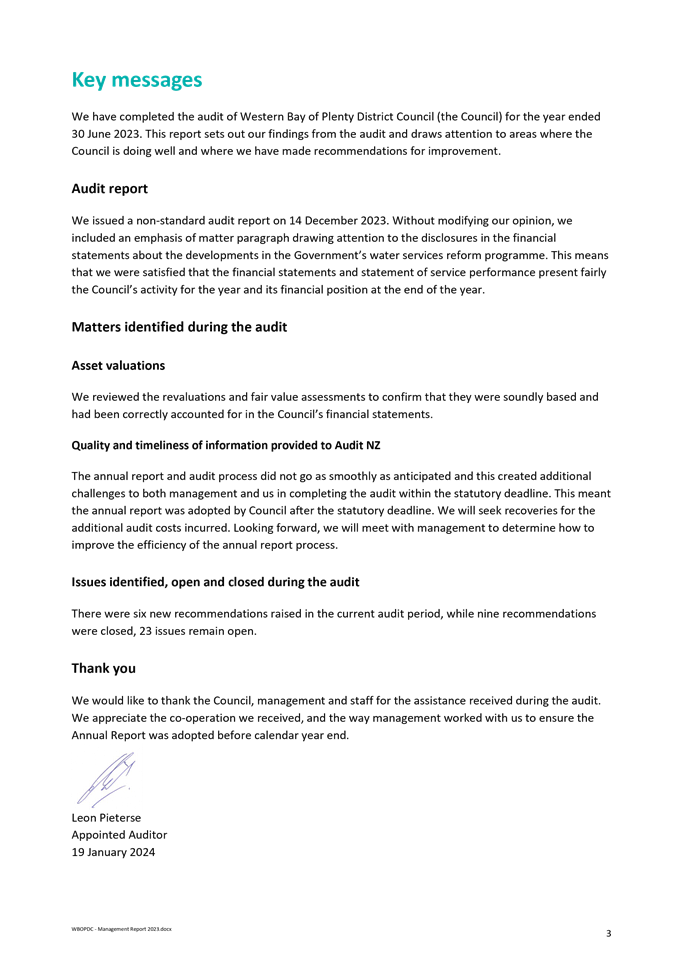
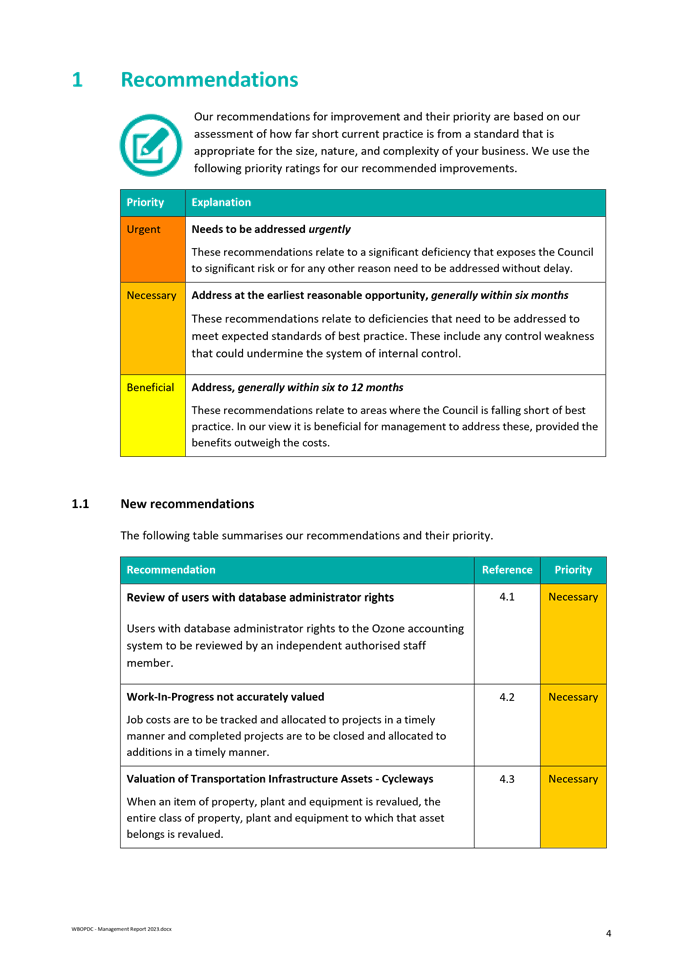
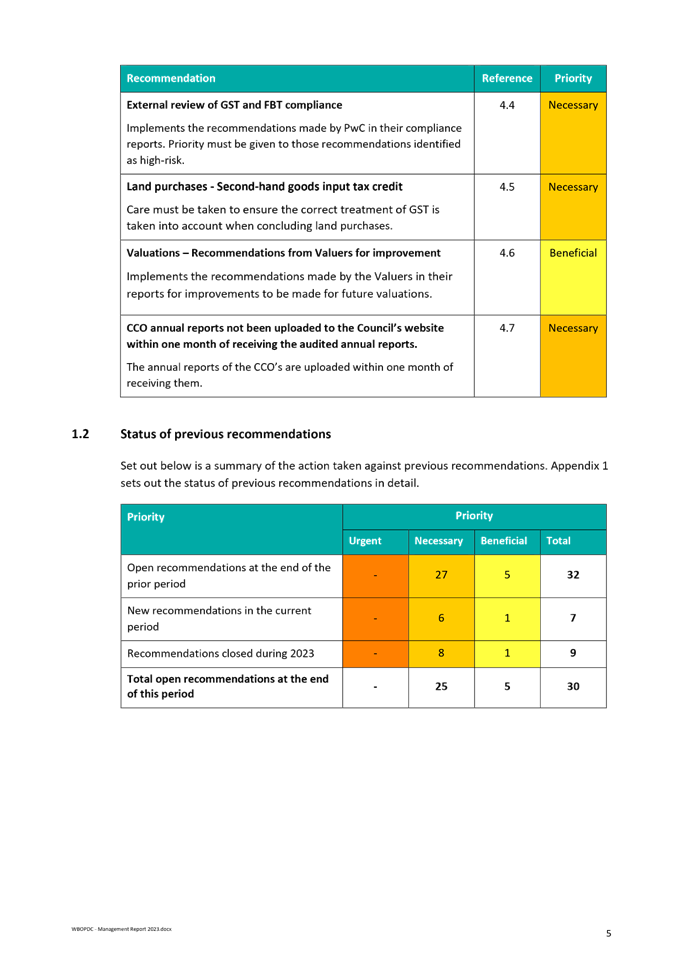
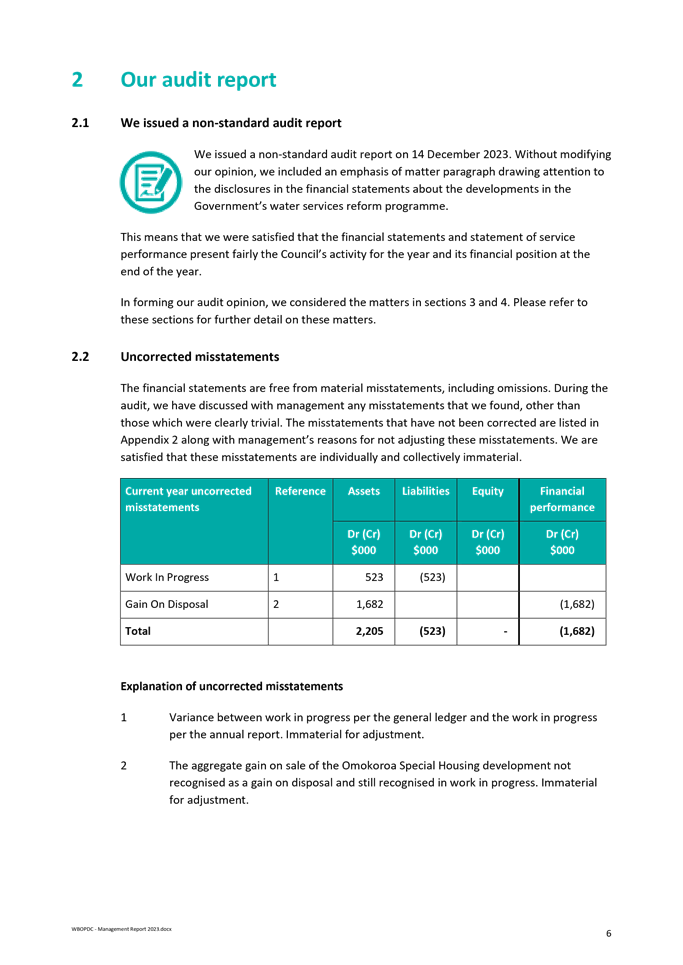
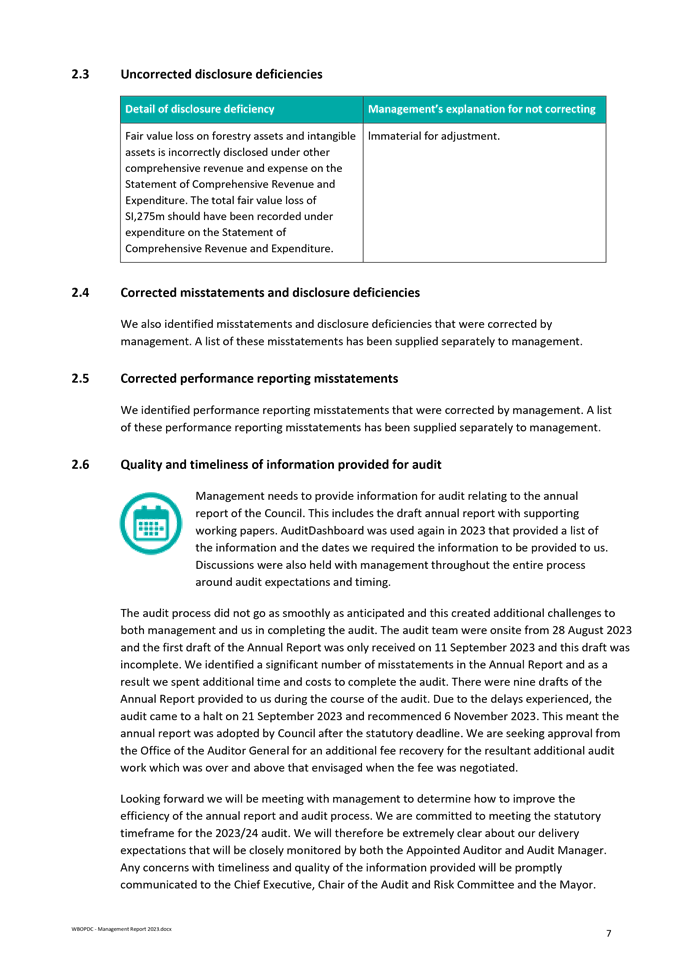
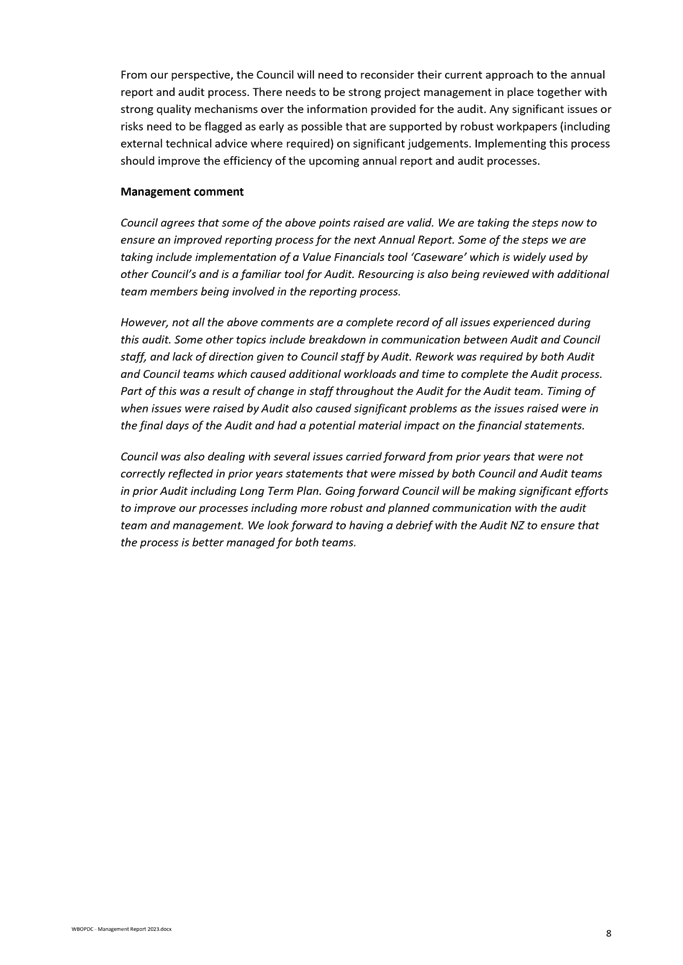
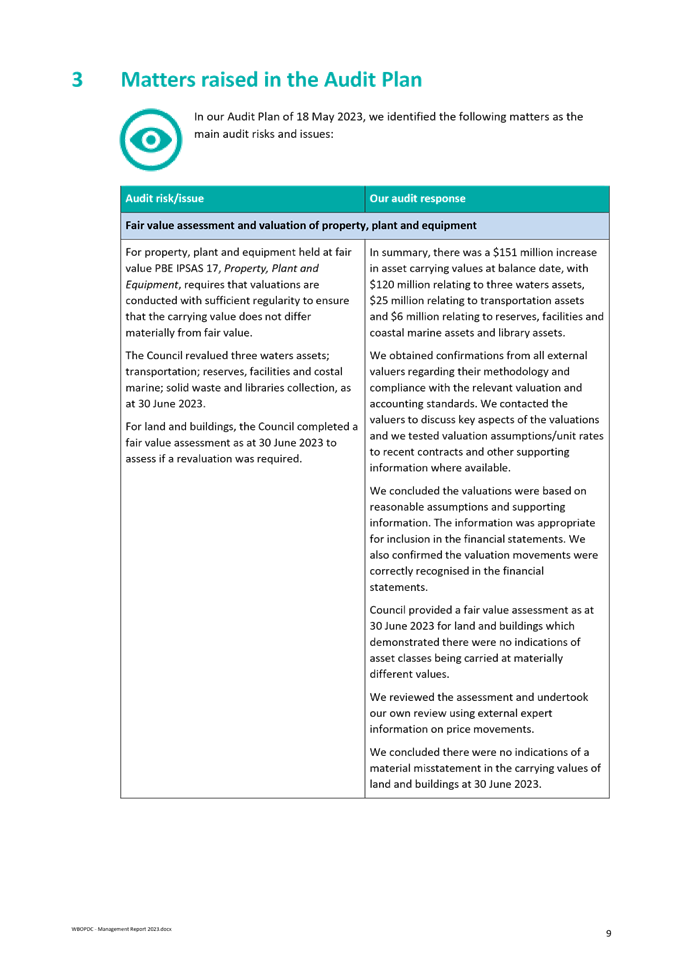
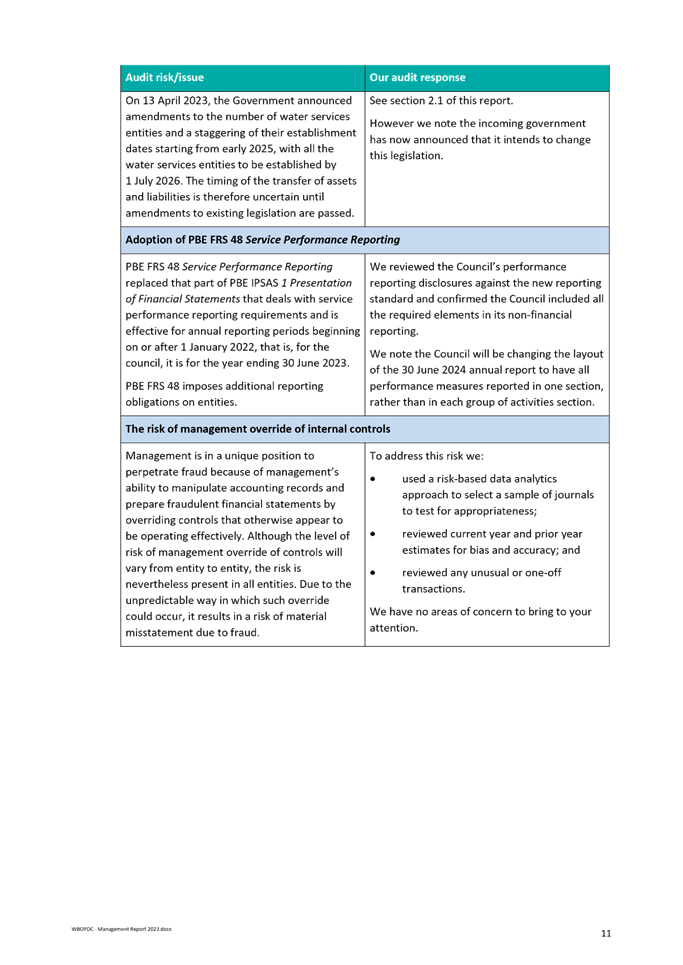
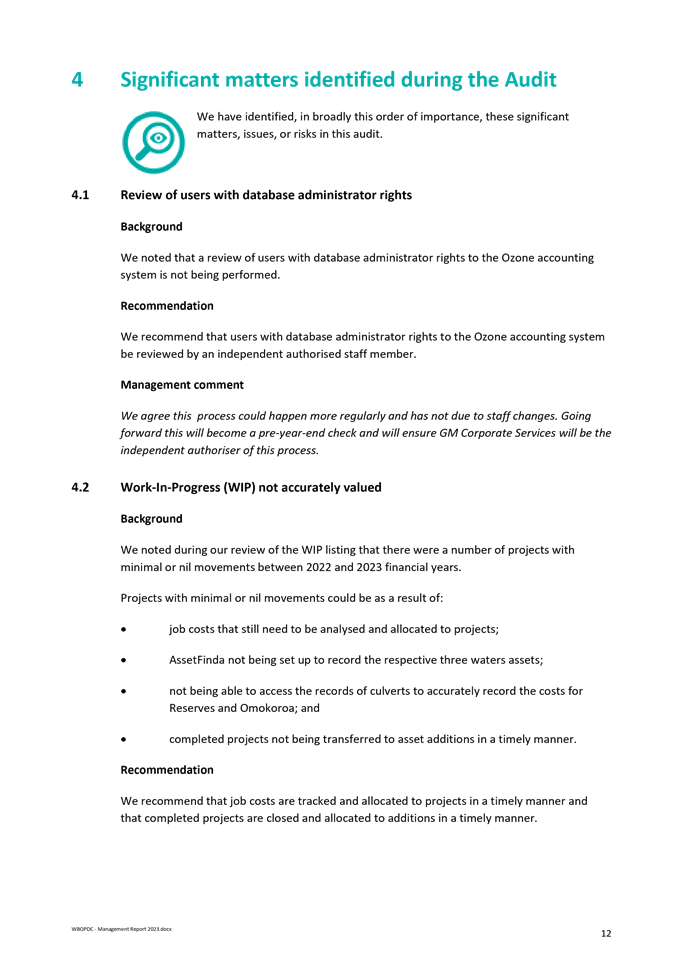
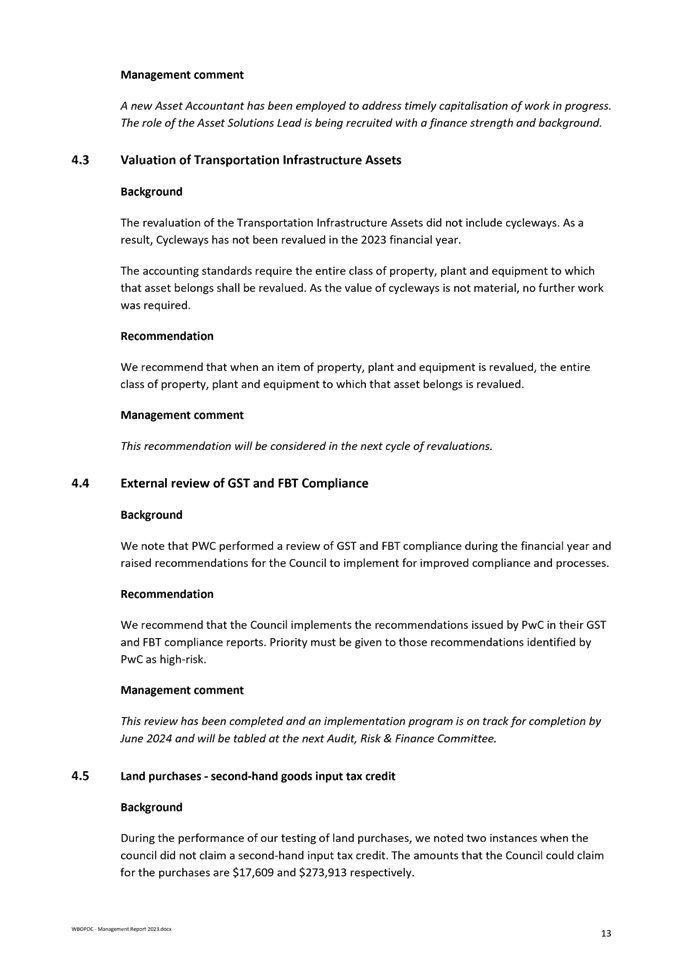
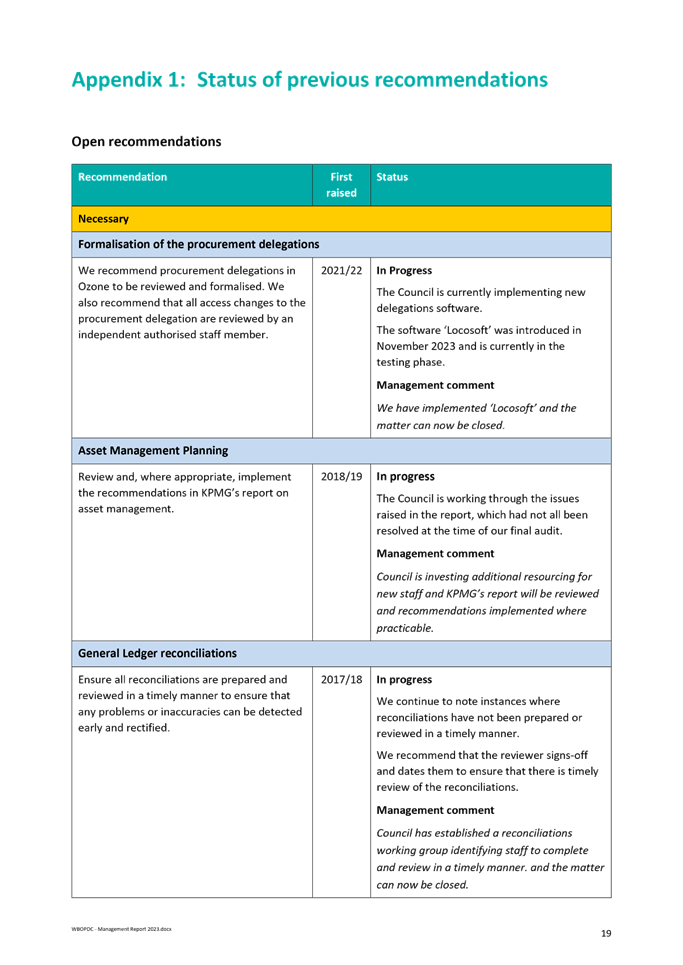
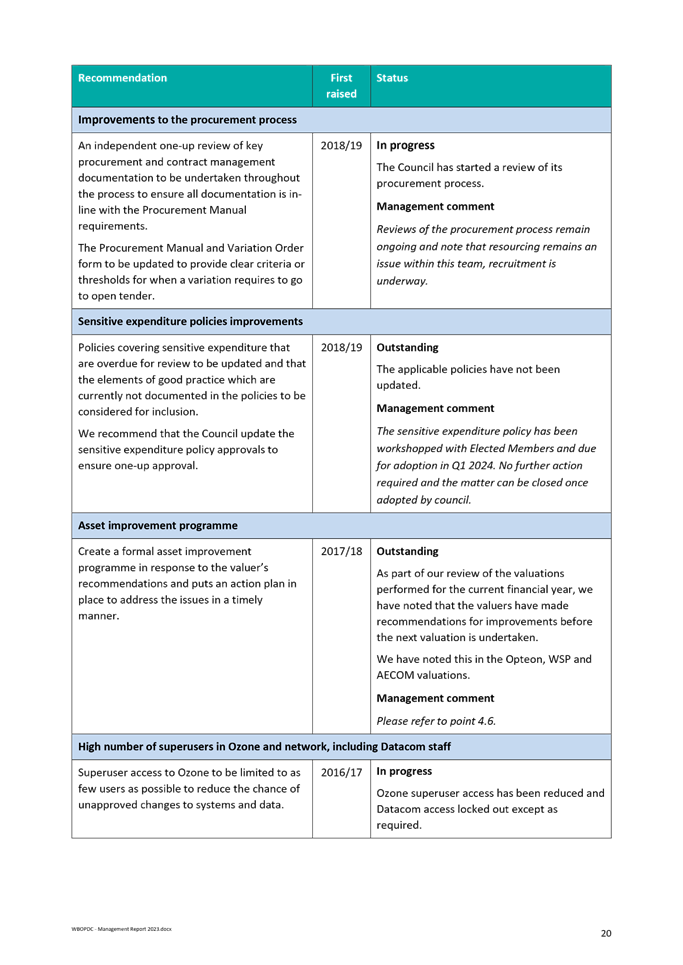
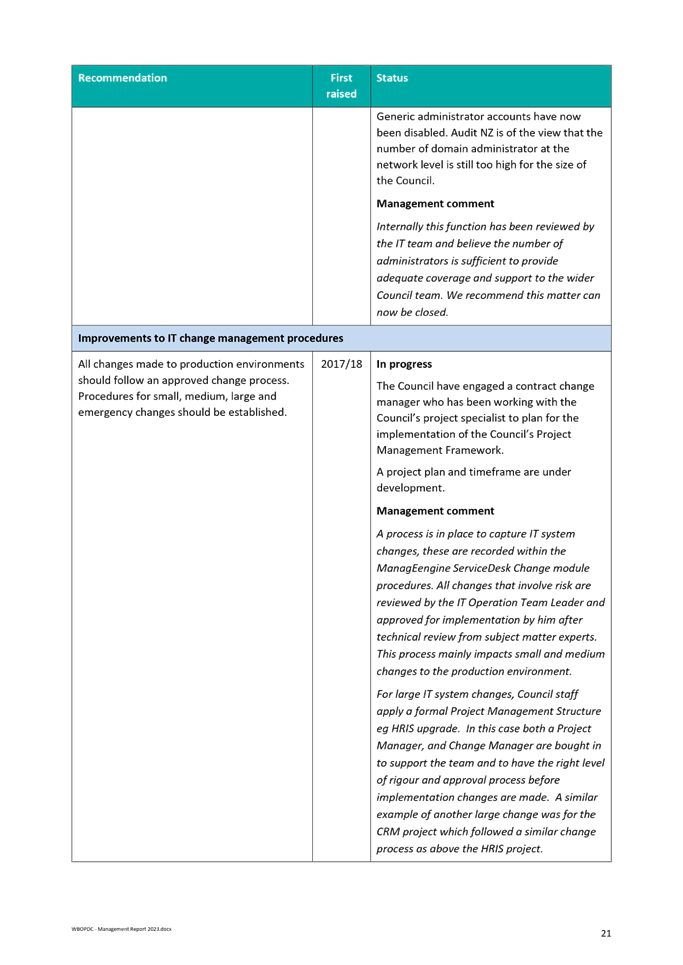
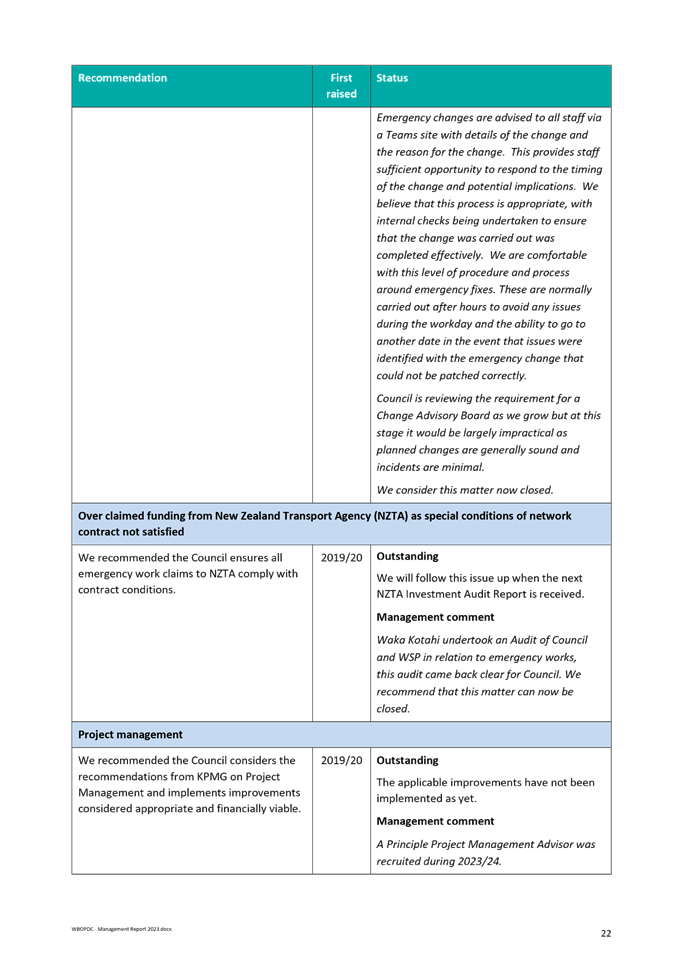
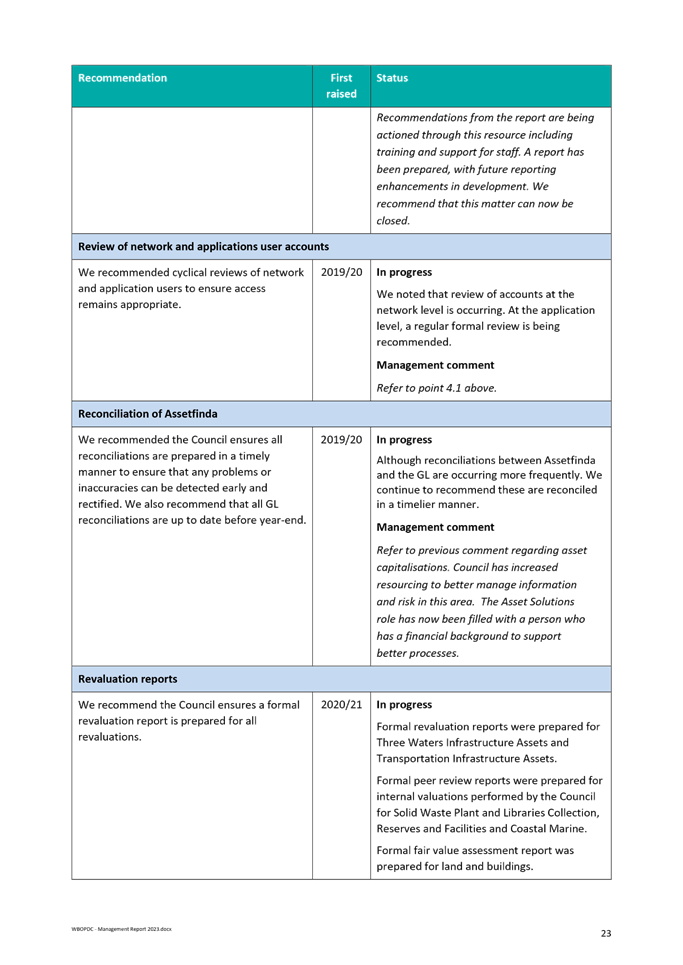
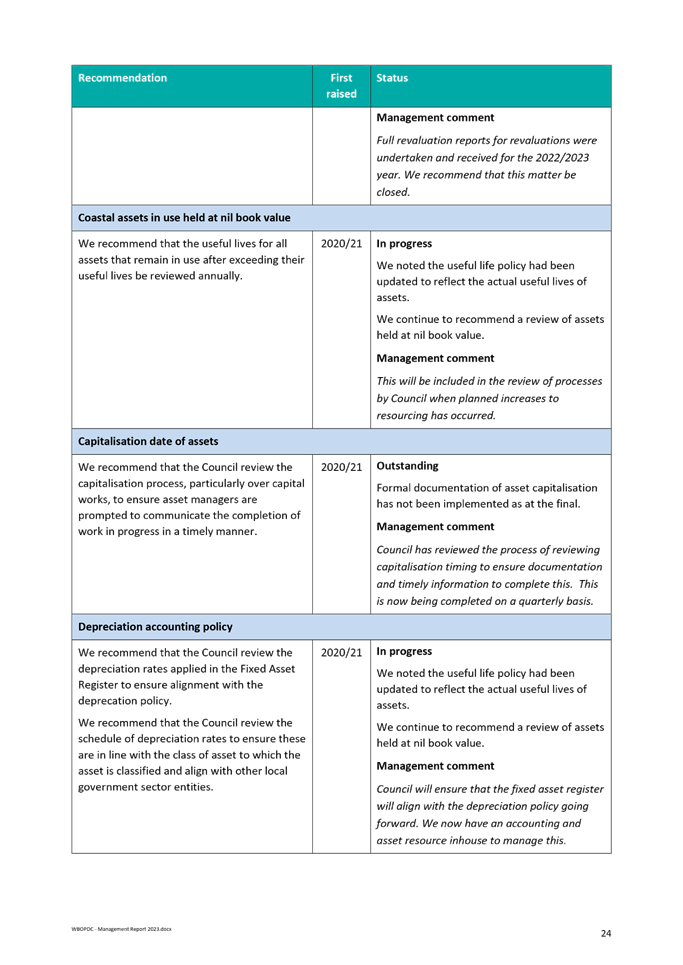
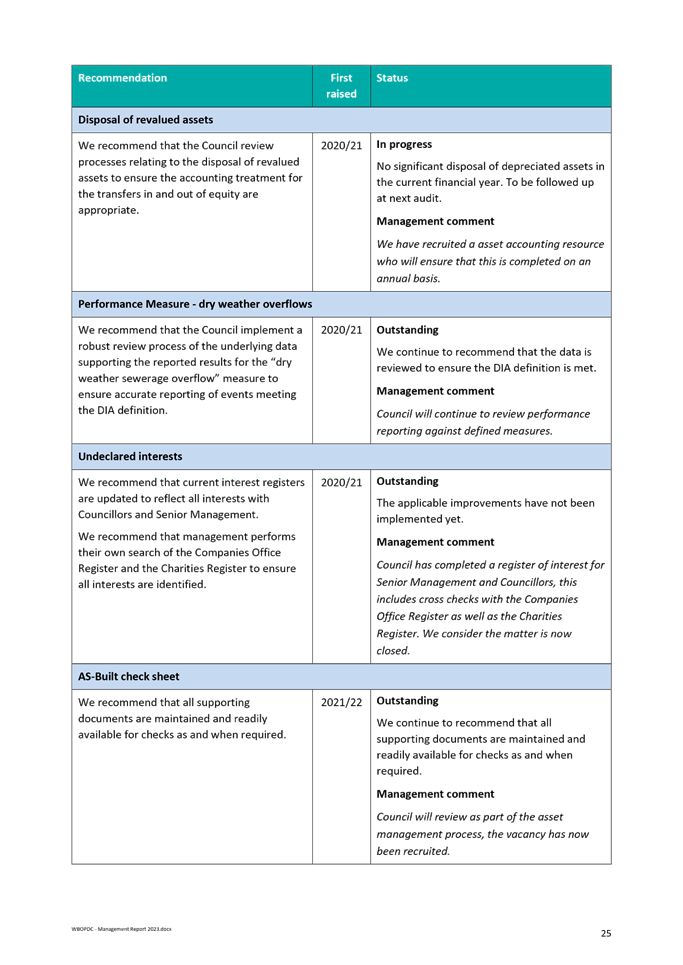
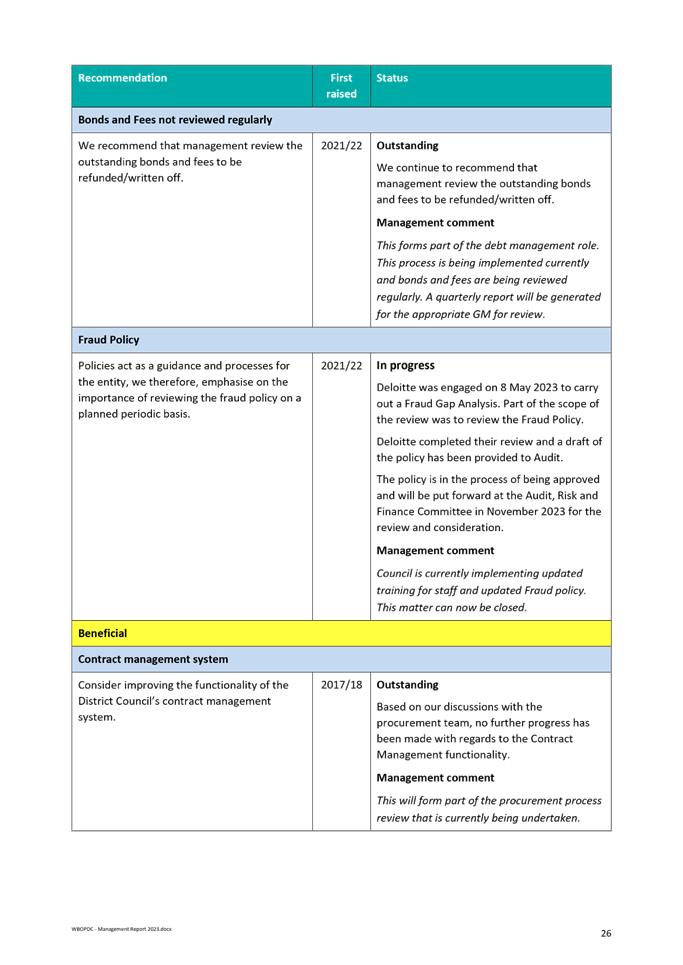
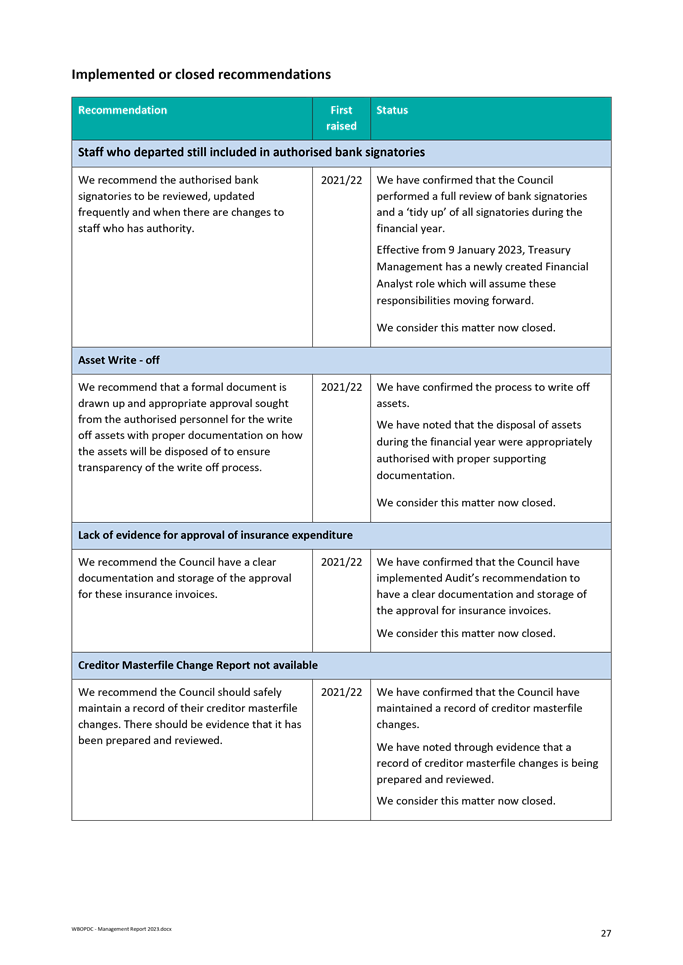
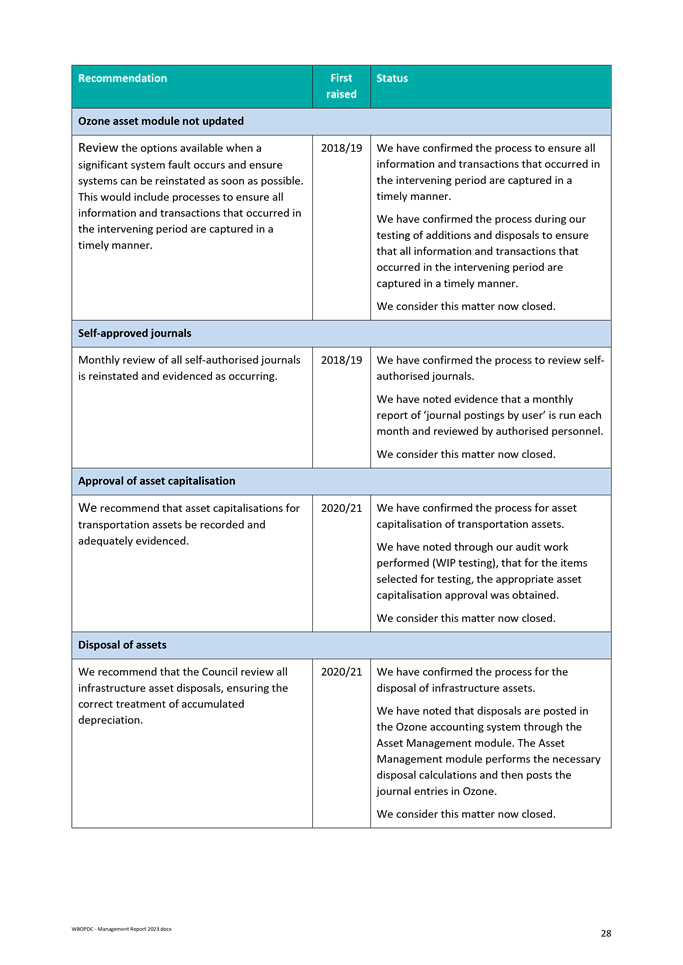
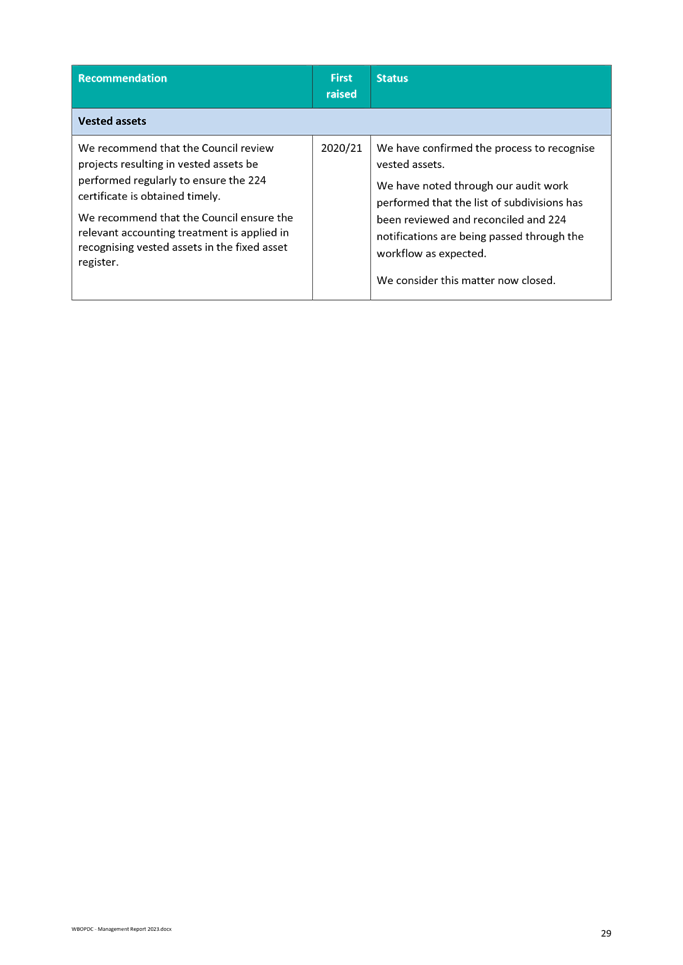
2. The final audit Management Report (the report) was issued on 19 January 2024 and has been reviewed by the Management Team. Management comments have been provided setting out proposed actions and areas for improvement in response to audit findings provided in the report.
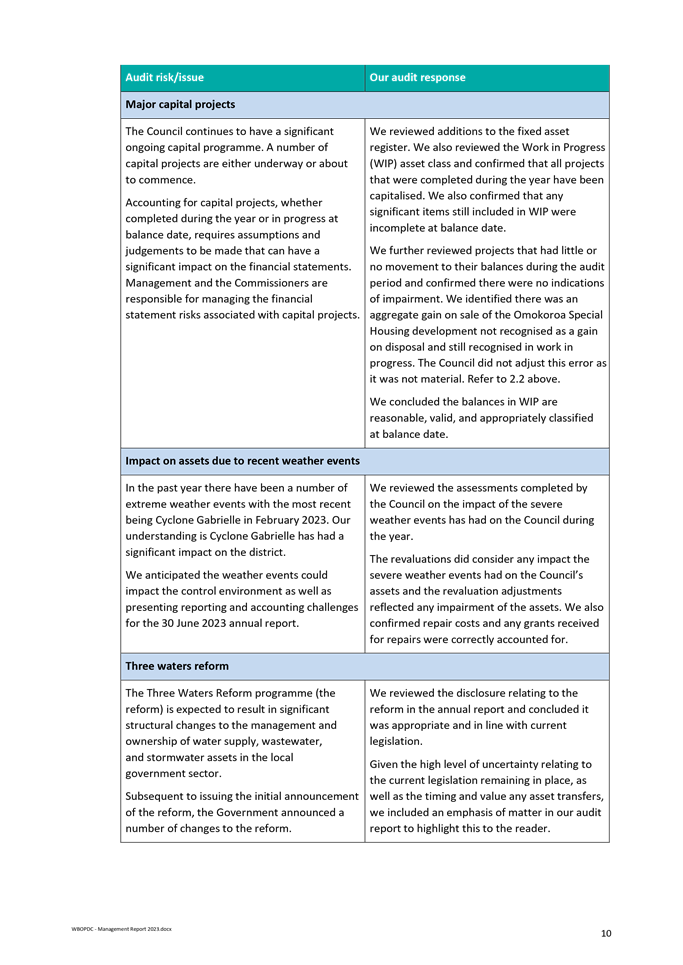
3. Audit New Zealand issued a non-standard audit report on 14 December 2023. Without modifying their opinion, they included an emphasis of matter paragraph drawing attention to the disclosures in the financial statements about the possible impact of the Government’s three waters reform on the District Council.
This means that Audit New Zealand was satisfied with the financial statements and statement of service performance fairly reflected Council’s activity for the year and financial position at the end of the year.
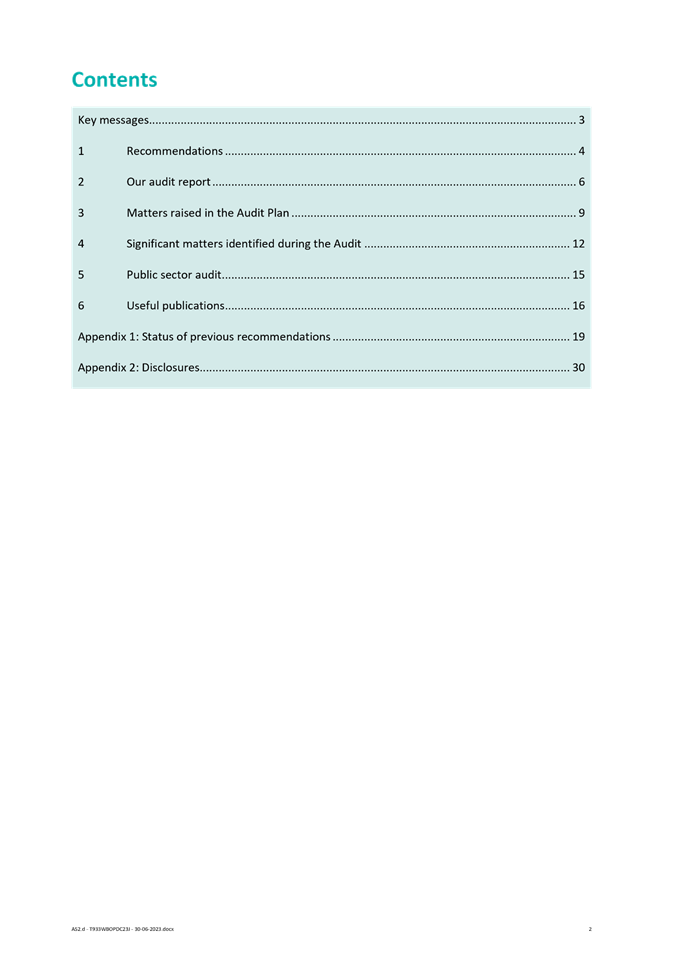
4. Matters raised in Audit New Zealand’s audit plan, together with other findings and areas of focus, are noted in sections 3 (page 9) and section 4 (page 12) of the report.
1. Final
Audit Management Report 2023 ⇩
|
27 February 2024 |
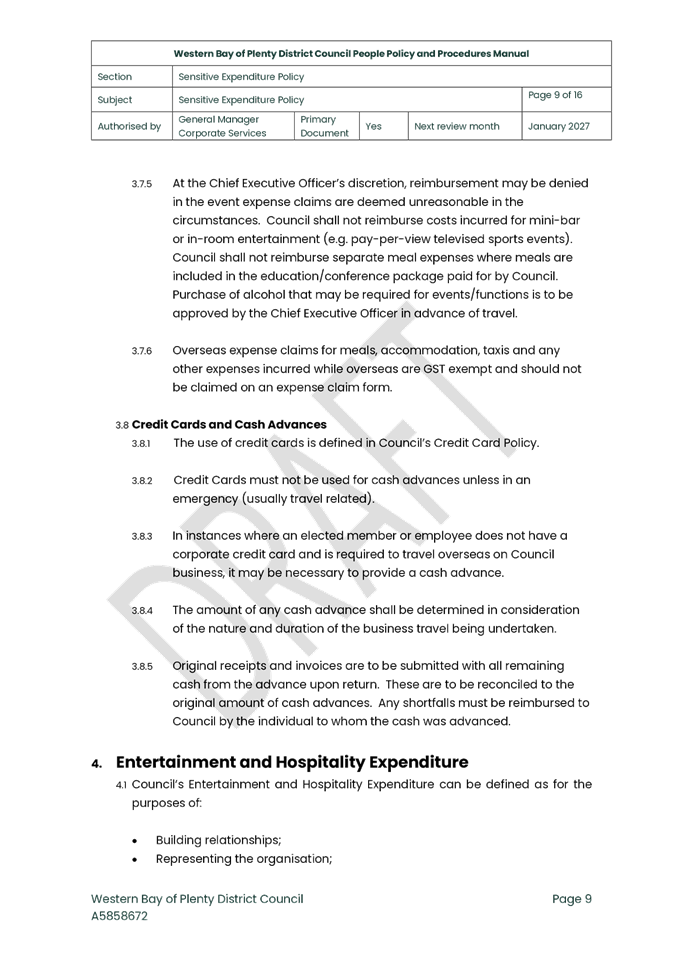
10.5 Sensitive Expenditure Policy
File Number: A5278944
Author: Azoora Ali, Chief Financial Officer
Authoriser: Adele Henderson, General Manager Corporate Services
Executive Summary
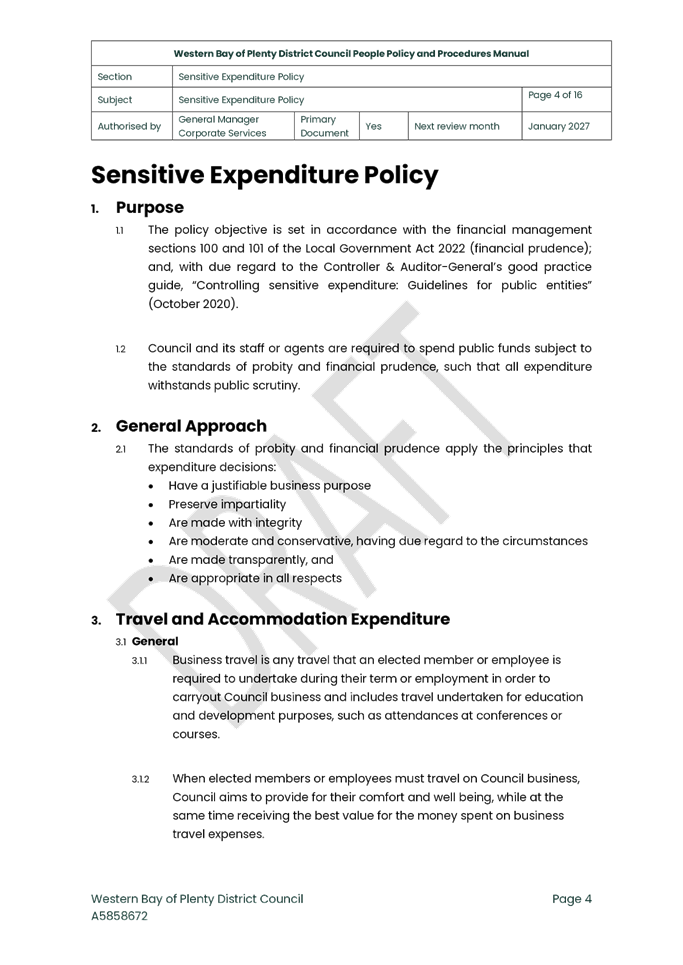
The purpose of this report is to request that the Elected Members review Council’s Sensitive Expenditure Policy and approve any amendments accordingly.
|
1. That the Chief Financial Officer’s report dated 27 February 2024 titled ‘Sensitive Expenditure Policy” be received. 2. That the report relates to an issue that is considered to be of low significance in terms of Council’s Significance and Engagement Policy. 3. That the Audit, Risk & Finance Committee approve the updated Sensitive Expenditure Policy. Or 4. That the Audit, Risk & Finance Committee do not approve/or recommend changes to the updated Sensitive Expenditure Policy. |
Background
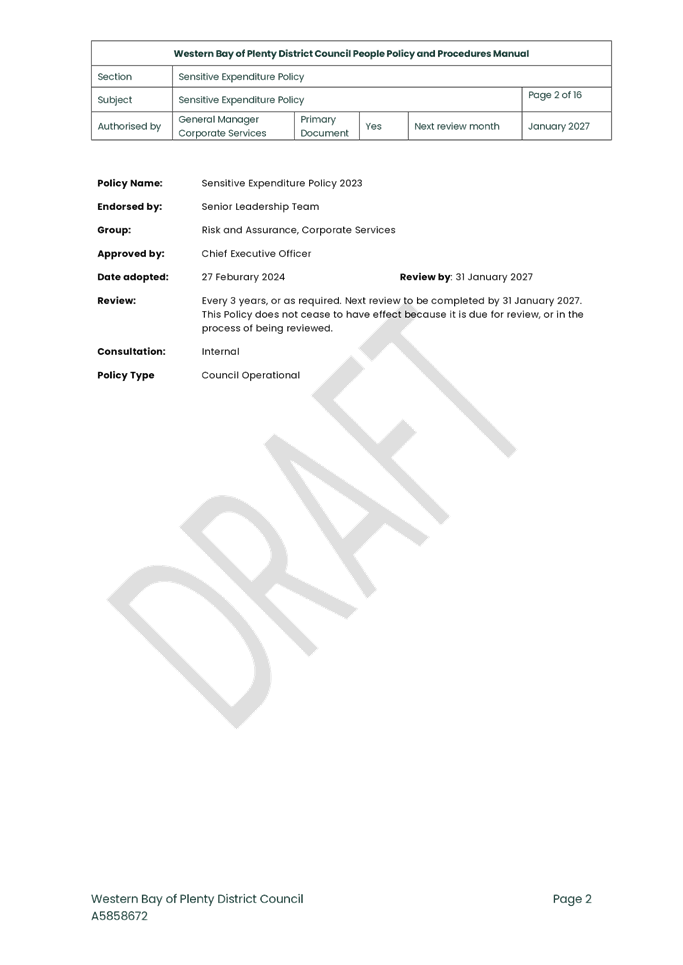
1. The current policy was approved by the Policy Committee 6 August 2018 and is now due for review. Audit New Zealand’s interim audit of the Annual Report recommended the policy be reviewed. Therefore, the Audit, Risk & Finance Committee are requested to review the updated policy.
2. The policy was reviewed by the Senior Leadership Team 27 March 2023, 1 May 2023 and 27 November 2023.
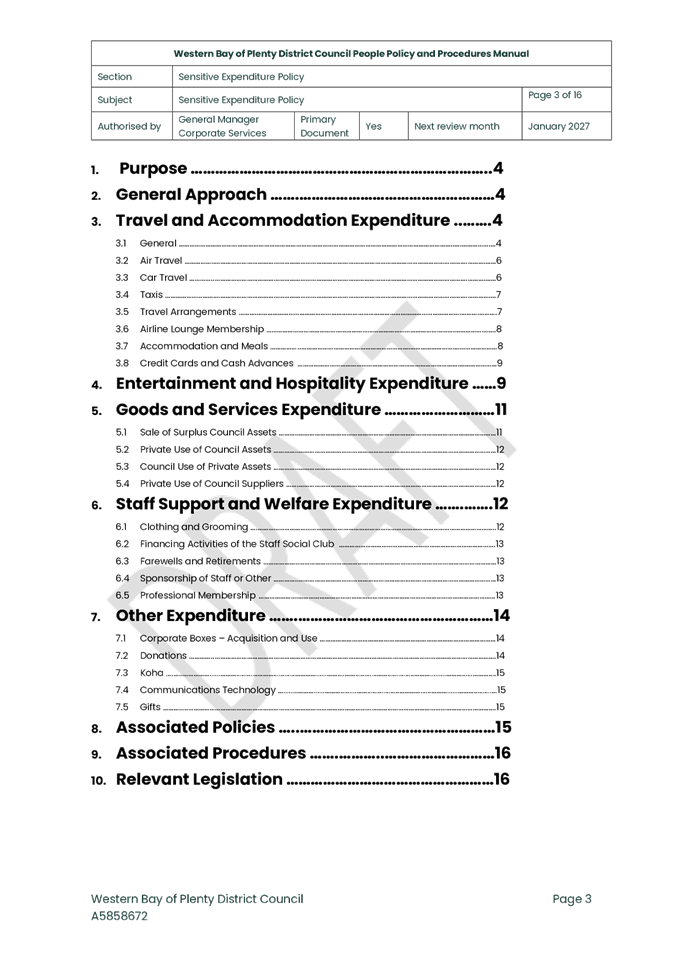
3. Amendments between the previous and the proposed policies are as follows:
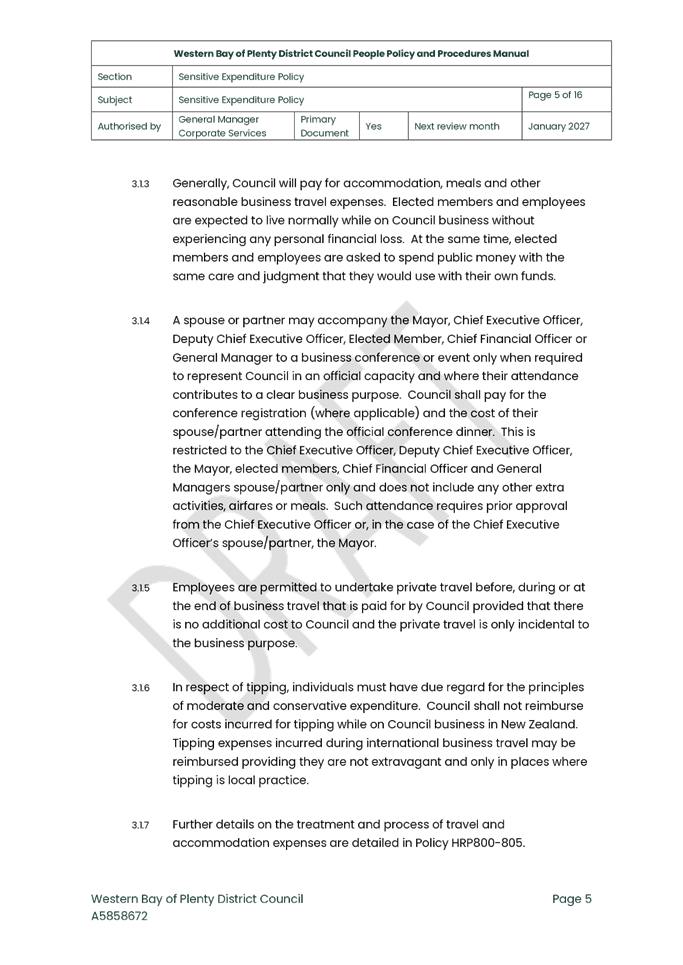
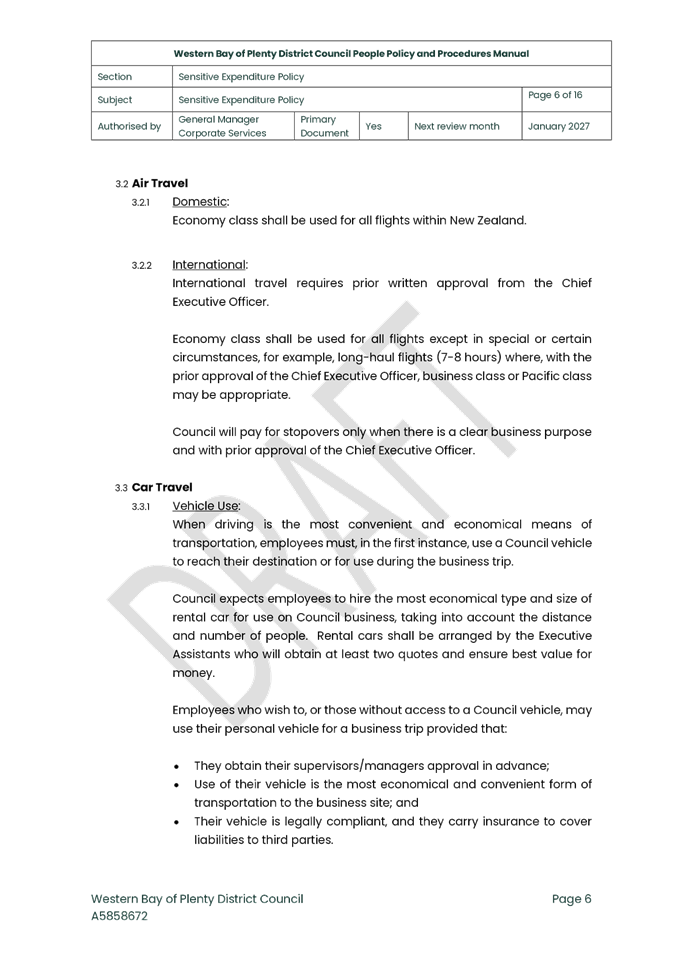
(a) Under car travel, the following bullet point has been added “Their vehicle is legally compliant and they carry insurance to cover liabilities to third parties.”
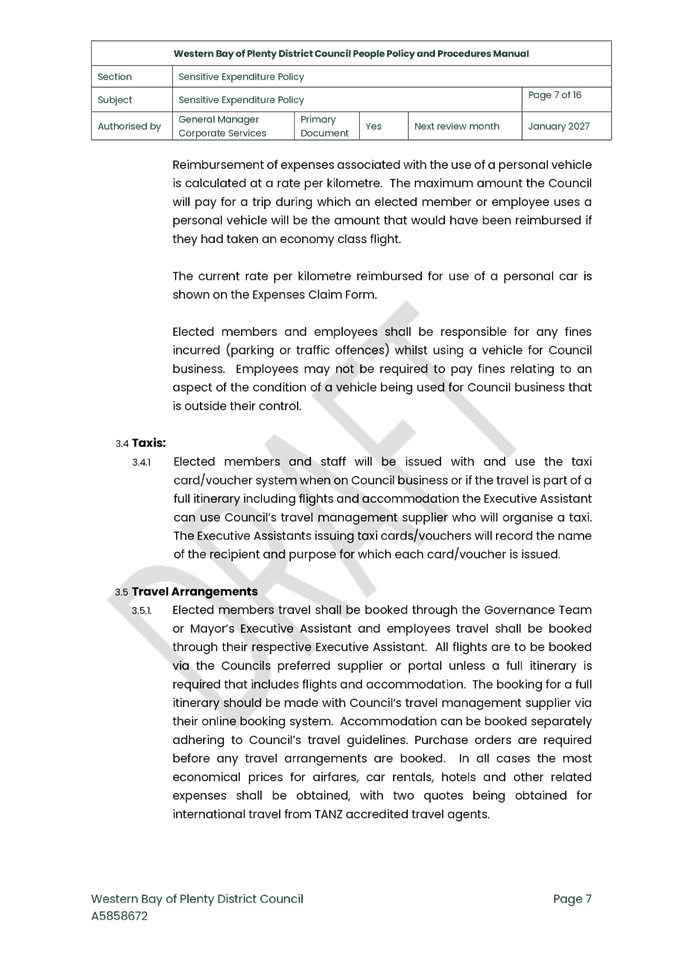
(b) Under Travel Arrangements the supplier noted is altered from AOG Air New Zealand to “Council’s preferred supplier”.
(c) Under Accommodation and Meals the following amendments have been made:
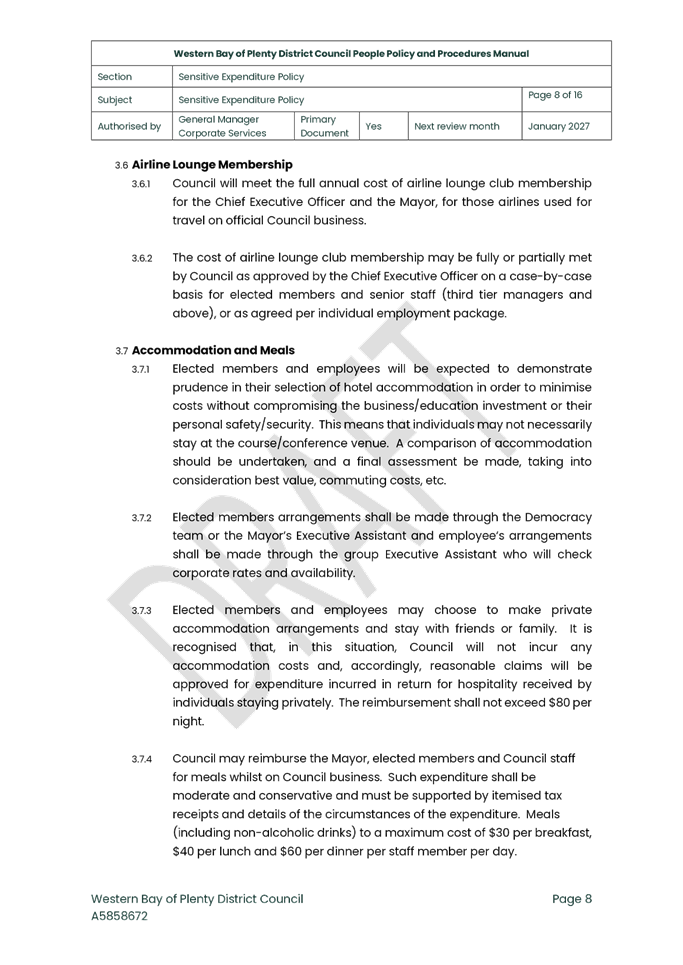
(i) The amendment to the private overnight accommodation reimbursement (maximum) has been raised from $65.00 per night to $80.00 per night.
(ii) It has been added that Council staff will be reimbursed for meals (including non-alcoholic drinks) to a maximum cost of $30 per breakfast, $40 per lunch and $60 per dinner per staff member per day (previously stated specific roles only).
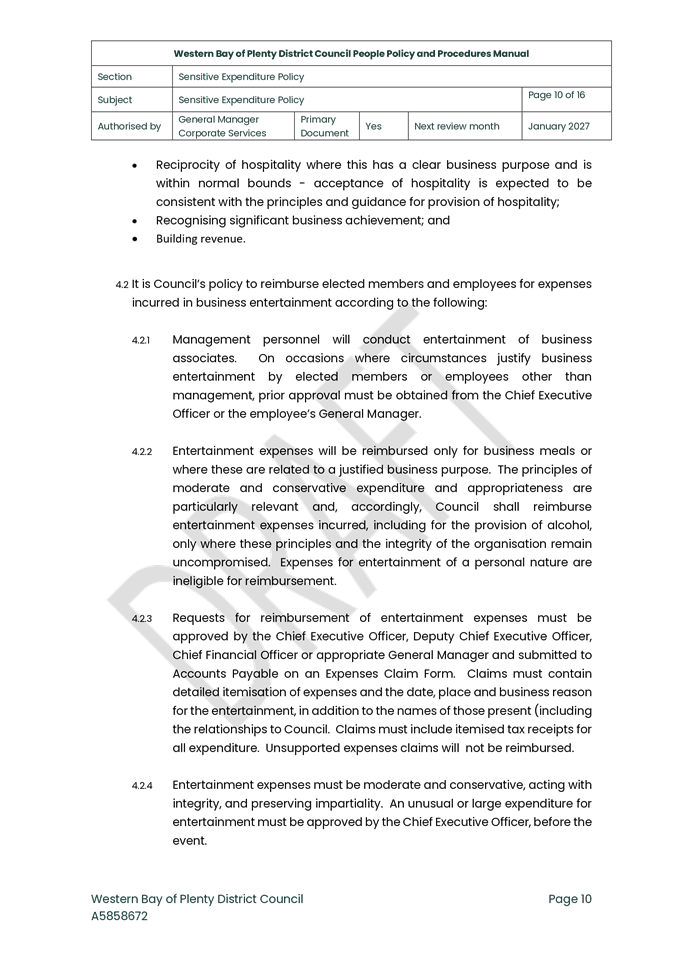
(iii) It has been added that “Purchase of alcohol that may be required for events/functions is to be approved by the Chief Executive Officer in advance of travel”.
(d) Clauses 4.4, 4.5 and 4.6 have moved to this section from the Policy Procedures section (deleted).
(e) A Professional Membership section has been added.
(f) Under Entertainment and Hospitality Expenditure the following amendments have been made:
(i) 4.1 Definition points have been altered to read:
(1) Third bullet - Reciprocity of hospitality where this has a clear business purpose and is within normal bounds – acceptance of hospitality is expected to be consistent with the principles and guidance for provision of hospitality.
(2) Fifth bullet added – Building revenue.
(ii) 4.2.4 wording changed to “Entertainment expenses must be moderate and conservative, acting with integrity, and preserving impartiality. An unusual or large…..”
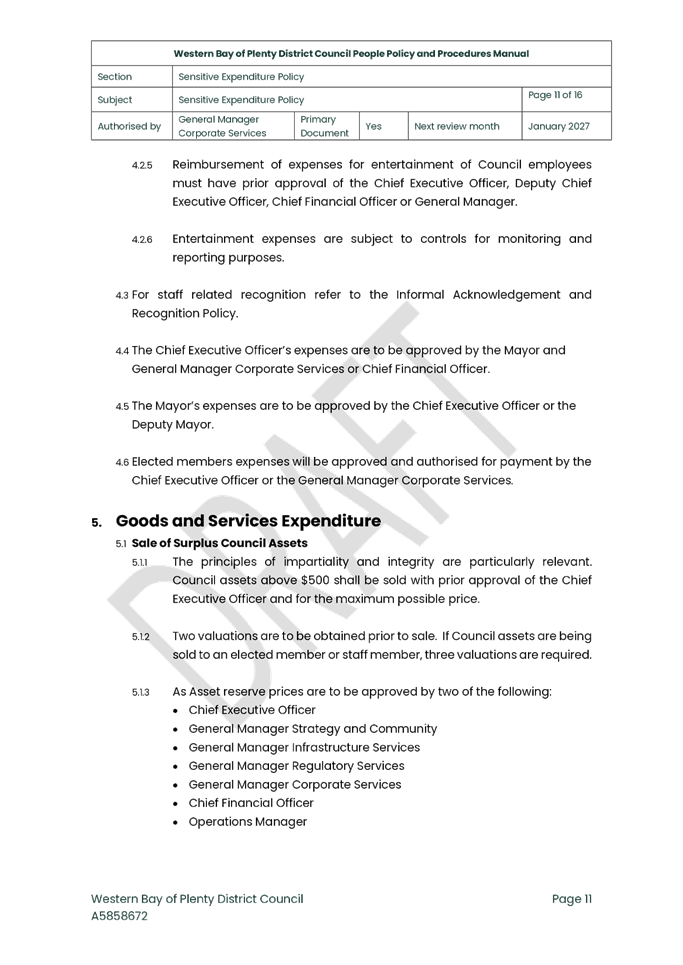
(iii) A new paragraph has been added to refer the reader to a new policy which covers staff/team related recognition, the “Informal Acknowledgement and Recognition Policy”.
(iv) Replaced approval of Chief Executive Officer’s expenses to the General Manager Corporate Services or the Chief Financial Officer rather than the Deputy Mayor.
(v) Replaced approval of Elected Members expenses to the Chief Executive Officer or the General Manager Corporate Services rather than the Group Manager Technology, Customer and Community Services.
(g) Under Sale of Surplus Council Assets the following staff changes have been made:
(i) Deputy CEO/Group Manager Infrastructure updated to General Manager Infrastructure Services.
(ii) Group Manager Policy, Planning & Regulatory updated to General Manager Regulatory Services.
(iii) General Manager Corporate Services added.
(iv) Strategic Property Manager updated to Operations Manager.
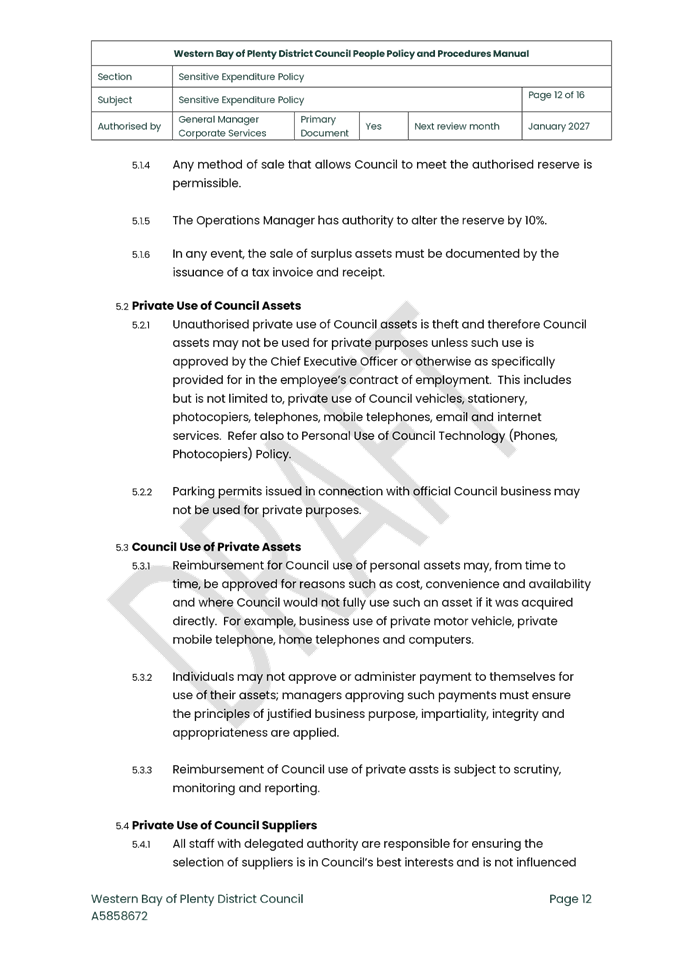
(h) Under Sale of Surplus Council Assets the following has been added “In any event, the sale of surplus assets must be documented by the issuance of a tax invoice and receipt.”
(i) Under Private Use of Council Assets the following has been removed “Route K toll cards issued in connection with official Council business may not be used for private purposes.”
(j) Under Sponsorship of Events and Teams:
(i) Removal of clause stating $600 per annum for sponsorship.
(ii) Removed “Once the annual budget has been allocated, there shall be no further sponsorship for that financial year. The Chief Executive Officer’s decisions shall be final.”
(iii) Added that the relevant group General Manager can approve applications for sponsorship within existing budgets.
(k) Added the Informal Acknowledgement and Recognition Policy to the list of Associated Policies.
(l) In Donations, added that donations may be approved by the relevant General Manager.
(m) Communications Technology clause replaced with “Refer to HR policies for information regarding reimbursement to Council for the costs of personal use of Council assets.”
Significance and Engagement
4. The Local Government Act 2002 requires a formal assessment of the significance of matters and decision in this report against Council’s Significance and Engagement Policy. In making this formal assessment there is no intention to assess the importance of this item to individuals, groups, or agencies within the community and it is acknowledged that all reports have a high degree of importance to those affected by Council decisions.
5. The Policy requires Council and its communities to identify the degree of significance attached to particular issues, proposals, assets, decisions, and activities.
6. In terms of the Significance and Engagement Policy this decision is considered to be of low significance because
(a) It is a legislative requirement for councils to hold/adhere to a Sensitive Expenditure Policy.
(b) All ratepayers and residents are affected as it is in the interest of the community that Council staff and Elected Members follow Council’s Sensitive Expenditure Policy and remain transparent in all transactions.
(c) Council and its staff or agents are required to spend public funds subject to the standards of probity and financial prudence, such that all expenditure withstands public scrutiny.
Engagement, Consultation and Communication
7. If there is no requirement for an engagement plan, please fill in the following table with other communication which may have taken place or be required to keep our communities fully informed.
|
Interested/Affected Parties |
Completed/Planned Or Insert/refer to/attach to report Engagement Plan |
||
|
Name of interested parties/groups |
Staff Elected Members |
Planned |
Completed |
|
All Staff |
All staff to be notified accordingly and the updated policy to be uploaded to the policy library on the intranet. |
||
Issues and Options Assessment
|
That the Audit, Risk & Finance committee approve the updated Sensitive Expenditure Policy. |
|
|
Reasons why no options are available Section 79 (2) (c) and (3) Local Government Act 2002 |
Legislative or other reference |
|
It is a legislative requirement for councils to hold/adhere to a Sensitive Expenditure Policy. The Policy is due for review.
Council can adopt the revised policy as recommended, or provide officers with any proposed changes to be included in a final document. |
Local Government Act 2002 NZ International Financial Reporting Standards Goods & Services Tax Fringe Benefits tax Income Tax Act |
Statutory Compliance
8. The above recommendations are compliant with the Local Government Act 2002 and the review of the Sensitive Expenditure Policy.
Funding/Budget Implications
|
Budget Funding Information |
Relevant Detail |
|
N/A |
All funding and budgets will be managed through existing budgets. |
1. Sensitive
Expenditure Policy ⇩ 
|
27 February 2024 |
10.6 Fraud and Corruption Policy
File Number: A5731773
Author: Azoora Ali, Chief Financial Officer
Authoriser: Adele Henderson, General Manager Corporate Services
Executive Summary
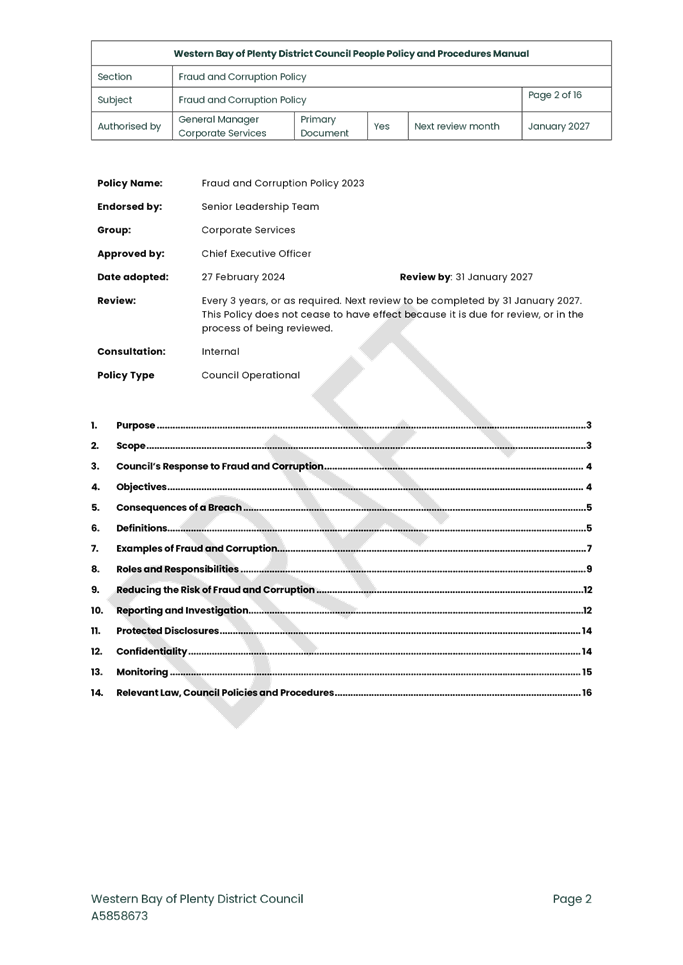
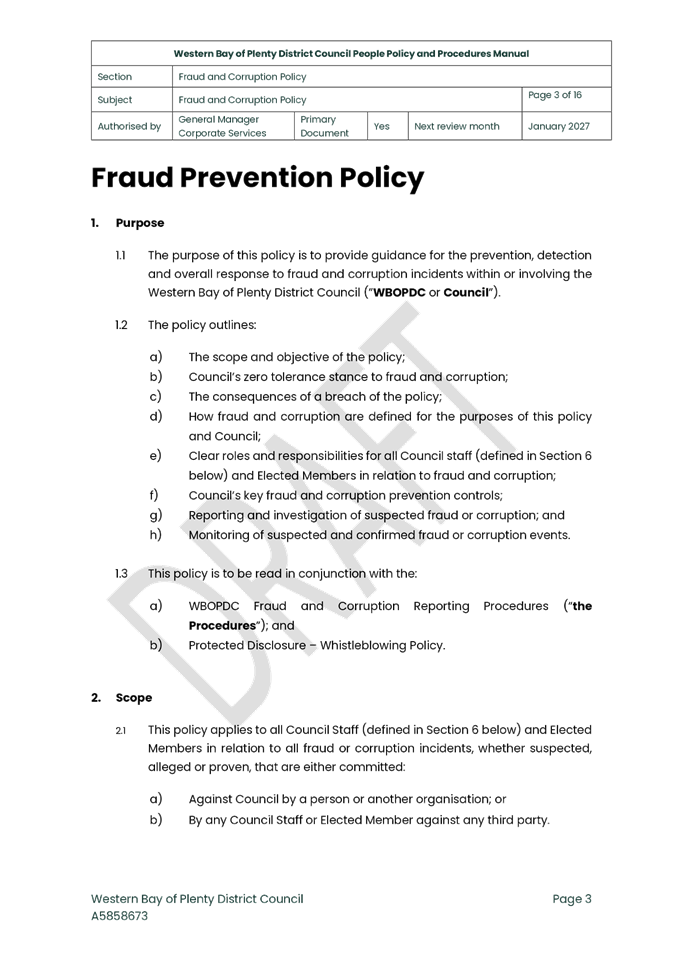
1. The purpose of this policy is to provide guidance for the prevention, detection and overall response to fraud and corruption incidents within or involving the Western Bay of Plenty District Council (”WBOPDC or Council”).
|
1. That the Chief Financial Officer’s report dated 27 February 2024 titled ‘Fraud and Corruption Policy’ be received. 2. That the report relates to an issue that is considered to be of low significance in terms of Council’s Significance and Engagement Policy. 3. That the Audit, Risk & Finance Committee adopt the Fraud and Corruption Policy (Attachment 1 of this report) OR: 4. That the Audit, Risk & Finance Committee do not adopt/or recommend changes to the Fraud and Corruption Policy (Attachment 1 of this report). |
Background
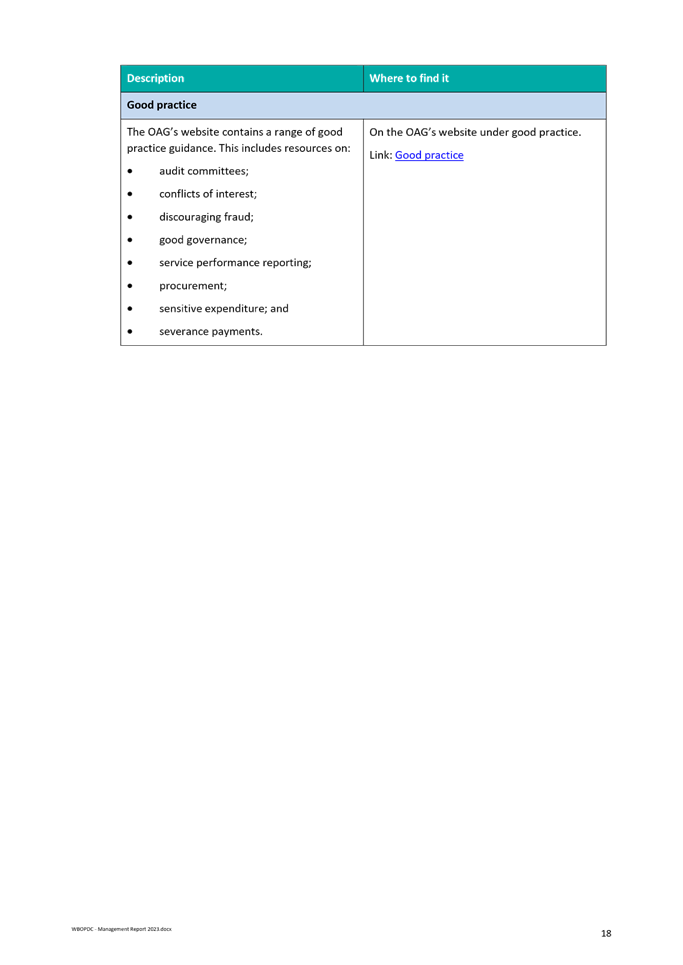
2. The policy and procedures were due to be reviewed in April 2022 and it was recommended by Audit NZ to carry out a full review on the policy.
3. Council engaged Deloitte to review and refresh the Policy to align with best practice (specifically in relation to AS: 8001:2021 Fraud and corruption control standards, MOJ/OAG guidance) and the needs of Council.
Gap Analysis
4. In order to ensure that our overall risks are strengthened, Council undertook a gap analysis. The purpose of the gap analysis was to identify key risks and provide recommendations for Council to consider in its effort to strengthen its fraud and corruption framework to align with recommended practice.
5. Deloitte worked with senior Council staff and undertook a Better Practice Gap Analysis Workshop. The workshop was informed by key documents relevant to Council’s counter-fraud and corruption efforts.
6. The gap analysis measured how well Council approaches and manages its foundation, prevention, detection, and response to fraud and corruption risk. The key findings highlighted that Council’s strongest areas are prevent and respond, with key strengths being internal controls, disciplinary procedures, and investigation processes.
Fraud & Corruption Policy
7. The review resulted in multiple updates to align with current best practice. Notwithstanding updates to presentation and structure, generally key updates comprised of:
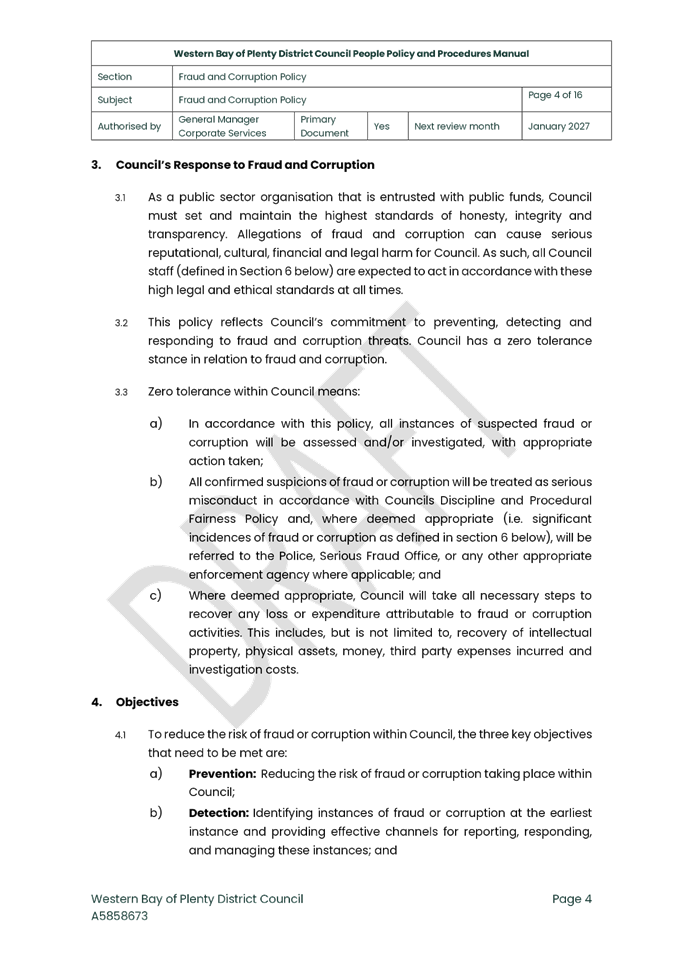
· Including and reiterating Council’s commitment to zero tolerance to fraud;
· Inclusion (update) of objectives/scope/fraud and related definitions and application of policy;
· Assignment of dedicated roles and responsibilities/accountabilities;
· Providing for an annual confirmation of compliance;
· Outline procedures the Council will follow to recover losses from fraudulent or corrupt activity;
· Highlighting how incidents of fraud and corruption will be treated under the organisation’s disciplinary process;
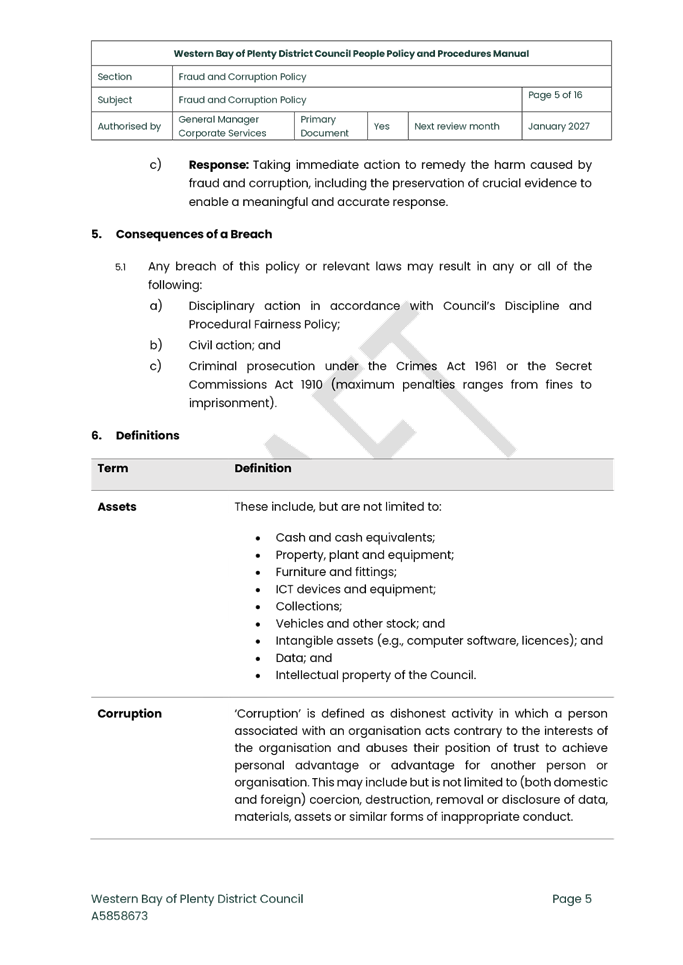
· Provide warning of the high penalties that people can face if they are convicted of fraud or corruption offences under the Crimes Act 1961 or the Secret Commissions Act 1910; and
· Inclusion of requirement for staff to undergo fraud awareness training on a regular basis to educate staff about risks specific to the Council.
· Consideration of legal action for recovery (where applicable);
· Reiterating the need for staff to report any suspicious behaviour immediately upfront in the policy;
· Minor updates resulting from the Strategy and Policy Workshop 7 December 2023.
The scope and objective of the Policy
8. The scope and objective of the policy:
· Council’s zero tolerance stance to fraud and corruption;
· The consequences of a breach of the Policy;
· How fraud and corruption are defined for the purposes of this policy and the Council;
· Clear roles and responsibilities for all Council personnel (defined in Section 6 below) and Elected Members in relation to fraud and corruption;
· Council’s key fraud and corruption prevention controls;
· Reporting and investigation of suspected fraud or corruption; and
· Monitoring of suspected and confirmed fraud or corruption events.
9. Where the allegation of fraud or corruption is considered significant, the Risk and Assurance Manager will notify the Chief Executive Officer and Chairperson of the Audit, Risk and Finance Committee as soon as practicable.
10. The Risk and Assurance Manager will monitor and review the Council’s Policy and recommend updates as required. In collaboration with the Chief Executive Officer, these recommendations will be considered on a periodic basis.
Significance and Engagement
11. The Local Government Act 2002 requires a formal assessment of the significance of matters and decision in this report against Council’s Significance and Engagement Policy in order to guide decisions on approaches of engagement and degree of options analysis. In making this formal assessment it is acknowledged that all reports have a high degree of importance to those affected by Council decisions.
12. The Policy requires Council and its communities to identify the degree of significance attached to particular issues, proposals, assets, decisions, and activities.
13. In terms of the Significance and Engagement Policy this decision is considered to be of low significance because it is predominately an internal policy
Engagement, Consultation and Communication
|
Interested/Affected Parties |
Communication
|
||
|
Name of interested parties/groups |
Staff will be provided training on the Policy and its requirements. Regular follow ups will be undertaken to maintain a high awareness. |
Planned |
Completed |
|
Tangata Whenua |
Not required |
||
|
General Public |
Not required |
||
Issues and Options Assessment
14. Option A – Adopt policy with no further changes OR;
15. Option B – Adopt policy with recommended changes from the Audit, Risk & Finance Committee.
Statutory Compliance
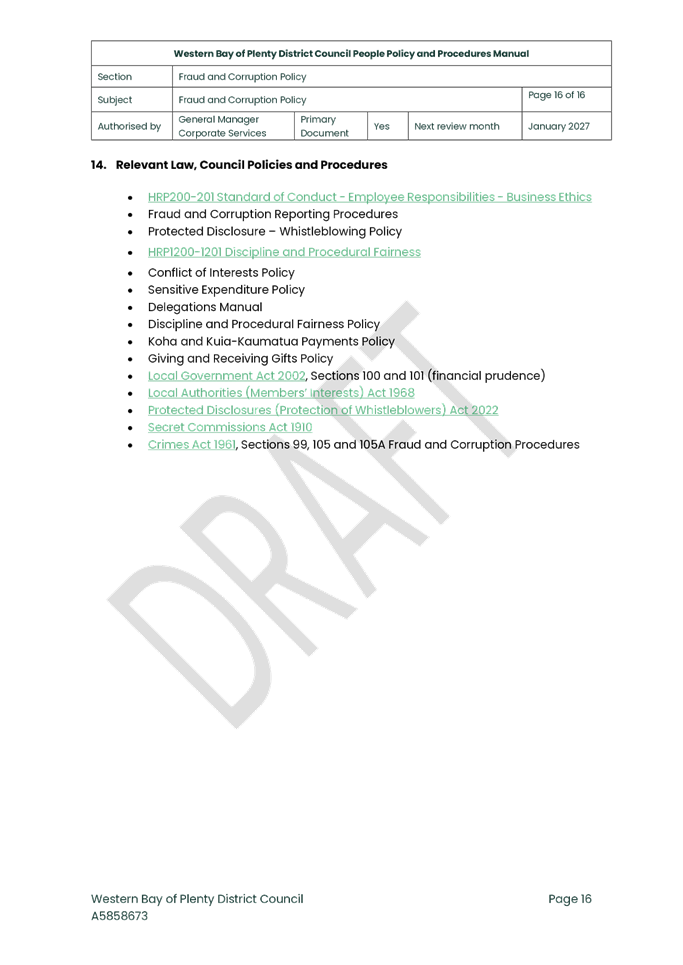
16. Council Personnel and Elected Members can make a protected disclosure for instances of suspected Serious Wrongdoing under the Protected Disclosures (Protection of Whistleblowers) Act 2022. Please refer to the Council's Protected Disclosure – Whistleblowing Policy on how to report.
17. Other policies and relevant Acts to the Fraud and Corruption policy are noted below
· Standard of Conduct - Employee Responsibilities - Business Ethics
· Fraud and Corruption Reporting Procedures
· Protected Disclosure (Whistleblowing) Policy
· Discipline and Procedural Fairness
· Conflict of Interests Policy
· Sensitive Expenditure Policy
· Delegations Manual
· Discipline and Procedural Fairness Policy
· Koha and Kuia-Kaumatua Payments Policy
· Giving and Receiving Gifts Policy
· Local Government Act 2002, Sections 100 and 101 (financial prudence)
· Local Authorities (Members’ Interests) Act 1968
· Protected Disclosures (Protection of Whistleblowers) Act 2022
· Secret Commissions Act 1910
· Crimes Act 1961, Sections 99, 105 and 105A Fraud and Corruption Procedures
Funding/Budget Implications
18. All funding and budgets will be managed through existing budgets.
1. Fraud
& Corruption Policy ⇩ 
|
27 February 2024 |
11.1 Audit, Risk and Finance Committee Work Programme
File Number: A5929940
Author: Azoora Ali, Chief Financial Officer
Authoriser: Adele Henderson, General Manager Corporate Services
Executive Summary
The Audit, Risk and Finance Committee (ARFC) work programme for February – December 2024 is to assist the Committee with items that are set out in their Terms of Reference. The purpose of the work programme is to provide Elected Members with oversight of the planned and upcoming activities/schedule of work for 2024 for Council and all its committees.
ARFC can add into the work programme any matters or areas that the Committee wish to review.
|
That the Chief Financial Officer’s report dated 27 February 2024 titled ‘Audit, Risk and Finance Committee Work Programme’ be received. |
Background
The Audit, Risk and Finance Committee (ARFC) work programme for 2024 are in line with terms of reference for this Audit Risk and Finance Committee. The work programme sets out the reports for 2024 year.
|
Work Programme 2024 |
||||
|
February |
May |
August |
November |
|
|
Public items |
||||
|
Risk and Assurance Report (quarterly) |
ü |
ü |
ü |
ü |
|
Health and safety update (quarterly) |
ü |
ü |
ü |
ü |
|
Probity update (Report will be provided only if probity matters arise) |
ü |
ü |
ü |
ü |
|
Financial Performance Update (quarterly) |
ü |
ü |
ü |
ü |
|
Review of Accounting Policies & Key Accounting Judgements (annually) |
|
ü |
|
|
|
Audit NZ Audit plan and engagement letters (annually) |
|
ü (LTP 3 yearly) |
|
|
|
Annual Report - Management Report from Audit NZ |
ü |
|
|
|
|
Debenture Trust Deed Audit Report |
ü |
|
|
|
|
Key Accounting Judgement (annually) |
|
ü |
|
|
|
Tax Risk Management Framework (next report 2025) |
|
ü |
|
|
|
Tax Risk Management Framework – yearly update |
|
|
ü |
|
|
Insurance renewal - Aon (annually) |
|
ü (strategy) |
|
ü (endorse) |
|
Insurance – Broker Presentation (Aon) |
|
|
|
ü
|
|
Treasury Update & Presentation (Bancorp) |
|
ü |
|
|
|
Credit rating review |
|
|
|
ü |
|
Public excluded items |
||||
|
Health and safety update (quarterly) – if there are any public excluded items to be provided to the Committee |
ü |
ü |
ü |
ü |
|
Litigation Update and Issues Watch Register (quarterly) |
ü |
ü |
ü |
ü |
|
Probity update (Report will be provided only if probity matters arise) |
ü |
ü |
ü |
ü |
|
Confidential Risk and Assurance Report (as required) |
ü |
ü |
ü |
ü |
|
Cyber Security Report (as required) |
ü |
ü |
ü |
ü |
|
Outstanding items raised by audits (ORR) |
ü |
ü |
ü |
ü |
|
Draft annual report review (annually) |
|
ü |
|
|
|
Review audit representation letters (annually) |
|
ü (depending on timing – here for now) |
|
|
|
Audit NZ interim audit report |
|
ü |
|
|
|
Employee matters (as required) |
ü |
ü |
ü |
ü |
|
Auditor NZ Update |
ü |
ü |
ü |
ü |
|
27 February 2024 |
12 Resolution to Exclude the Public
RESOLUTION TO EXCLUDE THE PUBLIC